
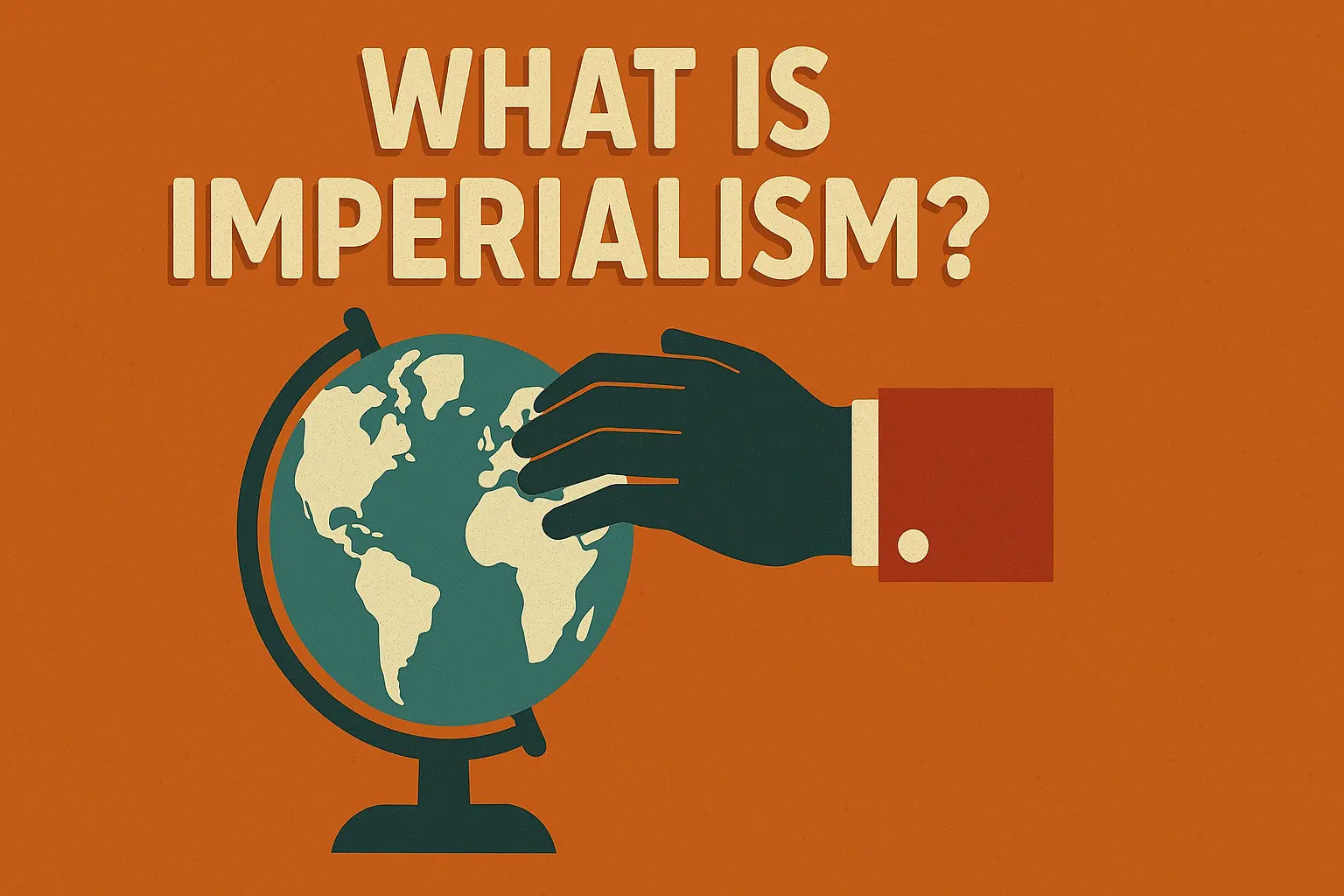
Ever stumble upon an old map—one covered in bizarrely straight lines and different colors marking vast empires—and wonder, “Who thought dividing continents like pizza slices was a good idea?” Yeah, that’s imperialism for you. But what exactly does imperialism mean, and why should you even care? Let’s dive in.
I used to think imperialism was strictly past tense—dusty old kings and queens fighting over spice islands. Then, one day, I learned something shocking. Imperialism isn’t just a chapter from your history textbook. It shapes our world today, politically, culturally, and economically.
But why does that matter? Well, understanding imperialism helps explain some of today’s complex international relationships. Like, have you ever wondered why so many countries speak English, Spanish, or French—even thousands of miles away from Europe?
Simply put, imperialism is when one powerful country expands control over other territories, often to exploit resources, labor, and strategic advantages. Think of it as a high-stakes Monopoly game. Except the board isn’t cardboard, and the consequences affect millions of lives.
Imperialism takes many forms:
Colonialism: Direct control—think Britain in India.
Economic Imperialism: Control through money—like how powerful nations today often influence smaller countries economically.
Cultural Imperialism: Dominance through culture, media, and language. Ever wonder why American TV shows are everywhere?
Imagine a time when powerful nations sought not only to expand their borders but to reshape entire continents by imposing their cultural, economic, and political systems on others. Consider that during the height of the 19th century, European powers controlled vast territories in Africa, Asia, and the Americas, fundamentally altering the lives of millions. Did you know that at its peak, the British Empire alone spanned over 13 million square miles, influencing the language, politics, and economies of nearly a quarter of the world’s population?
This striking historical fact raises the question: what is imperialism? In this article, we’ll explore imperialism from multiple angles:
By the end of this guide, you’ll have a robust understanding of imperialism, empowering you to engage in informed discussions about its role in shaping our global landscape.
At its most basic level, imperialism refers to the practice of extending a nation’s authority and influence over other territories through acquisition, colonization, or economic and political domination. This extension of power often involves not only territorial control but also the imposition of cultural, economic, and political norms upon the conquered or influenced regions.
Imperialism is a complex phenomenon that can be characterized by several key attributes:
In short, what is imperialism? It is the systematic practice of a nation extending its influence beyond its borders to dominate other regions—economically, politically, and culturally.
Understanding what is imperialism requires delving into its historical roots and observing how it has evolved over time. Imperialism is not a modern phenomenon; its origins can be traced back to ancient civilizations and have morphed significantly over the centuries.
The concept of expanding territories and exerting control over distant lands is as old as civilization itself. Ancient empires such as the Roman Empire, Persian Empire, and Macedonian Empire under Alexander the Great were early practitioners of imperialism. These empires sought not only to conquer but to integrate diverse populations under a centralized administrative and cultural framework.
The arrival of European explorers in the late 15th and early 16th centuries marked a new era in imperialism. The discovery of new lands led to unprecedented exploration, colonization, and the establishment of trade routes that connected continents.
The 19th century witnessed a dramatic resurgence of imperialist expansion, driven by the twin forces of industrialization and nationalism.
The mid-20th century brought significant changes to the imperialist landscape. The two World Wars, along with the rise of nationalist movements, led to the gradual dismantling of classical empires.
Now that we have established a historical foundation, let’s break down the multifaceted nature of imperialism and explore its key components in greater detail.
Economic imperialism refers to the control exerted by a dominant nation over the economy of a weaker region. This form of imperialism is characterized by:
Under King Leopold II, Belgium exploited the Congo Free State for its rubber and mineral wealth in the late 19th and early 20th centuries. The ruthless extraction practices led to widespread human rights abuses, decimating local populations and leaving a legacy of economic hardship that persists to this day.
Political and military imperialism involves the use of force, coercion, or diplomatic pressure to control other regions.
Throughout the 20th century, the United States intervened in several Latin American countries, often under the banner of protecting national security or promoting democracy. From the overthrow of governments to covert operations during the Cold War, these actions illustrate how military and political imperialism continue to shape global power dynamics.
Cultural imperialism is the process by which a dominant culture imposes its values, language, and traditions on another society. This form of imperialism can have profound effects on identity and social structures.
The worldwide popularity of American films, music, and fast food is often cited as evidence of cultural imperialism. Critics argue that this cultural dominance can erode local traditions and contribute to a homogenized global culture, while proponents claim that cultural exchange enriches societies and fosters mutual understanding.
Imperialism is not solely about tangible control over land and resources—it also involves shaping the mindset of both the colonizer and the colonized.
Beyond individual acts of colonization, imperialism can be understood as a system that shapes international relations, economics, and politics.
Understanding what is imperialism is not just an academic exercise; it has practical implications for various aspects of society and our daily lives.
There are several misconceptions surrounding imperialism. Here, we clarify some of the most frequent misunderstandings to help you better understand what is imperialism.
Clarification: While classical imperialism often involved territorial conquest and colonization, modern imperialism can also take the form of economic and cultural domination without direct political control. Neocolonialism, for example, refers to the ways in which former colonial powers or global economic forces continue to influence and control other nations through economic dependencies and cultural influence.
Clarification: Although the age of traditional colonial empires has largely ended, the legacies of imperialism persist in various forms today. Many of today’s global economic and political systems have roots in imperialist practices, and debates over cultural imperialism continue as global media and multinational corporations spread dominant cultural norms.
Clarification: While imperialism has undoubtedly resulted in exploitation, cultural erosion, and political oppression, it is also important to acknowledge that it has led to the exchange of ideas, technology, and cultural practices. However, the costs and benefits are often unevenly distributed, and the negative consequences for colonized peoples are significant.
Q1: What is imperialism in simple terms?
A1: Imperialism is the practice of a powerful nation extending its control over other regions, often through economic, political, or cultural domination.
Q2: How does imperialism differ from colonialism?
A2: Colonialism typically refers to the direct control and settlement of territories, while imperialism encompasses a broader range of strategies, including economic exploitation and cultural influence, which may not always involve formal colonization.
Q3: Can imperialism exist without military force?
A3: Yes. While military conquest was a key component of historical imperialism, modern forms often rely on economic influence, political pressure, and cultural hegemony rather than overt military force.
Q4: Is imperialism relevant in today’s globalized world?
A4: Absolutely. Many contemporary international relations, economic dependencies, and cultural exchanges are influenced by imperialist legacies and practices.
Q5: How can understanding imperialism help us today?
A5: Understanding imperialism provides context for global power dynamics, informs debates on international policy and trade, and encourages a more nuanced view of cultural exchange and historical accountability.
In our interconnected, digital age, the effects of imperialism are as relevant as ever. Modern debates continue to grapple with its legacy and transformation.
Learning what is imperialism and its diverse manifestations can empower individuals, communities, and policymakers in several key ways.
Throughout this in-depth exploration, we have unpacked the intricate tapestry of imperialism. From its historical roots in ancient empires to its modern manifestations in economic policies and digital culture, the question what is imperialism invites us to consider how power is exercised and how its legacies continue to shape our world.
As you reflect on this journey through the world of imperialism, consider how historical patterns continue to influence the present—and what steps can be taken to ensure a more equitable future. By questioning established power structures and seeking a deeper understanding of our shared global history, we can contribute to a world that respects cultural diversity, promotes sustainable development, and values human dignity.
For further reading and research on imperialism, consider exploring these reputable sources:
Short answer—absolutely. Today’s imperialism might look subtler, cloaked in economic policies, international loans, and cultural dominance. Take China’s Belt and Road Initiative, for instance—a global infrastructure project that critics argue could increase dependency on China, echoing older imperial tactics.
Controversial, right? But some historians argue imperialism accelerated global connectivity, technological advancement, and economic development. The big “but” here: was it worth the cost? Millions suffered enormously for these supposed “benefits.”
Knowing about imperialism helps us understand current global tensions, from the ongoing struggles in the Middle East to economic disparities between countries. It also guides our views on modern foreign policies, humanitarian efforts, and international cooperation.
Feeling overwhelmed? Curious? Maybe even a bit frustrated? Good. Imperialism isn’t something we should casually dismiss as history. It’s a reminder of how power dynamics shape our world—and why understanding our shared history can empower us to shape a fairer future.
So next time you sip your tea, watch a foreign Netflix series, or look at a map, remember: history is complicated, messy, and surprisingly personal. And understanding imperialism? That’s just the first step to becoming a more thoughtful global citizen.