
Interactive Periodic Table of Elements: How to Read It
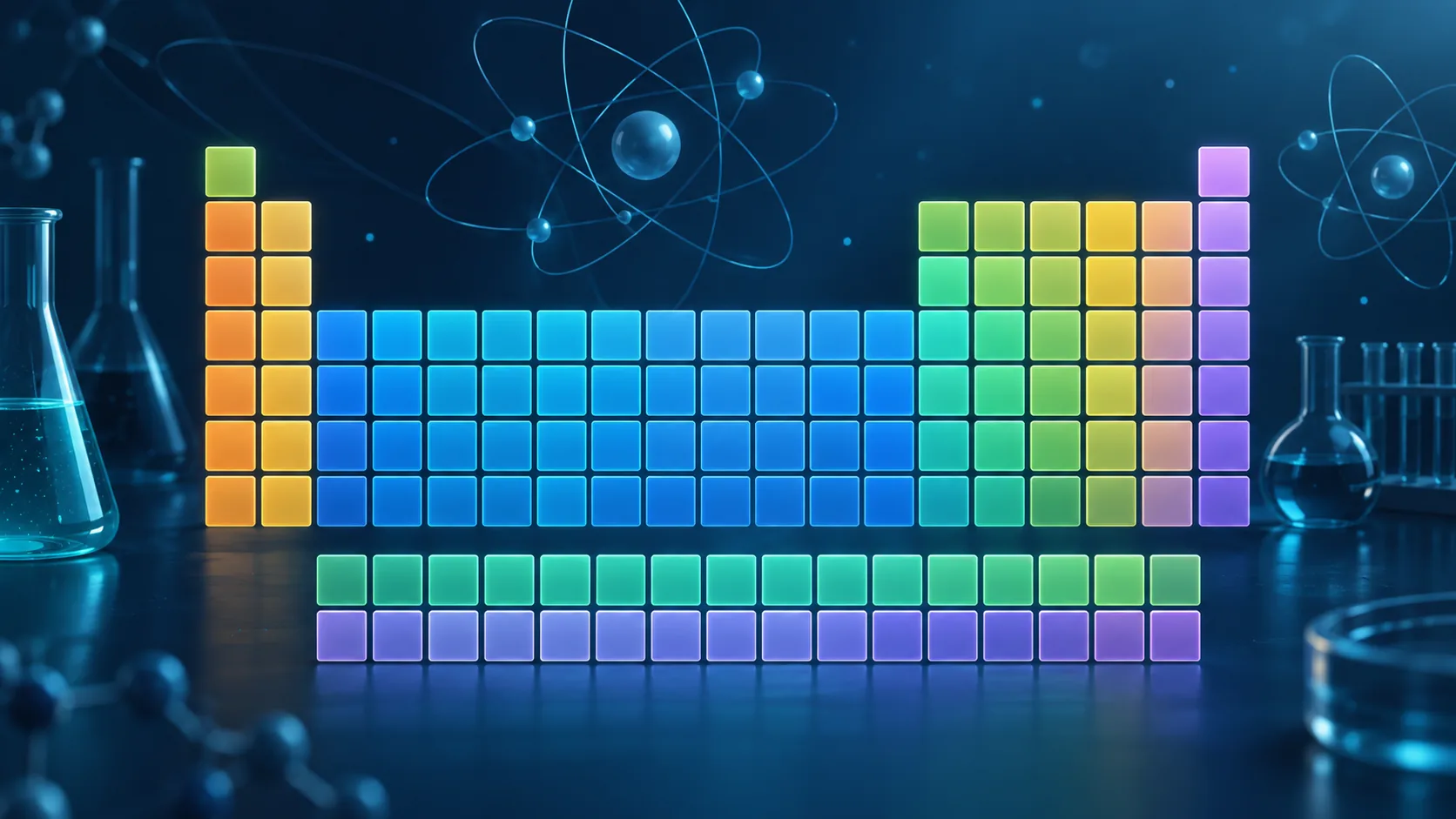
Interactive Periodic Table of Elements
Explore the elements with this interactive periodic table. Click on any element to view detailed information.
Loading elements...
Hydrogen
Nonmetal
Basic Information
Periodic Table of Elements: How to Read and Use It
The periodic table is a map of atomic structure, not just a wall chart to memorize. Its layout helps you identify an element, compare it with its neighbors, and make cautious predictions about bonding and chemical behavior. The interactive table on this page lets you search and filter elements; the guide explains what the numbers, positions, and recurring patterns actually mean. You can use it for introductory chemistry, AP Chemistry revision, or a quick check while solving a problem.
Begin with one element tile. It usually shows an atomic number, a one- or two-letter symbol, a name, and an atomic-weight value. Atomic number tells you how many protons are in the nucleus. That number defines the element: every carbon atom has six protons, and an atom with seven protons is nitrogen regardless of what a label says. In a neutral atom, electron count equals proton count. In an ion, electron count changes but proton count—and therefore the identity of the element—does not.
The displayed atomic weight needs careful reading. It is not the mass number of every atom. Most elements have isotopes: atoms with the same number of protons but different numbers of neutrons. A periodic-table weight generally reflects a standardized average or interval based on isotopic composition in normal materials. To find neutrons in a specific isotope, use that isotope’s whole-number mass number minus atomic number. Do not round a periodic-table decimal and declare that every atom has the resulting neutron count. IUPAC’s periodic table and NIST’s atomic-weight information are authoritative references when a printed chart and an online widget show slightly different rounded values.
Use the interactive table as a thinking tool
Search for an element by name or symbol, then locate its row and column before reading the detailed panel. Filtering by family helps you see a pattern, but filters are learning aids rather than rigid laws. “Alkali/Alkaline” groups two different families together for convenient exploration; “nonmetals” may combine elements with different reactivity. If a tile is missing from a filter view, clear the filter before concluding the element is absent. On a narrow screen, move carefully through the table and open one tile at a time rather than trying to memorize a compressed grid.
Try a three-step routine. First, predict from position: is the element a metal or nonmetal, and what kind of valence-electron pattern might it have? Second, inspect the tile or data panel for atomic number, symbol, and other values. Third, test your prediction with a chemical example or an official data source. If the tool’s value differs from a classroom reference, check the units, rounding, isotope convention, and update date. A static or interactive display can lag behind an authoritative data table, and it may simplify properties that depend on temperature or chemical environment.
This page’s graphic is intended for exploration, not as a full experimental database. The NIST periodic table provides critically evaluated atomic-property data, while the Royal Society of Chemistry’s interactive table offers additional educational context. Use a current primary reference for a high-precision value or a disputed property. No ordinary periodic table can by itself tell you the exact rate of a reaction, the behavior of a compound, or every possible oxidation state.
Why elements are arranged by atomic number
Modern tables order elements by increasing atomic number, from hydrogen with one proton through oganesson with 118. Rows are called periods and vertical columns are groups. The current official table contains 118 named elements; claims about a confirmed element beyond 118 should be checked against IUPAC before repeating them. The display is deliberately uneven because the allowed arrangements of electrons are not a simple rectangular sequence.
Early chemists noticed that properties recur as elements are ordered, even before they understood electrons. Dmitri Mendeleev’s nineteenth-century table was important because its patterns helped him leave gaps and predict properties of then-undiscovered elements. The modern atomic-number ordering explains why periodicity works more reliably than ordering by mass alone. This history is useful as a lesson in science: a table is a model that organizes evidence and makes testable predictions, not a decorative collection of facts.
The table’s shape encodes electron organization, but the familiar picture is a convenient layout, not a drawing of literal planetary orbits. Electrons occupy quantum states described by orbitals. The broad s, p, d, and f blocks correspond to the kind of subshell receiving the differentiating electron in the conventional arrangement. There are exceptions in detailed configurations, especially among transition metals, so a block tells you what to investigate, not an infallible shortcut for every atom or ion.
Periods: reading across a row
The seven horizontal periods track a broad progression in electron-shell occupation. Across a typical main-group period, atomic number rises one proton at a time while added electrons occupy the same principal shell or related subshells. Nuclear attraction tends to increase, so atomic radius often decreases from left to right. This is a general trend, not a demand that every experimental radius value follow a perfectly smooth staircase. “Atomic radius” itself has several definitions, depending on whether atoms are bonded, isolated, or in a metal.
As you cross a period, metallic character generally gives way to nonmetallic character. Sodium at the left of period 3 forms a positive ion readily in many compounds; chlorine near the right commonly forms a negative ion in ionic salts. Silicon in the middle is a metalloid with behavior that cannot be captured by simply calling it “half metal, half nonmetal.” This is why a prediction based on position should be followed by evidence about the actual substance and conditions.
Groups: reading down a column
Groups collect elements that often share a valence-electron pattern and therefore show related chemistry. Group 1 alkali metals tend to form +1 ions, while Group 17 halogens often form −1 ions in simple salts. Group 18 noble gases have filled outer-shell patterns associated with low reactivity under ordinary conditions. “Low reactivity” is more accurate than “never reacts”: some heavier noble gases can form compounds under suitable conditions.
Going down a group usually adds an occupied shell and increases atomic size. Ionization energy often decreases down a main-group family because an outer electron is farther from the nucleus and more shielded. Alkali-metal reactions with water can become more vigorous down the group, but never demonstrate that with an unplanned experiment. Laboratory handling is a safety question, not an invitation to test a trend. The table helps explain tendencies; it does not replace a safety data sheet or supervised procedure.
Hydrogen deserves special treatment. It sits above Group 1 on many charts because it has one electron, but it is a nonmetal with distinctive bonding and can gain or share electrons as well as form H⁺ in appropriate chemistry. Helium sits with noble gases because its first shell is full, even though its electron configuration differs from other members’ outer-shell pattern. These cases show why positional analogies have boundaries.
The main families at a glance
Alkali metals occupy Group 1 except hydrogen. They are soft, reactive metals in their elemental forms and are commonly found in compounds rather than as free metal in nature. Alkaline-earth metals in Group 2 often form +2 ions; magnesium and calcium are familiar examples. Group labels are not compound formulas: calcium chloride is CaCl₂ because charge balance requires two chloride ions for one calcium ion, not because calcium is “the second element” in a group.
Transition metals fill much of the central d block. They commonly show multiple oxidation states and form a wide range of coordination compounds. Iron may be found as Fe²⁺ or Fe³⁺, so an ionic formula cannot always be predicted from group position alone. The post-transition region includes metals with different bonding and material properties, such as aluminum and tin. Metalloids near the zigzag boundary, including silicon, often have context-dependent properties valuable in electronics; the boundary is a teaching convention, not a single experimentally sharp line.
Halogens in Group 17 are reactive nonmetals that commonly form salts with metals. Noble gases in Group 18 are monatomic under ordinary conditions and generally much less reactive, though not absolutely inert. The lanthanides and actinides usually appear in two detached rows beneath the main table so the chart fits a page. They belong to periods 6 and 7, respectively. Pulling them out visually does not mean they are outside the periodic system; the detached position is a formatting choice.
The f-block contains many chemically similar elements, and precise electronic details can be more complex than a simple color key suggests. If a school chart assigns a slightly different group-3 boundary or uses a particular convention for the f-block, learn the course convention and recognize the underlying scientific discussion. For most introductory work, identifying the regions and explaining broad trends matters more than memorizing a disputed border.
Periodic trends—and what they do not prove
Periodic trends are comparative claims. They work best when you specify the property, the atoms or ions being compared, and the conditions. For atomic radius, an intuitive explanation combines effective nuclear attraction and electron-shell distance. Moving across a main-group row can pull electrons closer; moving down introduces a larger shell. But comparing an atom with its ion changes electron count and electron–electron repulsion, so it is a different comparison.
First ionization energy is the energy needed to remove the least tightly bound electron from a neutral gaseous atom in its ground state. It generally rises across a period and falls down a group, but there are well-known local exceptions arising from subshell energies and electron pairing. A useful answer says “generally” and explains the specific pair rather than drawing an unbroken arrow and stopping. NIST’s atomic spectra database provides evaluated ionization-energy data when numerical precision matters.
Electron affinity concerns the energy change when an electron is added to a gaseous atom, but sign conventions in tables vary. Do not compare two values without reading the convention. Electronegativity instead describes an atom’s tendency to attract bonding electrons within a particular scale; it is not a directly measured force that can be applied identically in every molecule. Fluorine is often highlighted at the high end of common electronegativity scales, while noble-gas values may be omitted or treated differently by different references.
Metallic character generally decreases across a period and increases down a group, but reactivity is not a single universal arrow. A metal’s tendency to lose electrons and a nonmetal’s tendency to gain electrons involve different processes. Reaction rate also depends on surface area, solvent, temperature, and barriers. Gold’s low reactivity under many ordinary conditions cannot be explained merely by saying it is “in the middle”; detailed electronic and chemical context matters.
Worked comparison: sodium and chlorine
Sodium and chlorine both lie in period 3. Sodium, on the left, has one valence electron in the simple main-group model and commonly loses it to form Na⁺. Chlorine, near the right, has seven valence electrons and commonly gains one to form Cl⁻ in an ionic salt. Opposite charges attract, giving sodium chloride an extended ionic lattice. That explanation is stronger than “they want full shells” because it identifies the particles and interaction. It also leaves room for energy changes: making ions requires steps, and lattice formation releases energy. A real chemical process depends on the total energy balance.
Now compare sodium with potassium below it in Group 1. Potassium’s outer electron is in a higher principal shell and, in the general model, easier to remove. That supports a down-group trend in first ionization energy. It does not tell you a safe reaction procedure or a precise reaction rate. Compare chlorine with bromine below it: bromine atoms are larger, and their elemental forms have different physical states at ordinary conditions. Again, a trend helps predict, but actual measurements establish the property.
Worked comparison: carbon, silicon, and germanium
Carbon, silicon, and germanium share Group 14, yet their familiar elemental structures and uses are not interchangeable. Carbon can form diamond or graphite networks with very different properties. Silicon’s electronic structure underlies semiconductor applications, and germanium has its own material behavior. A group connection tells you to look for four valence electrons in a simple main-group account, but bonding arrangement and solid structure determine a specific material’s properties. Avoid claims such as “all Group 14 elements conduct electricity” without naming the allotrope or physical form.
This comparison illustrates a general study method: move from position to electron model, then to bonding and structure, then to an observable property. At each step ask whether you have enough information. A periodic table is a starting map, not a complete answer key.
Atomic number, mass number, and atomic weight
These three labels are easy to confuse. Atomic number Z counts protons and identifies the element. Mass number A is a whole-number count of protons plus neutrons in a particular nuclide. Standard atomic weight is a comparative value for an element in normal terrestrial material, often reflecting a mixture of isotopes. A neutral atom’s electrons equal Z; a +2 cation has two fewer electrons than Z, and a −1 anion has one more. The nucleus does not change merely because an ordinary chemical reaction forms an ion.
Consider chlorine. A chlorine-35 atom has 17 protons and 18 neutrons. A chlorine-37 atom also has 17 protons but 20 neutrons. Their masses are not exactly 35 and 37 atomic mass units, but the integer labels identify the nuclides. A standard periodic-table value near 35.45 reflects isotopic abundance in ordinary samples; it is not evidence for a “fractional neutron.” If a problem supplies a specific isotope and asks for particles, use its mass number. If it asks for molar mass of naturally occurring chlorine-containing material, use an appropriate atomic-weight value.
Atomic-weight precision is not always fixed forever. Improved measurements and documented isotopic variation can change recommended values or reporting formats. A school’s exam reference sheet may use rounded values for calculation convenience. Follow the provided sheet in that exam, and use IUPAC or NIST for higher-precision scientific work. Avoid pretending that an app’s rounded tile is a laboratory measurement of your particular sample.
From electron patterns to bonding
The outermost electrons are often central to chemical bonding, so periodic position gives you a useful first model. Main-group metals commonly lose electrons to form cations; many nonmetals gain or share electrons. Charge balance then helps construct ionic formulas. Magnesium commonly forms Mg²⁺ and oxygen commonly forms O²⁻, so the simplest formula is MgO. Aluminum commonly forms Al³⁺ and oxygen O²⁻, giving Al₂O₃ after balancing total charge. Do not copy subscript numbers from group labels without doing this check.
Covalent bonding is different. Two nonmetals may share electron density, and the formula and shape depend on valence, energy, and molecular structure. Water’s H₂O formula cannot be explained by treating hydrogen and oxygen as pre-existing ions in every context. Carbon can make diverse covalent frameworks. Transition-metal compounds bring additional oxidation-state and coordination complexity. Use the periodic table to identify likely building blocks, then apply the appropriate bonding model and evidence.
For an AP Chemistry problem, a useful sequence is: identify relevant elements and common ions; count valence electrons; build a Lewis representation where appropriate; consider three-dimensional geometry and polarity; then reason about intermolecular forces and measurable properties. This sequence ties the periodic table to the AP Chemistry study guide and avoids reducing all chemistry to a single “octet rule.” The octet is a helpful introductory pattern, but real molecules and ions have exceptions and more nuanced electronic descriptions.
Everyday uses without oversimplifying the science
Silicon is central to many electronic devices because controlled semiconductor properties are useful in circuits. That does not mean a chunk of pure silicon by itself is a working computer chip; processing, doping, interfaces, and circuit design matter. Lithium appears in many rechargeable batteries, but the chemistry varies across battery types and involves compounds and electrode structures, not isolated lithium metal in a phone. Copper conducts electricity well and is used in wiring, while its behavior depends on purity, form, and the full circuit design.
Iron is important in steel and biological molecules, but “iron” in a steel alloy and iron ions in a protein are different chemical contexts. Calcium is part of bones and teeth mostly in mineral compounds, not as metallic calcium. Neon can emit a characteristic light in a discharge tube, but many colorful commercial signs use other gases, phosphors, or LEDs. These examples make the table more memorable when you distinguish element, compound, material, and application rather than treating one element name as a complete explanation.
The periodic table also helps interpret environmental and health information, but it cannot decide whether a substance is safe. Dose, chemical form, exposure route, and context are essential. “Contains chlorine” does not tell you whether the material is table salt, a disinfectant, or something else. For a safety decision, consult relevant product documentation and qualified guidance rather than inferring risk from the element’s tile.
Common misconceptions to correct
First, a group is not a promise of identical reactivity. Related valence structures create patterns, but reaction conditions and detailed electronic structure matter. Second, a period is not a line of atoms with the same size; radius generally changes across it and depends on definition. Third, atomic weight is not the neutron count of every atom. Fourth, neutral atoms and ions do not have the same electron count. Fifth, a larger atomic number does not automatically mean a larger atom; compare shells and effective nuclear attraction.
Another misconception is that the detached lanthanide and actinide rows are “extra” elements outside the main table. They fit into periods 6 and 7. Likewise, the graphic categories are not absolute borders: different educational charts may color metalloids and post-transition metals differently. Finally, a periodic trend is a hypothesis-generating shortcut, not experimental proof of a compound’s exact behavior. When your prediction conflicts with reliable measurements, revisit the model and the conditions.
Practice questions you can answer with the table
Choose magnesium. Without opening a detail panel, predict its atomic number region, group, and common ion. Then confirm the tile and explain why Mg²⁺ has fewer electrons than neutral Mg but the same proton count. Repeat with sulfur and ask what formula you predict for a simple magnesium sulfide. Check charge balance, not only the element symbols. Next, choose two elements in the same group and explain one similarity and one important limitation of the comparison.
Find two period-3 elements on opposite sides of the table. Predict which neutral gaseous atom generally has the higher first ionization energy and state the nuclear-charge and shielding reasoning. Then look up evaluated values and note any nuance. Choose two isotopes of one element and calculate their neutron counts; explain why both occupy one tile. Finally, take an unfamiliar material claim—such as “this alloy is nonreactive because it contains a noble metal”—and list the extra evidence you would need before accepting it.
For students using the table to prepare for AP Chemistry, convert each practice question into a short written explanation. A correct click on a tile is a start, but an exam response must articulate a model and evidence. The AP subjects overview can help plan related coursework; the interactive table and this guide are the tools for chemistry-specific reasoning.
Worked calculation: using atomic weights in a formula
Suppose you need the approximate molar mass of water, H₂O, using a classroom periodic table. Find the displayed values for hydrogen and oxygen, multiply hydrogen’s value by the subscript two, and add one oxygen value. With rounded values 1.01 and 16.00 g mol⁻¹, the result is about 18.02 g mol⁻¹. The subscript tells you how many atoms of that element appear in one formula unit or molecule; it does not multiply the atomic number or change the element’s identity. If the problem supplies its own rounded atomic masses, use those values and report a sensible precision.
Now consider carbon dioxide, CO₂. The same method gives approximately 12.01 + 2(16.00) = 44.01 g mol⁻¹. The comparison illustrates why you need both the formula and the atomic weights: carbon dioxide has fewer total atoms than some larger organic molecules, but its molar mass is determined by which atoms and how many of each are present. A formula such as Ca(OH)₂ requires you to distribute the outside subscript to both oxygen and hydrogen. Calculating 40.08 + 2(16.00 + 1.01) gives about 74.10 g mol⁻¹. A quick estimate catches misplaced parentheses before they turn into a larger stoichiometry error.
These classroom calculations use convenient rounded values. They do not imply every individual water molecule has a mass of exactly 18.02 atomic mass units or that every terrestrial sample shares identical isotope proportions. When a question is about a specific isotope, use that isotope’s information instead of the generic atomic-weight value.
A reliable way to study the table
Memorize a small core of symbols that you use often, such as H, C, N, O, Na, Mg, Al, Cl, K, Ca, and Fe, while learning how to retrieve less familiar information accurately. Draw a blank main-group skeleton and fill groups, periods, and broad families from memory. For each unfamiliar element, ask where it sits and what its valence pattern suggests. Then verify with the live table. Short, repeated retrieval is more durable than rereading every element tile in order.
Study trends through explanations and counterexamples. Sketch an arrow for a general change in atomic radius or first ionization energy, then annotate why it occurs and where the simple pattern needs care. Practice moving between an element tile, an electron configuration, an ion, and a real substance. When a question concerns a measured number, inspect units and source quality. When it concerns a reaction, ask for the compound, conditions, and mechanism rather than drawing an answer from location alone.
The periodic table earns its place in science because it compresses a great deal of information into a map you can reason with. Use it to form a prediction, check that prediction against trustworthy data, and explain the limits of the model. That habit—prediction, evidence, revision—is more valuable than memorizing 118 isolated facts.