
What is CMT?
An inherited condition of peripheral nerves
Charcot-Marie-Tooth disease, usually shortened to CMT, is a family of genetic conditions affecting the nerves outside the brain and spinal cord. These peripheral nerves carry commands to muscles and return information about sensation. When their signals become less effective, a person may develop weakness, muscle wasting, numbness and difficulty with balance. The feet and lower legs are often affected before the hands. CMT is also called hereditary motor and sensory neuropathy. Despite its name, it is not a tooth disorder. Gene-targeted therapies are being researched, not offered here as approved routine treatment. There is no cure, but rehabilitation, supportive equipment, symptom treatment and sometimes surgery can make daily activities easier. This guide explains the decisions that matter after a suspected or confirmed diagnosis. It is educational information, not a way to diagnose yourself or choose treatment without a clinician. A sudden change in strength or function needs assessment rather than an assumption that CMT has progressed. [1]
The outlook is individual, not a fixed timetable
CMT can begin in childhood, adolescence or adulthood. Severity ranges from subtle difficulties to substantial disability. People with the same diagnosis, including relatives with the same genetic change, can have different experiences. Most people have a normal life expectancy, although uncommon severe forms and complications require specialist care. A diagnosis therefore cannot tell someone exactly when they will need a brace, whether they will change jobs, or how much help they will need later. It is more useful to document current abilities and review changes over time. Record what matters to you: walking to a bus stop, using stairs, preparing meals, writing or maintaining a hobby. These goals give the clinical team something concrete to protect. Another person’s story may offer ideas and reassurance, but it is not a forecast. Mobility equipment is an option for conserving energy and participation, not a measure of someone’s effort or worth. [2]
Symptoms and everyday effects
Feet, ankles and walking
Early signs can include frequent trips, difficulty running, ankle instability and an unusually high step. Some people develop high arches or curled toes; others have flatter feet. Weakness may make the lower legs look thinner. Reduced sensation can accompany weakness, while the extra effort of walking can contribute to tiredness. Children may seem unusually clumsy before anyone recognizes a neurological explanation. These observations are reasons to seek an assessment, not proof of CMT: foot shape alone is not a diagnosis. Tell the clinician whether problems affect both sides, when they began, and whether they have been gradual or recent. Mention falls even if they have not caused an injury. Describe changes in practical terms, such as catching a toe on level ground or needing a handrail that was previously unnecessary. Symptoms involving speaking, swallowing or breathing are uncommon in CMT and deserve separate medical attention rather than casual reassurance. [3]
Foot drop is a symptom with several possible causes
Foot drop means difficulty lifting the front of the foot and toes. It can make the toes catch the ground during a step. CMT is one possible cause, but a compressed or injured nerve, a spinal problem and other neurological conditions can also cause it. New foot drop should be assessed, particularly when it is one-sided or developing quickly. Treatment depends on the cause rather than the label alone. Practical fall prevention includes supportive shoes, clear walking routes, good lighting and secure handrails. Loose rugs and trailing cables are worth removing. If a walking aid is recommended, ask for help choosing the correct height and learning how to use it. An electrical stimulation device advertised for foot drop is not automatically suitable for CMT; suitability depends on the underlying nerve problem. Take the actual device question to your rehabilitation team instead of assuming all foot-drop treatments are interchangeable. [4]
Hands, grip and fine movements
Hand involvement can make buttons, keys, cutlery, handwriting and phone use harder. Both muscle weakness and altered sensation matter: a person may struggle to grip an object, manipulate it accurately or judge its temperature. Occupational therapy can identify which part of a task is difficult and suggest a practical adjustment. Examples to discuss include adapted handles, alternative fastenings, a suitable splint or changes to a workstation. A hand therapist may also recommend tailored movement, stretching or strengthening work. Stretching should not be painful or force joints into a position they cannot comfortably reach. Because the pattern of weakness differs between people, copying a generic hand routine is less useful than having the hand examined. Bring one or two troublesome objects to an appointment if possible. Demonstrating how a jar, pen or zip causes difficulty can be more informative than simply reporting that your hands feel weak. [5]
Types, genes and inheritance
Demyelinating, axonal and intermediate forms
CMT is an umbrella diagnosis, not one disease caused by one gene. Clinicians use the examination, nerve conduction findings and genetic results to describe the subtype. The axon is the signaling fiber; myelin is the insulating covering that helps electrical messages travel effectively. Demyelinating forms predominantly disturb the nerve’s myelin system; axonal forms predominantly affect the nerve fiber itself. Intermediate forms have features between these categories. Familiar labels include CMT1 and CMT2, but naming systems have evolved, and a gene-based description can be clearer when the cause is known. Ask your specialist to write down your subtype and explain whether it is confirmed genetically or remains a clinical classification. A label should guide care and interpretation, not become a rigid prediction. Management commonly involves several specialties because nerve impairment can affect walking, joints, hands and everyday function. Keep a copy of the diagnostic summary so another service can understand the basis of the diagnosis without relying on an abbreviated name in an old letter. [6]
CMT1A and the PMP22 gene
CMT1A is commonly associated with an extra copy of PMP22, a gene important for peripheral nerve myelin. A deletion involving the same gene commonly causes a different condition, hereditary neuropathy with liability to pressure palsies, or HNPP. HNPP often produces episodes related to pressure on particular nerves. The two conditions overlap in some features but are not interchangeable diagnoses. This distinction also explains why the type of genetic test matters: looking for an extra or missing copy is not identical to reading the DNA sequence for small changes. If an old test was described simply as negative, ask what it actually examined. CMT1A is generally inherited in an autosomal dominant pattern, but some cases occur through a new genetic change. Symptoms and age at recognition vary, so a relative may only be identified after another family member is diagnosed. An apparently unaffected parent does not settle the question without assessment. [7]
How CMT is diagnosed
The examination and nerve tests
Assessment usually starts with your history and a neurological examination. The clinician looks at strength, reflexes, sensation, foot shape and walking. Nerve conduction studies measure the speed and strength of signals traveling through peripheral nerves. Small electrical stimuli are used at the skin; the results help characterize the neuropathy. Electromyography, or EMG, examines electrical activity in muscles using a small needle electrode. These tests answer different questions from a genetic test. They can show a pattern of nerve dysfunction, but an abnormal result does not independently prove an inherited cause. Ask what the findings support and what alternatives remain. A nerve biopsy is not a routine requirement for everyone with suspected CMT; it may be considered in selected unresolved cases. Before agreeing to an invasive test, ask what diagnostic question it is intended to answer and whether its result would change the next step in your care. [8]
A negative or uncertain result does not end the investigation
A negative result means that the particular test did not identify a relevant known change. It may not exclude an inherited neuropathy because tests do not detect every possible genetic cause. Sometimes further testing or later reassessment is useful. A variant of uncertain significance, often shortened to VUS, is different from a confirmed disease-causing result. It means the evidence is insufficient to determine what that change means for health. It should not be presented as a definite explanation or a precise prediction for relatives. Even a clearly positive result generally cannot tell someone exactly how severe their future symptoms will be. Ask whether family testing could help clarify an uncertain result and how you will learn about any future reinterpretation. Keep the report and the explanation together. Without the interpretation, a list of technical genetic terms can create unnecessary alarm or false reassurance. [9]
Other causes of neuropathy must still be considered
Diabetes, vitamin B12 deficiency, thyroid disease, kidney or liver disease, alcohol exposure, medicines and inflammatory conditions can also damage nerves. More than one explanation may be present in the same person. A known CMT diagnosis does not protect someone from developing a treatable additional problem. The clinician decides which blood tests or other investigations fit the history; not everyone needs every available test. Tell them about prescription medicines, nonprescription products, supplements and occupational exposures. If you also have diabetes, ongoing care remains important rather than attributing every foot symptom to inheritance. Our type 2 diabetes guide provides related background, but it does not replace a neuropathy assessment. A useful question is: “Does this explain all of my symptoms, or should we look for an additional cause?” That question is especially important after a change from your established pattern. [10]
Treatment that supports daily life
Build a plan around function
Treatment aims to reduce symptoms, maintain mobility and support independence. A coordinated team may include a neurologist, physiotherapist, occupational therapist, orthotist, podiatrist and orthopedic specialist. The right combination depends on your needs rather than a standard package for everyone. Exercise is usually planned individually and may include appropriate strengthening, stretching, aerobic activity and balance work. Doing nothing out of fear is not the only safe option, but pushing through excessive exertion is not a sound strategy either. Ask your physiotherapist which activities suit your strength and joint range, how to pace them and what changes should prompt review. Set a manageable goal, such as getting through a familiar outing more comfortably. Review the plan if it becomes painful, exhausting or impractical. A useful program fits your life and can be adjusted; it is not a test of determination or a promise to stop the underlying genetic disease. [11]
What exercise research does and does not show
A randomized trial in children with CMT studied a carefully prescribed progressive resistance program targeting the muscles that lift the foot. It found a longer-term benefit for that measured weakness without evidence of the muscle damage or overwork weakness assessed in the study. This supports a more balanced message than “never strengthen weak muscles.” It does not establish that every exercise, weight or training schedule is safe for every adult or child with CMT. The program was specific and monitored, and one trial does not demonstrate a cure or prove that exercise prevents every form of progression. For families, the practical lesson is to seek an individualized rehabilitation plan rather than impose either complete avoidance or unrestricted training. Ask how progress will be measured and what recovery should look like between sessions. A research protocol should not be copied at home as though it were a universal prescription. [12]
Braces, footwear and mobility aids
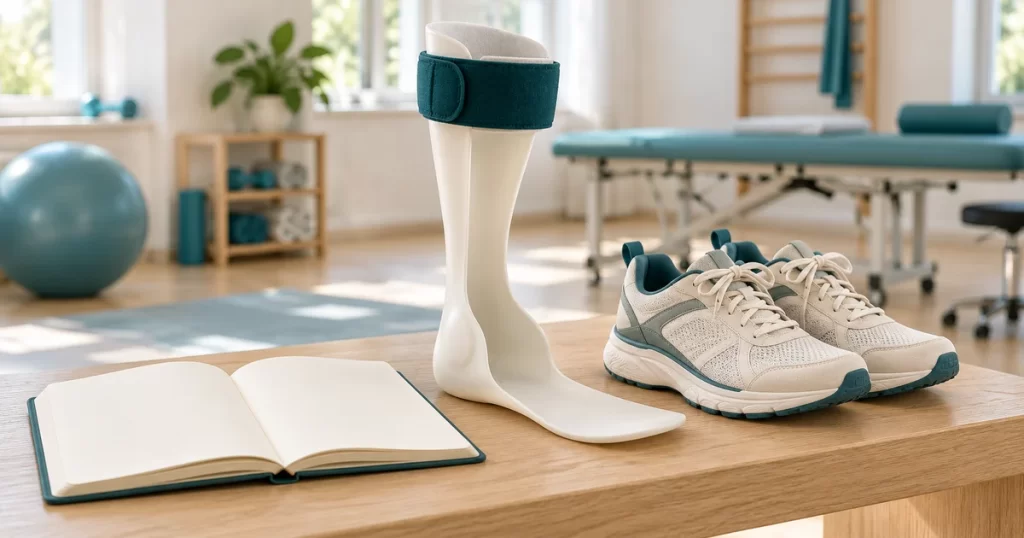
Braces can support weak hands or feet, while orthopedic footwear may help walking and reduce injury risk in peripheral neuropathy. An ankle-foot orthosis is one type of support that a specialist may consider for weakness and gait difficulty. Choosing equipment should involve the actual task, shoes, skin condition and walking pattern, not just the diagnosis. Ask to discuss the practical details: whether the device fits your usual footwear, how to put it on with hand weakness and who will review it if it becomes uncomfortable. A brace that remains in a cupboard is not meeting its purpose. Record what happens during a normal day rather than judging it only during a short clinic walk. The goal is useful support, not a particular appearance. Equipment can be reassessed as needs change, and using a walking aid does not mean rehabilitation has failed or that all independent walking must stop. [13]
Protect skin when sensation is reduced
Numbness can hide pressure, rubbing or a small injury. A daily look at the feet is therefore useful, especially where shoes or braces touch the skin. Check the soles and between the toes; a mirror or another person’s help may make this easier. Protect numb feet from hot water, heaters and heating pads, and check shoes for objects before wearing them. Do not cut corns or calluses yourself or use chemical removers on vulnerable skin without professional advice. Ask a podiatrist about nail care if reaching your feet or handling tools is difficult. These precautions are particularly important when diabetes is also present. Advice written for diabetic neuropathy is not evidence that CMT and diabetes have identical complication risks, but it illustrates why loss of protective sensation deserves attention. Seek medical help for a wound that is not healing, spreading redness, discharge or a new area of swelling rather than waiting for pain. [14]
Pain deserves an assessment of its cause
Pain can come from mechanical strain, an injury or damaged nerves, and treatment should match the problem. Burning, shooting or electric sensations may suggest neuropathic pain, but a description alone is not a diagnosis. Medicines used for nerve pain differ from ordinary painkillers, and dose changes may be gradual. Side effects such as drowsiness and dizziness matter especially if balance is already difficult. Discuss driving, alcohol use and falls when a new medicine is prescribed. Ask what improvement to look for, how long a trial should last and how to review a medicine that is not helping. Do not increase or stop prescribed treatment without advice. Complementary remedies and supplements also need checking for interactions and uncertain benefits. Keeping a brief record of pain location, timing, sleep disruption and activity can help the clinician distinguish problems that need a footwear change, rehabilitation adjustment or a different medical approach. [15]
When orthopedic surgery enters the discussion
Foot deformity may eventually make footwear, bracing or walking difficult enough to warrant a surgical opinion. CMT surgery should be planned by clinicians familiar with the condition, taking account of muscle imbalance and the individual foot. The aim is a more useful, stable foot, not removal of the genetic cause. A specialist consensus statement supports a comprehensive approach rather than one operation for everyone. Before deciding, ask the surgeon to describe the proposed procedure in plain language, the realistic functional goal and the alternatives. Discuss recovery arrangements just as carefully: stairs, bathroom access, help at home and the effect of hand weakness on using crutches can matter as much as the operation date. Ask what rehabilitation and equipment may still be needed afterward. Surgery is neither automatically required after a diagnosis nor automatically inappropriate because the nerve condition remains. The decision should address a specific problem that matters to you. [16]
Medication safety and changes that need urgent care
Vincristine requires a clear medical alert
Tell every prescribing team that you have CMT or are being investigated for an inherited neuropathy. This is particularly important before cancer treatment. The current vincristine sulfate label states that patients with the demyelinating form of CMT should not receive that product. This is a specific, serious prescribing issue, not a reason to avoid all medical treatment. If vincristine is being considered, the oncology team needs the diagnosis and should coordinate with your neurologist to choose an appropriate plan. Do not rely on a verbal mention made months earlier; ask for the condition to be visible in the treatment record. If your subtype is uncertain, say so rather than guessing that a particular restriction does not apply. Decisions about an anticancer regimen need expert review of the individual situation. Do not skip a cancer appointment or stop treatment on your own because you have encountered a medication warning online. [17]
Avoid blanket lists of forbidden medicines
The evidence for drug-related worsening is not equal for every medicine. A systematic review found particular concern for vincristine and possible concern for paclitaxel, but did not find convincing evidence to impose the same CMT-specific caution on every other drug it assessed. That does not make all other medicines risk-free; it means that a long undifferentiated “never take” list can be misleading. People with CMT still need effective treatment for cancer, infections and other illnesses. Ask the prescriber and pharmacist to consider the expected benefit, known neuropathy risk, alternatives and a monitoring plan. Reporting a clear baseline before treatment can help identify a subsequent change. If weakness or sensation worsens after starting a medicine, contact the treating team promptly. The safest response is a case-specific review, not abruptly discontinuing necessary treatment or assuming that every new symptom must be an unavoidable effect of CMT. [18]
Rapid weakness is not routine CMT progression
Weakness spreading over days or weeks, a major new loss of function or newly difficult swallowing needs urgent medical assessment. Some acquired nerve conditions, including Guillain-Barré syndrome, can progress quickly and require hospital care. Severe breathing difficulty, inability to swallow safely or rapidly worsening paralysis warrants emergency help. Having an existing neuropathy should not delay that response. Explain both the known diagnosis and what is different now: when the change began, how fast it is progressing and what you can no longer do. Do not wait for a scheduled genetics appointment to investigate a new urgent problem. Our Guillain-Barré syndrome guide explains that separate condition, but reading it should never delay care. You do not need to identify the exact cause before asking for help. The speed and severity of the change are enough to justify assessment. [19]
Sudden one-sided symptoms are an emergency
Sudden face drooping, weakness of an arm or difficulty speaking can indicate a stroke. Call your local emergency number immediately, even if the symptoms improve. Other sudden neurological changes, including new visual loss or marked loss of balance, also need urgent attention. Do not drive yourself. CMT should never be used as an explanation that postpones a stroke assessment. If possible, note when the person was last known to be at their usual baseline, and tell the emergency team what is normally affected by the neuropathy. A longstanding weak ankle and a newly weak arm are not the same event. Family members can help by describing the change clearly rather than trying to interpret it. The purpose of emergency assessment is to identify time-sensitive causes; it is not necessary to be certain that the problem is a stroke before calling for help. [20]
Charcot foot is not another name for CMT
Charcot foot, or Charcot neuroarthropathy, is a destructive problem affecting bones and joints in a foot with neuropathy. Diabetes is a common underlying context. It is not synonymous with Charcot-Marie-Tooth disease, and the shared name can cause confusion. A newly hot, red, swollen foot is not simply a typical high arch or an ordinary CMT deformity. It needs prompt assessment even if it is not very painful, because reduced sensation can make significant damage deceptively quiet. Avoid continuing to walk on a suspected acutely affected foot while arranging urgent advice. A clinician must distinguish Charcot changes from infection, injury and other causes. Treatment may require immobilization and specialist monitoring. Do not buy a brace online and assume that it addresses the problem. The important distinction is between a longstanding shape change and a new inflammatory-looking foot that may be at risk of further structural damage. [21]
Genetic counseling and family decisions
Counseling is support, not a directive
A genetic counselor helps explain test findings, inheritance and the implications for the individual and family. The role includes helping people work through uncertainty and emotional responses, not simply giving a percentage. You can ask for counseling when a diagnosis is suspected, before testing or after a result. Useful questions include whether relatives could benefit from information, which family member is most informative to test and how to explain the result without overstating what it predicts. It is reasonable to feel differently about learning your own result and sharing it widely. Bring those concerns into the appointment. Family planning discussions should reflect your values rather than imply that one choice is expected. Counseling can also help separate guilt from biology: nobody chooses the genetic variants they inherit. Taking time to understand the information is part of good care, especially when the result may affect several generations of a family. [22]
Recurrence risks depend on the exact diagnosis
For many autosomal dominant conditions, an affected parent has a one-in-two chance of passing on the relevant variant in each pregnancy. When both parents carry a disease-causing variant for the same autosomal recessive condition, the usual chance of an affected child is one in four per pregnancy. X-linked risks depend on which parent carries the variant and the chromosome inherited by the child. These examples explain the patterns; they are not a personalized CMT risk calculation. The gene, laboratory interpretation and family circumstances must be confirmed first. Each pregnancy is a new event: having one affected or unaffected child does not use up a risk. Nor does inheriting a variant necessarily predict precisely the same severity as an affected relative. Ask the genetics team to provide a written explanation for your family rather than trying to apply a diagram intended for a different type of CMT. [23]
Reproductive testing has choices and limitations
When a specific disease-causing variant is known, preimplantation genetic testing for a monogenic condition, or PGT-M, may be an option for some families. It involves IVF and testing embryos for the familial condition before transfer. Eligibility, access and funding depend on the service and local rules. It is not a simple guarantee of pregnancy or a universal test for every possible health problem. A specialist should explain the practical steps, possible inaccuracies, treatment burden and realistic chance of success. Some people prefer other reproductive options or choose not to pursue testing. A counseling discussion should make room for those choices without pressure. Ask early if this is relevant to you, because confirming the familial genetic cause and arranging fertility care can take time. Do not assume that a vague historical CMT diagnosis or an uncertain variant is enough to design a reliable embryo test. [24]
Current care, research and your next appointment
Experimental treatment is not established treatment
As checked in October 2026, the official CMT guidance cited here describes care as symptomatic or supportive rather than curative. Do not interpret a laboratory discovery, a trial registration or an early study result as evidence that a new treatment is approved for your subtype. Research programs may follow people over time to understand natural history and improve ways of measuring change, without providing an experimental medicine at all. The Inherited Neuropathies Consortium’s natural-history work is an example of this distinction. Ask whether a study is observational or interventional and what participants are actually asked to do. A gene-specific approach may be relevant to one subtype and not another. If someone advertises a cure, request the exact product, indication, regulator and published human evidence, then review those details with your specialist. There is no reason to abandon useful rehabilitation while waiting for research to produce a proven disease-modifying option. [25]
Read a trial offer as a decision, not a promise
A clinical trial evaluates an intervention; it does not guarantee benefit to an individual participant. Early phases focus heavily on safety, while later phases address effectiveness and comparison with other approaches. A study may include a placebo group, and eligibility criteria may exclude people whose subtype or circumstances differ from the group being studied. Ask what outcome the researchers hope to improve: a laboratory measurement, strength, walking or something else. Those outcomes are related but not interchangeable. A promising change in a biological marker is not automatically proof that everyday function improves. Ask how long participation lasts and how the study differs from standard care. Trial terminology can make an offer sound more established than it is, so have unfamiliar terms explained before deciding. Participation is a personal choice that should fit your goals and understanding of uncertainty, not a test of commitment to the CMT community. [26]
Make informed consent genuinely useful
Before joining research, you should understand the purpose, procedures, foreseeable risks, possible benefits and alternatives. You should also know that participation is voluntary and that you can change your mind. Ask practical questions about travel, time away from work, study visits, privacy and what happens if your health changes. Take the information home if needed and discuss it with someone you trust or your usual clinician. A research team’s enthusiasm should not replace your own understanding of the decision. Ethical oversight and consent are protections, but they do not make an experimental treatment risk-free. Ask how new information will be shared during the study and who to contact with a concern between visits. You can support research without enrolling in a particular trial, and declining participation should not be treated as giving up on your health or on future treatment development. [27]
A practical checklist for your next visit
Choose the two or three problems that most affect your day and bring a short record of them. Include what you were doing, what became difficult, whether it is new and what helped. Take your medication list, previous nerve-test results and genetic laboratory report if you have them. Bring the shoes, brace or hand aid that is causing trouble, or a photograph if carrying it is impractical. The aim is to leave with a clear plan rather than a longer list of unfamiliar terms.
- Ask which diagnosis and subtype are confirmed, and which questions remain open.
- Ask whether any new symptom needs a separate investigation rather than being attributed to CMT.
- Agree on one practical rehabilitation goal and who will help you pursue it.
- Clarify who to contact about brace discomfort, a foot wound, new weakness or medication concerns.
- Ask when follow-up is needed and what change should bring it forward.
- Write down the next action, the person responsible and how you will receive any outstanding results.
You do not need to memorize every gene or treatment name to participate effectively in care. A clear description of your daily difficulties, a reliable copy of your results and an agreed next step are often more useful. Keep the distinction between gradual long-term needs and a new urgent change at the center of the plan.
| Concern | Useful discussion | What not to assume |
|---|---|---|
| Trips or foot drop | Gait assessment, footwear and appropriate support | Every new foot drop is caused by CMT |
| Uncertain genetic result | Test limits and specialist interpretation | A VUS confirms the diagnosis |
| Pain or fatigue | Cause, function and a personalized plan | There is nothing to treat |
| Experimental treatment | Evidence, eligibility and informed consent | A trial listing means approval |
Sources
Sources checked on October 21, 2026. General education does not replace individual medical advice. Research findings are distinguished from established care.
- NINDS: Charcot-Marie-Tooth Disease
- MedlinePlus Genetics: Charcot-Marie-Tooth disease
- NHS: CMT symptoms
- NHS: Foot drop
- UCLH: CMT guide to promoting hand function
- GeneReviews: CMT hereditary neuropathy overview
- NHS Genomics Education: CMT1A and HNPP
- NHS: CMT diagnosis
- MedlinePlus Genetics: Interpreting test results
- NHS: Peripheral neuropathy causes
- NHS: CMT treatment
- Burns et al.: Randomized pediatric resistance exercise trial
- NINDS: Peripheral neuropathy
- NIDDK: Diabetes and foot problems
- NHS: Peripheral neuropathy treatment
- Pfeffer et al.: Consensus statement on surgical treatment of CMT
- DailyMed: Vincristine sulfate prescribing information
- Cavaletti et al.: Toxic medications in CMT systematic review
- NHS: Guillain-Barré syndrome
- NHS: Stroke symptoms
- Kent Community Health NHS: Charcot foot
- NHGRI: Genetic counseling
- MedlinePlus Genetics: Chances that children inherit a condition
- NHS Genomics Education: Preimplantation genetic testing
- NINDS: CMT natural history study
- NIH: Clinical research glossary
- NIH: Guiding principles for ethical research





