
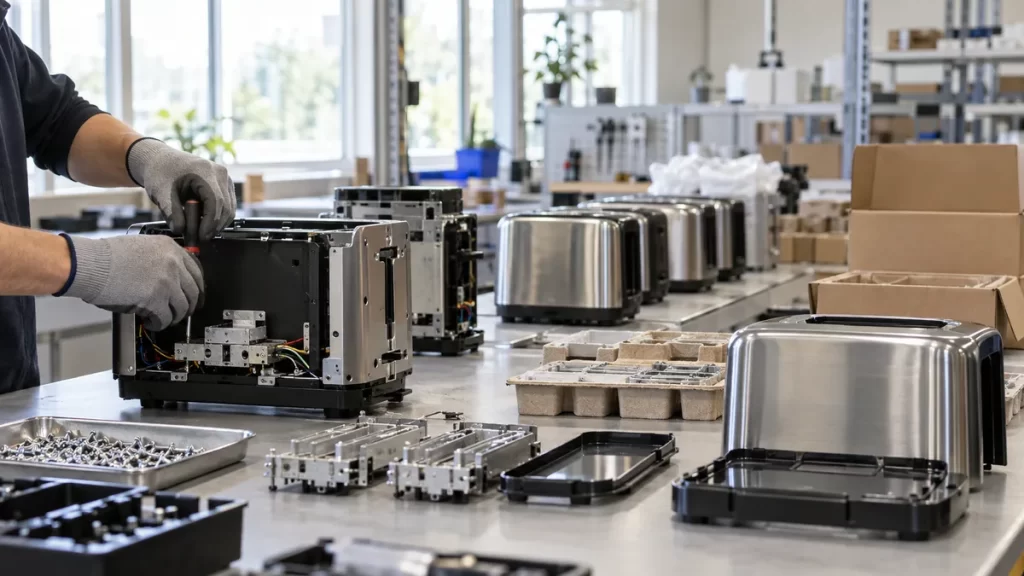
Manufacturers turn materials, components, labor, equipment and technical instructions into physical products. That sounds straightforward until you try to launch one: Who owns the design? Does a factory make every component itself? Is a supplier that merely boxes finished goods a manufacturer? What happens when a seemingly cheap unit price conceals expensive tooling, defects, freight or long delays? Understanding the manufacturer’s actual role helps students trace a supply chain and helps small businesses ask better questions before ordering inventory.
The U.S. Census Bureau’s manufacturing definition centers on mechanical, physical or chemical transformation of materials or components into a new product. Assembly normally counts. The finished output might be ready for a customer, or it might become another factory’s input. A manufacturer can work in a large plant, a small workshop or, in some cases, a home-based operation. Size, automation and whether the product bears the factory’s own brand do not by themselves settle the question.
What does a manufacturer do?
A manufacturer coordinates a repeatable transformation. For a simple example, imagine a company selling stainless-steel water bottles. One business might form metal shells, another could make lids and seals, and a third might assemble and test the complete bottle. Each production specialist can be a manufacturer. A distributor that buys finished bottles and resells them without transforming them plays a different role, even if it arranges packaging and transport. A brand may design the bottle and own the customer relationship while outsourcing every physical production step.
The typical workflow starts with a product requirement: dimensions, materials, performance, safety needs, appearance and expected volume. The producer determines how to make it consistently, sources inputs, configures tooling or work instructions, trains operators, produces a prototype or first article, checks results, and then runs production. Goods are inspected, packed and delivered to the next business or the final buyer. This is a useful map, not a universal sequence. Food processing, custom fabrication and regulated medical products involve different controls.
A good manufacturing decision balances quality, cost, delivery, flexibility and risk. Unit cost alone does not describe the result. A supplier may offer a low quote but require an expensive mold, a large minimum order, costly freight, or a long replenishment time. Another may charge more per unit but produce small batches quickly, reducing unsold inventory. The better choice depends on the product’s specifications, demand uncertainty, cash available and the consequences of failure.
Manufacturers also have limits. They cannot infer an unstated tolerance, guarantee that an untested design will perform, or always substitute one material for another without changing the product. A buyer should specify important requirements and agree on how they will be verified. The producer should flag manufacturability problems early. Shared responsibility works better than the assumption that a factory will somehow fix an incomplete design.
Where manufacturers sit in a supply chain
A supply chain connects extraction or growing, component production, assembly, storage, transport, retail and use. Consider a cotton shirt. Farmers supply fiber; textile mills spin yarn and make fabric; dyeing and finishing operations change its properties; a garment factory cuts and sews; a wholesaler or brand may then distribute it. More than one participant manufactures something. The retailer usually does not, unless it operates its own production process. Mapping these stages makes costs and dependencies visible.
Materials flow in one direction, but information and money travel in several. A sales forecast tells a factory how many units may be needed. The factory orders parts and schedules labor. Quality results may send information back to a designer. Customer returns can reveal a weak seam or inaccurate sizing. Payment terms determine whether the manufacturer can finance material purchases before being paid. A delayed component can stop an otherwise efficient assembly line.
The NIST Manufacturing Extension Partnership’s supply-chain guidance emphasizes mapping suppliers, evaluating them, understanding total cost of ownership and planning alternatives for critical inputs. That does not mean keeping a costly backup for every screw. It means recognizing which components have long lead times, single sources, hard-to-replace tooling or severe failure consequences. A small business can begin with a one-page map of the parts, suppliers, transit routes and decision owners for its main product.
Manufacturing is not the same as wholesaling, retailing or dropshipping. A wholesaler generally buys and resells in bulk; a retailer sells to the end customer. In dropshipping, the seller markets a product while another party fulfills an order, which does not make the seller the physical producer. For the distinction between a factory relationship and a catalog reseller, read Sly Academy’s product-sourcing guide. A business can occupy several roles, but each role creates different operational responsibilities.

A practical product-flow example
Suppose a small brand wants to sell a desk lamp. The brand chooses the target customer, appearance and desired functions. A fabricator forms the metal arm, an electronics supplier provides a compatible driver, and an assembly partner joins and tests them. Packaging comes from another vendor. A distributor may hold finished stock. The brand sells the lamp online and handles customers. Calling the entire chain “the manufacturer” hides important questions about who owns the tooling, tests electrical safety and remedies defects.
The lamp example also shows why a bill of materials matters. This is the organized list of parts and quantities needed for one product. If one driver is unavailable, the brand needs to know whether an alternative satisfies the design, approvals and warranty. It should not assume that an apparently similar replacement is interchangeable. A controlled change process documents the new part, tests the result and tells everyone which version is shipping.
Types of manufacturing: different ways to classify the work
Lists of “types of manufacturers” often mix three separate questions: What transformation occurs? Who owns the design and brand? When does production begin? Keeping those axes separate prevents confusion. A factory can be a contract manufacturer, make discrete products and run make-to-order jobs at the same time. None of those labels cancels the others.
Discrete manufacturing produces distinct, countable items such as bicycles, appliances and furniture. Parts are cut, machined, formed or assembled into identifiable units. A defective unit can often be traced to a production batch or serial number. Process manufacturing transforms ingredients or substances through recipes and operating conditions, as in many food, chemical and pharmaceutical operations. Outputs may be measured by mass, volume or batch rather than by a simple count of separate assembled items.
The distinction matters when selecting controls. A bicycle maker needs accurate parts, torque and assembly sequence. A beverage processor must manage formulation, mixing, temperature, sanitation and batch traceability. Some products combine both approaches: a chemical coating made by a process may be applied to a discrete metal component. Ask what process and control plan the actual product requires, not merely which broad category a supplier uses in its sales material.
Original equipment manufacturer, or OEM, is a relationship term whose usage varies by industry. In many business discussions it describes the company responsible for a final product or a producer supplying components to another brand. Because those meanings differ, define the parties in the contract instead of relying on the acronym. Contract manufacturing means one company makes a product or component for another under agreed specifications. The brand may own the design, while the contractor owns machinery and production know-how. Sometimes design services are included; sometimes the contractor simply builds to supplied drawings.
Private label describes a selling arrangement in which a seller puts its brand on a product made by another company. The factory may offer an existing design with limited customization. A genuinely custom design typically requires more engineering, validation and tooling, but can create meaningful product differentiation. A small logo change is not the same as controlling the formulation or mechanical design. Confirm who owns the design files, molds, tests and product claims.
Manufacturers also differ by business stage. A prototype shop optimizes for learning and rapid changes, often at high unit cost. A pilot-line partner tests whether the design can be made repeatably at moderate volume. A high-volume plant optimizes equipment use and consistency but may require greater minimum orders and longer setup. Moving from a prototype to mass production is not just asking for a bigger quantity; the product may need redesign for assembly, tolerance control and testability.
Make-to-stock, make-to-order and assemble-to-order
Production timing creates another important classification. Make-to-stock means building before a particular customer order, usually from a demand forecast. This suits stable, repeatable items that customers expect quickly. The trade-off is inventory: if the forecast is wrong, goods may sit, become obsolete or require discounting. The manufacturer also needs space and cash to carry materials and finished units.
Make-to-order starts production after an order is placed. It can reduce finished-goods inventory and support customization, but the customer waits for production and any materials not already available. A custom cabinet is a familiar example. Yet “made to order” does not mean everything begins from raw material. A workshop may hold standard boards, hardware and fittings so that a confirmed order can start promptly.
Assemble-to-order keeps selected components ready and completes the final configuration after the order. A computer supplier might stock cases, memory and drives, then assemble a requested combination. This can offer more variety with less finished-goods inventory than building every possible variant in advance. It works only if common components are available and the assembly process is well controlled.
A blended plan is common. A lamp maker may stock standard housings, order specialty finishes when demanded and assemble variants to order. The right method depends on demand variability, customer patience, component lead times and the cost of holding inventory. It should be revisited when the product or market changes, not treated as a permanent identity of the company.
What a manufacturer contributes beyond making the item
The physical transformation is only part of useful manufacturing service. Production engineering can improve how a design is cut, formed, joined or packaged without changing its intended function. For example, reducing unnecessary part variants can simplify purchasing and lower the chance of assembly mistakes. A prototype can expose a tolerance stack-up that was invisible in a drawing. Those improvements need documented approval when they affect fit, performance or safety.
Quality assurance asks whether a process can repeatedly meet requirements; quality control checks particular outputs. A buyer and supplier should agree on critical dimensions, acceptable defects, inspection points, test methods and records. “High quality” is too vague to enforce. For a reusable bottle, a defined leak test, lid-fit check, material specification and labeling review are more useful than a general promise. For regulated products, applicable legal and technical requirements must also be identified with qualified help.
Manufacturers may contribute packaging, labeling, batch records, storage and shipping preparation. Those services matter when the item is fragile, temperature-sensitive or likely to be confused with another variant. However, the brand or seller remains responsible for understanding the obligations it assumes to customers. Outsourcing production does not magically outsource every safety, advertising, import or warranty responsibility.
Some factories provide design-for-manufacture feedback before production. They may suggest a different fastener, a less wasteful sheet layout or a more robust assembly order. Treat such suggestions as testable proposals, not automatic cost savings. A cheaper part that shortens life or makes repairs impossible may increase total cost. Ask for a sample, compare it with the specification and record the approved revision.
How to choose a manufacturing partner
Start with a clear brief rather than a broad request for “your best price.” Include the product’s intended use, drawings or sample, materials, dimensions and tolerances where relevant, quantities, expected repeat orders, quality criteria, packaging, delivery region and target timeline. Identify requirements that cannot be compromised and those open to suggestions. If the design is not ready, say so and ask for prototyping or engineering support rather than pretending it is a production-ready specification.
Shortlist suppliers by demonstrated capability, capacity, location, communication and willingness to discuss process. The NIST MEP supplier-scouting service illustrates a capability-based approach: find producers able to make the specific item or process required. A polished website alone cannot prove a factory owns the equipment, has available capacity or can meet a standard. Request relevant process descriptions, comparable work, sample results and any current certifications that actually apply to the product.
Ask who will make the work. Some firms broker orders to another factory; that can be a legitimate model, but it changes visibility and control. Clarify where production occurs, which steps are subcontracted, who approves changes and who holds records. Ask about minimum order quantity, tooling ownership, setup charges, sample fees, payment schedule, rejected units, returns, warranty work and what happens if a run is late. A written request for quotation makes replies comparable.
Order a representative sample and test it under realistic use. A beautiful prototype is not proof of stable production at scale; it may have been made slowly by a specialist. For the first production run, agree on an approved “golden sample” or documented specifications and inspect early units before the whole batch is complete. Independent inspection may be appropriate for high-risk or distant production, but it should supplement a sound process rather than replace one.
Evaluate the supplier’s response to problems. A factory that reports a failed test early and proposes a documented fix may be safer than one that promises zero defects without evidence. Ask how it handles corrective action, component substitutions and traceability. A supplier relationship is a sequence of decisions, not a single price comparison. Small firms should keep their own copy of drawings, specifications, approvals and correspondence.
Calculating the real cost of a manufacturing order
Imagine Supplier A quotes $8 per lamp for 2,000 units, plus $6,000 in tooling and $4,000 in inbound freight. Supplier B quotes $11 per unit for 500 units, with $1,000 in setup and $500 in freight. Before other costs, A’s first order totals $26,000 for 2,000 units, or $13 per unit; B’s totals $7,000 for 500 units, or $14 per unit. A’s apparent $3 unit-price advantage shrinks to $1 in this first-order comparison. Neither figure includes import charges, storage, defects, financing or the risk of unsold goods.
The exercise is deliberately simple; actual quotes require careful terms. Tooling may be reusable over many orders, reducing later unit cost, but only if the buyer can access it and the design stays stable. Freight can vary by packaging density and mode. Tax and customs treatment depends on product and route. A business with uncertain demand may value B’s lower initial cash commitment more than A’s potential long-run scale. A business with verified repeat orders may reach the opposite conclusion.
Think in total cost of ownership: unit price plus setup, tools, testing, transport, duties where applicable, inventory holding, scrap, returns and administration. Then consider time. A lower-priced producer that takes 16 weeks to replenish may force the seller to buy more stock or accept stockouts. A nearby producer is not always faster or better, and an overseas one is not automatically cheaper. Compare actual quotes, lead-time evidence and risk, not a geographic stereotype.
This calculation connects to Sly Academy’s small-business planning overview, because inventory and tooling tie up cash before sales arrive. Keep a cash forecast alongside a margin estimate. If a first batch is defective or sells slowly, the business still owes the supplier. A production plan should survive a realistic downside scenario, not only the best-case sales forecast.
Managing quality, delays and supply-chain risk
Risk is not a reason to avoid manufacturing; it is a reason to make dependencies visible. The NIST discussion of small-manufacturer risk strategies recommends examining inputs, internal processes and customer outputs. For a small brand, that may mean identifying the one custom seal that has a long lead time, the single machine that sets capacity, and the seasonal sales window that makes a late shipment especially costly.
Write down the likely failure modes: material shortage, incorrect specification, failed test, machine downtime, transport disruption, unexpected demand or a supplier exiting the market. Give each a practical response. Qualify an alternate component before an emergency, hold a modest safety stock for a critical inexpensive item, schedule an early production checkpoint, or negotiate a realistic buffer before a launch. The response should be proportionate; excessive inventory creates its own financial risk.
Quality problems should trigger diagnosis, not a blame cycle. If a customer reports a leaking bottle, determine the affected batch, inspect retained samples, compare the seal material with the approved specification and record the corrective action. Was the design weak, the material substituted, the assembly step inconsistent, or the test inadequate? A recall or legal reporting obligation may apply for certain products; consult the relevant regulator and qualified specialists rather than relying on a generic article.
Supplier diversification is not simply finding two websites. An alternate must have compatible capability, approved specifications, realistic capacity and a workable commercial relationship. Two suppliers that depend on the same scarce upstream component may not provide genuine resilience. The supply-chain map should extend at least one step beyond the direct factory for parts whose loss would stop production.
Local, overseas and hybrid production
Location changes more than freight cost. Domestic or regional production may make visits, small batches and collaboration easier for a particular buyer. International production may offer specialized processes, established component ecosystems or scale. Neither category guarantees quality, low labor cost or ethical practice. A good decision compares named suppliers and routes under the same specification.
Lead time includes material procurement, production queue, fabrication, inspection, packaging, transport and customs clearance where relevant. “Factory time” is only one piece. Ask which parts are in stock and which are ordered after deposit. Clarify the point at which goods are ready for collection, the party responsible for shipping and the documents needed. A quoted delivery date without these assumptions can be misleading.
Hybrid arrangements can be effective. A company may source standard components globally but perform final customization and testing near its customers. Another may prototype locally, then transfer a proven design to a higher-volume producer. Such moves require careful version control and comparable tests; two factories can make products that look similar yet perform differently. The handoff should include controlled drawings, specifications, approved samples and quality records.
Sustainability claims deserve the same specificity. A shorter transport route can help, but material choice, production energy, yield, product life and end-of-life options also matter. Avoid declaring a product “green” solely because it was made nearby or uses recycled packaging. Verify relevant data and limit claims to what evidence supports. The manufacturer’s ability to document material sources and waste can be useful, but the seller still needs to assess the whole claim.
Manufacturer, supplier, wholesaler and brand: a quick distinction
A manufacturer transforms inputs into a new physical product. A supplier is any party providing something needed by another business; it may be a manufacturer, distributor or service provider. A wholesaler usually buys finished goods for resale in volume. A brand defines an identity and offers a product to a market; it may own a factory, contract one or buy ready-made goods. A retailer sells to the final customer. One company can perform multiple roles, so the most useful question is what it actually does in this transaction.
For example, an online store may show a jacket under its own name. If it selects a stock item from a wholesaler, it is not necessarily the manufacturer. If it commissions a factory to cut and sew its design, it owns more product-development decisions but may still not physically manufacture anything. If it runs its own sewing workshop, it is both brand and manufacturer. The Sly Academy dropshipping explanation describes another fulfillment arrangement in which the seller need not hold stock.
Terminology matters because it changes what to ask. With a catalog reseller, investigate product origin, stock accuracy and returns. With a contract factory, investigate tooling, specifications, production tests and change control. With an in-house line, the business itself must manage equipment, workers and throughput. A “direct from manufacturer” claim is useful only if the claimed relationship is real and the terms are clear.
Measure the relationship after the first order
The first shipment is evidence, not the end of supplier evaluation. Record the promised and actual ship dates, units accepted, units reworked, reasons for rejection and how quickly the producer resolved questions. Compare those measures over several orders; a single late delivery caused by an extraordinary event tells less than a recurring pattern of missed milestones. Invite the manufacturer to explain process changes, while keeping approval of product specifications explicit. When a supplier performs well, better forecasts and earlier design updates can make its planning easier. That shared information can improve reliability without removing the buyer’s responsibility to verify the output.
A practical checklist before placing a first order
Define the customer’s problem and test that demand exists. Prepare a written product brief and identify applicable safety, labeling and market requirements. Decide which parts of the design are fixed and which can change. Ask several qualified manufacturers the same questions, then compare capability, samples, total cost, lead time and communication. Verify where the work happens and who owns any molds or design files.
Before paying for a full run, approve a prototype or first article and a measurable quality plan. Put the agreed version, quantities, deadlines, payment milestones, change procedure and defect remedies in writing. Consider a smaller pilot order when demand or the process is uncertain. Track actual yield, delivery performance and customer complaints after launch. Use those observations to improve the next order rather than assuming the first specification was perfect.
Manufacturing turns an idea into a repeatable physical result, but the value lies in more than a machine or factory floor. Sound specifications, traceable materials, realistic economics, tested quality and resilient relationships determine whether that result meets a customer’s need. Once those elements are visible, “finding a manufacturer” becomes a sequence of concrete choices rather than a search for the lowest advertised unit price.