
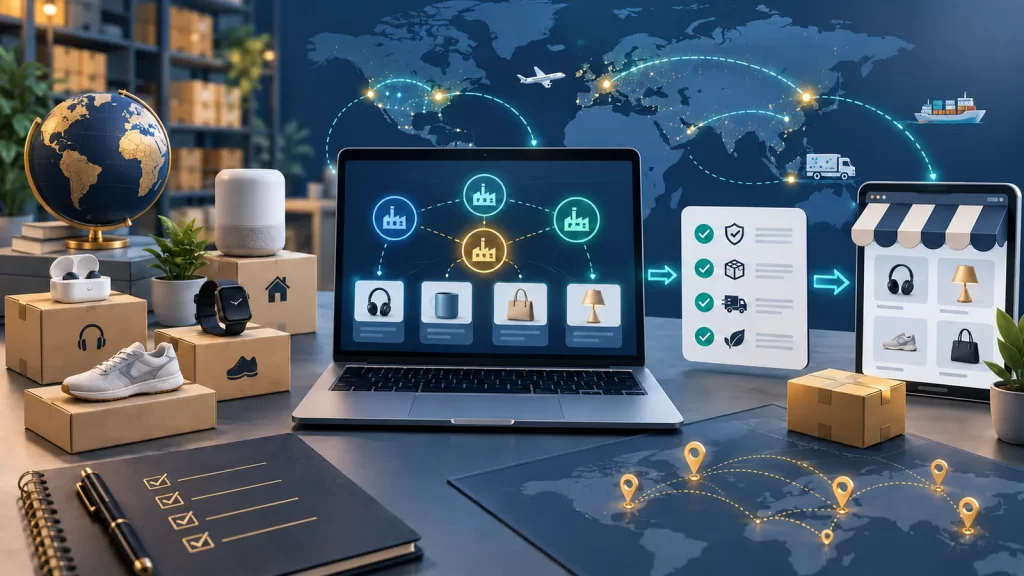
The best dropshipping sites in 2026 help you find suitable suppliers, keep product data accurate, route orders reliably, and set realistic delivery expectations. No directory can guarantee product quality or profit, so use this comparison to build a shortlist—then verify the individual supplier, sample the product, and calculate the landed cost.
This guide separates brand networks, supplier marketplaces, directories, global sourcing services, and print-on-demand platforms. Prices and eligibility can change, so confirm current terms on each official site before committing.
Best dropshipping sites at a glance
| Site | Best for | Type | Main trade-off |
|---|---|---|---|
| Shopify Collective | Products from established Shopify brands | Brand network | Eligibility and ecosystem limits |
| Syncee | Regional and global brands | Supplier marketplace | Policies vary by supplier |
| DropCommerce | US and Canadian products | Supplier marketplace | Smaller catalog than mass marketplaces |
| Worldwide Brands | Supplier research | Directory | Directory access does not automate fulfillment |
| Wholesale Central | Manual US wholesale research | Directory | You must vet and contact suppliers |
| AliExpress | Huge catalog and product testing | Marketplace | Quality and delivery vary widely |
| DSers | AliExpress order workflow | Sourcing and automation app | Supplier quality still needs verification |
| CJdropshipping | Catalog plus sourcing requests | Marketplace and sourcing service | Complex global shipping choices |
| Zendrop | Beginner-friendly product importing | Sourcing and fulfillment platform | Feature access depends on plan |
| AutoDS | Multi-supplier automation | Automation platform | Automation adds cost and operational complexity |
| Spocket | US/EU-focused supplier discovery | Supplier marketplace | Confirm the origin of each listing |
| Doba | Centralized catalog and ordering | Supplier marketplace | Compare subscription cost with expected volume |
| Printful | Custom print-on-demand products | POD fulfillment platform | Higher unit cost than bulk manufacturing |
The right option depends on your niche. Fashion merchants should also compare dedicated clothing dropshipping suppliers, while product ideation should begin with a clear method for evaluating dropshipping niches.
13 best dropshipping sites for product sourcing in 2026
1. Shopify Collective: best for Shopify-to-Shopify brand partnerships
Shopify Collective lets eligible Shopify merchants discover products from other Shopify brands, import listings, synchronize inventory, route orders, and handle supplier payments inside Shopify. It is useful for stores that want recognizable, complementary products rather than generic marketplace items.
Choose it when: you already use Shopify and meet current eligibility requirements. Compare supplier margins, shipping regions, returns, and brand fit before adding a product.
2. Syncee: best for filtering suppliers by market
Syncee combines dropshipping and wholesale in a marketplace with suppliers from multiple regions. Retailers can filter products and suppliers, import listings, and synchronize orders and tracking.
Choose it when: you want regional options or plan to test through dropshipping before buying winning products wholesale. Vet each supplier’s shipping and returns separately.
3. DropCommerce: best for US and Canadian sourcing
DropCommerce focuses on suppliers in the United States and Canada. For North American audiences, a more local catalog can simplify shipping estimates and reduce cross-border uncertainty on eligible products.
Choose it when: domestic or regional sourcing matters more than having the largest possible catalog. Check the full landed margin for every listing.
4. Worldwide Brands: best for directory-based research
Worldwide Brands is a supplier directory rather than a single fulfillment network. Directories can help you locate wholesalers and dropshippers, but a listing is only the beginning of due diligence.
Choose it when: you are comfortable contacting suppliers, negotiating terms, and managing your own integrations. Verify that a supplier still offers dropshipping for your product and region.
5. Wholesale Central: best for manual US supplier discovery
Wholesale Central organizes wholesale suppliers across many categories. Some listings may support dropshipping, while others sell only in bulk.
Choose it when: you want leads for direct supplier relationships. Ask about minimum orders, data feeds, inventory updates, blind shipping, returns, and account requirements.
6. AliExpress: best for breadth and early product testing
AliExpress provides a very large international catalog and low barriers to ordering samples. The same breadth creates risk: seller quality, product consistency, intellectual-property status, and delivery performance can differ sharply.
Choose it when: you can evaluate sellers and order samples before listing. Never copy an unverified delivery estimate or sell branded goods without evidence that the supplier is authorized.
7. DSers: best for managing AliExpress orders
DSers is designed to connect ecommerce stores with AliExpress sourcing and order workflows. It can reduce manual processing and help compare supplier options for the same product.
Choose it when: AliExpress is already part of your sourcing strategy. Automation does not replace product testing, seller verification, or customer-support planning.
8. CJdropshipping: best for sourcing requests and fulfillment options
CJdropshipping combines a product catalog, sourcing requests, store integrations, and fulfillment services. Multiple warehouses and shipping methods can be useful, but they also make product-level checks essential.
Choose it when: you need sourcing help or wider fulfillment choices. Confirm the exact warehouse, processing time, shipping line, customs treatment, and returns for every SKU.
9. Zendrop: best for a guided sourcing workflow
Zendrop offers product importing, order fulfillment, and additional branding or sourcing features depending on the current plan. Its streamlined interface is aimed at merchants who want fewer moving parts.
Choose it when: ease of operation matters and the available products fit your market. Compare plan costs and fulfillment options against your realistic sales volume.
10. AutoDS: best for multi-supplier automation
AutoDS is an automation platform for product importing, monitoring, and order workflows across supported suppliers and sales channels. This can help at scale, but inaccurate automation can multiply mistakes quickly.
Choose it when: you understand the underlying supplier process and need operational automation. Test price, stock, variant, and tracking updates before expanding your catalog.
11. Spocket: best for US/EU-focused marketplace sourcing
Spocket provides a supplier marketplace and store integrations, with an emphasis on products from US and European suppliers. Product origin and shipping still need to be checked at listing level.
Choose it when: your customers value regional fulfillment. Order samples to the destination you actually serve.
12. Doba: best for a centralized catalog
Doba centralizes products from multiple suppliers and supports product discovery and order management. The convenience can reduce supplier-by-supplier setup, but you still need to compare quality, margin, and shipping.
Choose it when: a unified workflow is worth the subscription cost. Model the cost per order at conservative sales volume.
13. Printful: best for original print-on-demand products
Printful creates products after a customer orders, then packs and ships them. Print on demand is different from reselling a supplier’s ready-made catalog because your original design is part of the product.
Choose it when: you have original artwork or a brand concept and want automated production without inventory. Sample each core product and price for production, shipping, returns, and marketing.
How to choose a dropshipping website
1. Match the sourcing model to your advantage
A generic catalog is easy for competitors to copy. Stronger options include exclusive supplier relationships, a carefully defined audience, regional fulfillment, original print-on-demand designs, or useful bundles and education around the product.
2. Verify the supplier—not just the platform
Check the legal business name, contact information, product origin, sample quality, response time, dispatch history, and return address. Avoid suppliers that charge unusual “approval” fees, refuse samples, or make unsupported authenticity claims.
3. Calculate landed profit
Gross margin is not net profit. Include the product, shipping, duties, payment processing, platform and app subscriptions, refunds, chargebacks, customer support, and advertising. US import rules changed in 2025, so review current CBP guidance on low-value shipment duties instead of relying on old de minimis assumptions.
4. Check customer-law obligations
Your store remains accountable to the buyer even when a third party fulfills the package. The FTC’s online-order guidance explains US shipping-delay and refund obligations. Businesses selling to EU consumers should also review EU return and legal-guarantee rules.
5. Run a small operational test
Place sample orders to at least two destinations. Track processing time, delivery, packaging, product accuracy, support, refund handling, and inventory synchronization. Launch a small tested catalog before adding more products.
Start with products, numbers, and customer experience
- Choose a specific buyer and problem.
- Research demand and competing offers.
- Shortlist two or three supplier platforms.
- Order samples and document total landed cost.
- Write original product pages with accurate measurements and delivery estimates.
- Publish clear shipping, returns, privacy, and contact information.
- Test a small catalog and expand only after reliable fulfillment.
For product research, use Sly Academy’s guide to dropshipping products to sell. When the shortlist is ready, the ecommerce startup guide covers the wider storefront and operating plan.
Bottom line
Choose Shopify Collective, Syncee, or DropCommerce for more curated supplier discovery; Worldwide Brands or Wholesale Central for direct research; AliExpress, DSers, CJdropshipping, Zendrop, AutoDS, Spocket, or Doba for broader sourcing and workflow options; and Printful when original print-on-demand products are the strategy. The best site is the one that survives sample testing, landed-cost math, and real customer-service scenarios.