
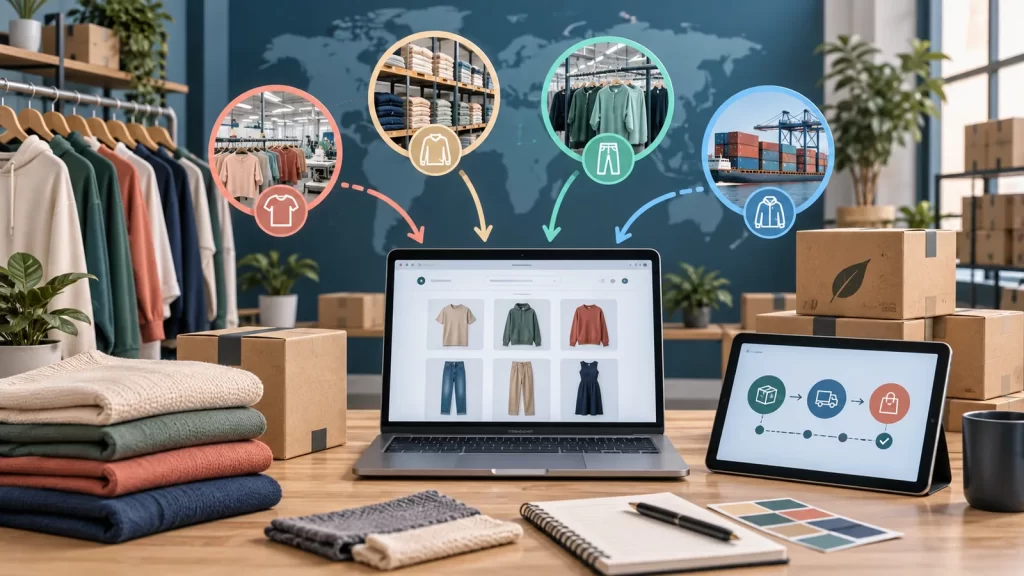
The best clothing dropshipping supplier is the one that can deliver the right product quality, sizing consistency, shipping speed, and branding options for your customer—not simply the supplier with the largest catalog. This 2026 guide compares 12 established options across ready-made fashion, curated brands, print-on-demand apparel, private label, and global sourcing.
Start with a shortlist, order samples to your main delivery markets, and calculate the fully landed cost before importing a large catalog. Platform features, shipping lanes, and pricing change frequently, so confirm the current terms on each supplier’s official website.
Best clothing dropshipping suppliers at a glance
| Supplier | Best for | Sourcing model | Important check |
|---|---|---|---|
| Shopify Collective | Established Shopify brands | Brand-to-retailer network | Store and region eligibility |
| DropCommerce | North American products | Supplier marketplace | Product-level delivery estimates |
| Syncee | Global and regional brands | Dropshipping and wholesale marketplace | Supplier location and ship-to filters |
| Trendsi | Fashion boutiques | Ready-made fashion and wholesale | Return exclusions and destination coverage |
| Printful | Quality-focused custom apparel | Print on demand | Sample quality and fulfillment route |
| Printify | Wide POD catalog and provider choice | Print-provider network | Provider-specific quality and shipping |
| Apliiq | Private-label streetwear | Print on demand and branding | Branding setup and production times |
| Gelato | Locally produced global POD | Distributed print network | Product availability by destination |
| Modalyst | Fashion and independent brands | Supplier marketplace | Integration and supplier-level policies |
| Spocket | US/EU-focused sourcing | Supplier marketplace | Actual origin, processing, and transit time |
| BrandsGateway | Luxury fashion | Premium wholesale and dropshipping | Authenticity, margins, and return terms |
| CJdropshipping | Broad global sourcing | Marketplace and sourcing service | Variant quality, duties, and warehouse route |
If you need suppliers beyond apparel, compare Sly Academy’s broader guide to the best dropshipping sites for product sourcing. For a narrower store concept, start by evaluating potential dropshipping niches before choosing a catalog.
12 clothing dropshipping suppliers to compare in 2026
1. Shopify Collective: best for selling products from Shopify brands
Shopify Collective connects eligible Shopify stores with other Shopify brands. Retailers can discover products, review supplier price lists, import listings, and route orders through the Shopify ecosystem. It is a strong starting point when you want branded products rather than a generic marketplace catalog.
Best fit: an established Shopify merchant that meets Collective’s current eligibility and regional requirements. Confirm margins, return handling, shipping coverage, and whether a supplier’s brand complements your audience.
2. DropCommerce: best for North American brands
DropCommerce focuses on products from US and Canadian suppliers, including clothing, jewelry, and accessories. Local fulfillment can make delivery expectations easier to manage for North American customers, but transit time still depends on the individual supplier and destination.
Best fit: stores prioritizing North American product origin and shorter regional shipping. Check each listing’s wholesale cost, shipping charge, return policy, and inventory history.
3. Syncee: best for filtering suppliers by region
Syncee is a dropshipping and wholesale marketplace with fashion suppliers in multiple regions. Its location filters can help a merchant compare where a supplier operates and where it ships, while inventory and order synchronization reduce repetitive work.
Best fit: retailers that want to test regional brands before moving successful products into wholesale. Treat every supplier as a separate business: sample products and review its service terms individually.
4. Trendsi: best for online fashion boutiques
Trendsi specializes in fashion for boutiques and supports dropshipping, samples, custom branding on eligible plans, and wholesale purchasing. Its catalog and integrations make it practical for trend-led stores, especially those selling into supported destinations.
Best fit: boutiques selling women’s apparel and accessories. Review the current shipping-country list and category-specific return exclusions before promising returns to customers.
5. Printful: best for an integrated custom-apparel workflow
Printful prints, packs, and ships custom clothing after an order is placed. It integrates with major ecommerce platforms and marketplaces and offers multiple apparel-decoration methods, making it useful for sellers who own original designs and want one operational system.
Best fit: creators building a branded print-on-demand line. Order a sample of every core garment because fabric, fit, print method, and color reproduction affect customer satisfaction.
6. Printify: best for comparing print providers
Printify connects sellers with a network of print providers. The large catalog and provider choice can improve product and location flexibility, but quality, production time, and shipping vary by the provider selected for a listing.
Best fit: sellers who want to compare production partners or diversify fulfillment. Keep a tested backup provider for important products and do not assume every provider performs identically.
7. Apliiq: best for private-label streetwear
Apliiq focuses on apparel and fashion-brand features such as private labels and custom embellishment. That positioning suits merchants who want a clothing line to feel more distinctive than a basic graphic tee catalog.
Best fit: streetwear and creator brands that value labeling and garment decoration. Confirm which branding elements apply to each product and allow for production time in delivery promises.
8. Gelato: best for distributed print-on-demand production
Gelato uses a distributed production network for print-on-demand goods, including selected apparel. Producing nearer to the customer can reduce long-distance shipping for eligible products and locations, although availability depends on the destination and item.
Best fit: international brands that want localized production options. Test the exact product in your primary market rather than relying on a sample fulfilled in another country.
9. Modalyst: best for fashion brands and marketplace variety
Modalyst combines independent brands, regional suppliers, private-label options, and AliExpress-connected sourcing. It integrates with major storefront platforms and can synchronize product and inventory information.
Best fit: merchants who want fashion variety from a single dashboard. Compare policies supplier by supplier; the marketplace does not make every product equal in quality, margin, or delivery speed.
10. Spocket: best for US- and EU-focused discovery
Spocket helps retailers discover products from a supplier network that includes US and European options. Its store integrations are useful for importing listings and synchronizing orders.
Best fit: sellers prioritizing suppliers closer to customers. Verify the actual dispatch location shown for each product; a platform’s overall regional focus is not a guarantee that every item ships locally.
11. BrandsGateway: best for luxury fashion
BrandsGateway specializes in designer fashion for wholesale and dropshipping. Luxury catalogs can support higher order values, but they also demand stronger authenticity checks, customer service, fraud controls, and clear return terms.
Best fit: experienced merchants with a premium audience. Calculate payment fees, returns, duties, and customer-acquisition costs before assuming a high retail price means a healthy net margin.
12. CJdropshipping: best for broad catalog sourcing
CJdropshipping offers a large catalog, sourcing requests, integrations, and fulfillment from multiple warehouses. It can be useful when a merchant needs product breadth or help locating a specific item.
Best fit: sellers prepared to manage a global supply chain. Sample every garment variant and confirm warehouse location, processing time, shipping method, customs treatment, and returns before publishing the listing.
How to choose a clothing dropshipping supplier
Order samples to the countries you serve
Check fabric weight, stitching, print quality, color, odor, packaging, size accuracy, and tracking. Wear and wash the garment. A polished supplier page cannot replace a real product test.
Build a size and returns system
Apparel returns are often driven by fit. Use product-specific measurements, state how to measure, and avoid converting every supplier into one generic size chart. Make sure your customer-facing policy is compatible with the supplier’s return window and exclusions.
Calculate landed cost, not catalog price
Add the garment, printing or branding, shipping, duties, payment fees, platform costs, expected returns, and advertising. In the United States, low-value import rules changed in 2025; the US Customs and Border Protection duty-waiver guidance should be checked before relying on old de minimis assumptions.
Verify delivery promises and legal obligations
You remain responsible to your customer even when a supplier ships the order. The US Federal Trade Commission explains online-order shipping obligations, including delay notices and refunds. Sellers serving EU consumers should also review the EU’s distance-selling return and guarantee rules.
Test inventory and support before scaling
Ask a real pre-sale question and measure the response. Track stockouts, dispatch time, delivery variance, defects, and return handling for a small catalog. Expand only after the supplier performs consistently.
A practical supplier test
- Choose three suppliers that serve the same niche and destination.
- Order the closest comparable item from each.
- Record total cost, processing time, delivery time, packaging, fit, and quality.
- Wash or use the item as a customer would.
- Send one support question and review the response.
- Model the net margin after returns and customer-acquisition cost.
- Launch five to ten tested products rather than hundreds of unverified listings.
When you are ready to build the storefront and operations around that supplier, follow Sly Academy’s guide to starting an ecommerce business. Merchants developing original apparel can also use the step-by-step guide to launching a T-shirt business.
Bottom line
For ready-made clothing, start with a curated or regional marketplace such as Shopify Collective, DropCommerce, Syncee, Trendsi, Modalyst, or Spocket. For original designs, compare Printful, Printify, Apliiq, and Gelato. BrandsGateway targets luxury sellers, while CJdropshipping offers wider global sourcing. Whichever route you choose, samples, landed-cost math, and reliable returns matter more than catalog size.