

Dupuytren’s contracture can gradually prevent a finger from straightening. Understanding the palm lump, the affected joint and the limits of each treatment helps you make sense of the choices ahead. 1
This guide is educational information, not a personal diagnosis or treatment plan. Evidence and regional medicine availability checked on 16 October 2026.
What changes in Dupuytren’s disease?
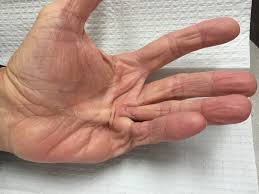
Dupuytren’s disease affects the fascia, a layer of connective tissue beneath the skin of the palm. Small areas can become thickened and form firm nodules. Bands of affected tissue, usually called cords, may then tighten and pull a finger toward the palm. A contracture is the resulting restriction in straightening; the underlying disease and the visible bend are related but are not identical. A person may have a palm nodule without a bent finger. Although the cord can look and feel like a tight tendon, it is not the tendon that normally bends the finger. That anatomical distinction explains why treatment targets the abnormal fascia rather than simply stretching a supposedly shortened tendon. Current procedures can improve the restriction, but they do not cure the underlying disease. 2
The first noticeable change may be a small, firm lump, a pit in the skin, or a ridge extending along the palm. The ring and little fingers are commonly involved, although other fingers can be affected. Either hand or both hands may develop changes, and the pattern need not match on the two sides. Pain is often limited, so the absence of pain does not tell you whether the hand is becoming less functional. Conversely, an uncomfortable lump is not automatically advanced disease. Over time, a finger may sit increasingly bent even when you try to open the hand. The useful distinction is between the appearance of the palm and a measurable loss of movement that interferes with what the hand needs to do. 1
The effects of contracture depend on the tasks you perform, not just how the finger looks. A bent finger can catch on a pocket or glove, obstruct washing the palm, or make it harder to open the hand around a large object. Someone who can still grip a small handle may nevertheless struggle with a wide grasp. Another person may notice the limitation mainly when putting the hand flat. These are different expressions of restricted opening, and they deserve to be described separately during assessment. Treatment goals should also include useful bending and grip after recovery, rather than focusing only on a photograph of a straight finger. A visually improved finger is most valuable when the whole hand works better for the activities that matter to that person. 4
Is it the same as trigger finger?
Trigger finger is a different problem involving the movement of a flexor tendon through its surrounding pulley. Thickening can make that passage less smooth, producing catching, clicking or locking as the finger bends and straightens. It can also cause tenderness near the finger’s base. Severe trigger finger may remain bent, so a fixed bend alone cannot reliably distinguish it from other conditions. The clinician considers the history of locking and examines the moving tendon as well as the palm. This matters because treatment aimed at a tendon pulley answers a different anatomical problem from treatment aimed at a fascial cord. Do not assume that every painful palm nodule, every click or every bent finger represents Dupuytren’s disease. 29
Causes, family history and risk factors
Inherited susceptibility contributes to Dupuytren’s disease, but family history does not work like a simple yes-or-no prediction. Several genetic influences and other factors are involved, and some people develop the condition without knowing of an affected relative. The disease is more frequent in certain ancestry groups, particularly people of European ancestry, but ancestry cannot confirm or exclude an individual diagnosis. It is also more common with increasing age and in men. Related thickening can occur over the knuckles or in the soles of the feet, although having a palm nodule does not mean these other sites must be involved. A family pattern can help explain susceptibility; it does not establish how rapidly a particular hand will change, which finger will be affected, or whether that person will eventually need a procedure. 5
Diabetes, smoking exposure and alcohol intake have been associated with Dupuytren’s disease in observational research. A large UK Biobank case-control study compared people with and without the condition and found several such associations, including a relationship with diabetes complications and poorer glucose control. These findings describe patterns across groups. They do not identify a single cause in an individual, prove that changing one exposure will reverse a cord, or justify blaming someone for developing the disease. The distinction between association and a treatment effect is important: a study identifying higher odds of disease is not a trial showing that a specific prevention program works. Discuss diabetes and other health conditions as part of the overall hand assessment, while keeping ordinary health management separate from claims of a Dupuytren-specific cure. 31
How the diagnosis is made
A typical diagnosis is usually made by discussing the symptoms and examining the hand. The clinician looks at where the lump or cord lies, how the skin is affected and whether a finger has lost extension. Most straightforward cases do not require a battery of laboratory tests or scans. That does not mean the assessment is casual: the physical findings must fit the explanation. A new lump should first be identified rather than being assigned a familiar label from a photograph. Loss of sensation or a fingertip that becomes cold or blue is not a finding to dismiss as the expected course of a slowly tightening palm. Those changes require medical assessment because they raise concerns beyond an uncomplicated fascial contracture. 6
Examination needs to separate the condition of the skin from the position of each joint. The knuckle where a finger joins the hand is the metacarpophalangeal joint, often shortened to MCP. The next joint along the finger is the proximal interphalangeal joint, or PIP. Recording which joint is restricted gives more useful information than saying that the entire finger is bent. Clinicians also assess whether the limitation fits a palpable cord, whether another disorder could explain it, and how the restriction affects function. The tabletop check is one part of this assessment: gently try to rest the palm and fingers flat without forcing them. Inability to do so identifies a loss of extension worth discussing, but it does not establish the cause or automatically mean that an operation is required. Equally, a flat hand cannot exclude early disease when a nodule has not yet restricted movement. 7
Ultrasound, X-ray or MRI may be considered when the history or examination leaves an important question unanswered, rather than being routine confirmation tests for every suspected case. An uncertain mass or an atypical symptom pattern may need a different investigation pathway. Similarly, rapidly increasing pain, marked weakness, new sensory loss, or a suddenly red, hot and swollen finger should prompt assessment instead of being attributed automatically to the existing diagnosis. A familiar palm cord does not explain every later hand symptom. The purpose of reviewing a new change is to decide whether the original diagnosis still accounts for the problem or whether another condition needs attention. This is particularly important when symptoms change much faster than the previous, gradual course of the contracture. 8
What happens if you wait?
An early nodule does not inevitably develop into a disabling contracture. Some remain relatively unchanged, and early tenderness from pressure can settle. When tightening does develop, it often does so slowly. This variable course makes observation a reasonable discussion for someone whose hand remains useful. Observation means recognizing the current findings and noticing meaningful change, rather than assuming either that deterioration is inevitable or that the condition has disappeared. A comfortable hand with a lump and normal opening raises different treatment questions from a hand that is steadily losing extension. Neither appearance alone nor the fact that a relative had surgery is enough to decide what should happen next. 3
A five-year prospective study followed 258 people and measured both the area of affected tissue and the amount of contracture. On average, disease area increased, but changes in extension were not uniform across the hand; progression in contracture was concentrated toward the little-finger side. Some measurements remained stable or improved. The researchers did not find reliable predictors of worsening extension from the traditional factors they evaluated. This does not prove that progression is random or that individual risk factors never matter. It shows why a confident prediction based only on family history, age or the size of one nodule would be too strong. It also explains why a change in the amount of thickened tissue and a change in finger function are related observations, not interchangeable measurements of the same outcome. 26
The decision to continue observation should take account of what the hand currently allows you to do and what improvement a procedure could realistically offer. There is a difference between accepting a small, tolerable restriction and overlooking progressive difficulty with personal care or everyday tasks. A treatment decision also includes the possibility of incomplete correction, recovery time and the chance of later return of the contracture. These considerations make the choice more than a contest between doing everything and doing nothing. Some people place greater value on avoiding an intervention now; others find the current functional restriction more burdensome than the anticipated recovery. The discussion is most useful when those priorities are linked to a specific hand problem and a realistic expected benefit, rather than to a general promise of a permanently normal hand. 9
When treatment becomes worth considering
Treatment is usually considered when the contracture is affecting function, is progressing, or is likely to create a more difficult limitation. The involved joint, severity, general health and the person’s own priorities all influence the decision. A measured angle can help describe severity and local referral policies may use thresholds, but an angle is not a universal instruction to operate. The same measurement may have different practical consequences in two people. Equally, waiting for severe disability is not a necessary condition for seeking advice. A specialist can explain whether the current pattern is likely to be straightforward to improve or whether further tightening could reduce the achievable correction. The aim of that discussion is a proportionate decision about timing, with the benefits and burdens of the available options made explicit. 20
The affected joint matters when interpreting expected results. In a prospective collagenase cohort, investigators followed treated fingers for about five years and found that greater starting contracture and treatment of the little finger were associated with PIP recurrence. The study used a defined combination of later treatment or worsening extension to identify recurrence. These findings support a joint-specific conversation rather than a single prediction for the entire hand. They do not mean that a person with a little-finger PIP contracture cannot benefit, or that the same risk estimate applies after another procedure. Ask how much of the limitation is at the knuckle and how much is at the middle joint, and what that pattern means for likely correction and durability. A good immediate result and a durable result are separate clinical outcomes. 27
The main treatment options
Needle fasciotomy or needle aponeurotomy
Needle fasciotomy, also called needle aponeurotomy, divides a cord through small skin punctures. It releases the tight band without removing the affected fascia. It is commonly performed with local anesthesia, but suitability depends on the particular cord and contracture rather than simply on a preference for a small procedure. Correction may be partial. The small entry points do not make it a home treatment or eliminate the possibility of skin tears and injury to nearby structures. A useful explanation from the clinician should identify the part of the deformity that the needle release is expected to improve and the limitation that may remain. Because the diseased tissue stays in place, the procedure should be understood as release of an existing restriction, with future reassessment possible, rather than removal of the underlying tendency to form cords. 13
NICE considers the evidence sufficient for needle fasciotomy to be used with the usual arrangements for consent, clinical oversight and outcome review. This describes an established clinical option, not a guarantee that it is the right option for every finger. Its less extensive approach must still be weighed against the risk of the contracture returning and the possibility that another technique will better suit the anatomy. In practical terms, consent should cover both what can happen during the procedure and what may happen later. A small puncture is a description of access through the skin; it does not, by itself, tell you how complete the correction will be or how long the benefit will last. 21
Collagenase injection
Collagenase is an enzyme treatment that weakens the collagen in a Dupuytren cord. In the United States, XIAFLEX is indicated for adults with contracture and a palpable cord. An appropriately experienced clinician administers it and, if contracture persists, performs a planned finger-extension procedure approximately 24 to 72 hours later. That extension is part of professional treatment, not an instruction to break a cord yourself. Swelling, bruising and pain can occur, and important risks include skin injury, damage to tendons or ligaments, and allergic reactions. Assessment therefore concerns both the cord and the neighboring structures. Injection is not interchangeable with a steroid injection for a tender nodule: these are different medicines used for different clinical purposes, with different expectations and follow-up requirements. 10
Limited or partial fasciectomy
Limited fasciectomy removes the abnormal fascia through an incision. The word distinguishes it from fasciotomy, which divides tissue without taking it out. Removing the involved fascia allows the surgeon to address the cord directly, but creates a wound and a larger recovery task than a puncture-based release. The surgeon may need to account for skin that is closely attached to the diseased tissue, and in some cases skin removal and grafting become part of the plan. Anesthesia and the setting for surgery vary. The important comparison is therefore not simply injection versus an operation: it is the expected improvement for this pattern of disease, the work required for wound healing and rehabilitation, and the risks accepted in pursuit of a more durable correction. Limited removal also does not mean that every area of abnormal tissue in the hand is eradicated. 14
Dermofasciectomy and skin grafting
Dermofasciectomy removes affected fascia together with overlying skin, replacing the skin with a graft. It may be considered when the skin is involved or in selected extensive or recurrent disease. The extra skin procedure changes wound care and recovery, so it is not simply another name for an ordinary fasciectomy. Its role should be explained in relation to the actual skin and cord findings rather than presented as the default treatment for every recurrence. 3
The Dutch multidisciplinary guideline recommends considering dermofasciectomy when the skin over a cord cannot be preserved or when recurrence is persistent. It also emphasizes that skin grafting brings additional healing and immobilization needs, and that graft shrinkage can itself contribute to contracture. More extensive tissue removal therefore does not mean a risk-free or guaranteed permanent result. Previous treatment, skin quality and the possibility of residual bending all need to be reviewed before another intervention. The guideline also highlights health and medication factors that may alter surgical risk, including diabetes, impaired circulation, immunosuppression and anticoagulant treatment. These are reasons for individualized assessment, not instructions to stop prescribed medicines or a blanket statement that surgery is impossible. A repeat procedure should be planned around the current hand, rather than assuming that the first treatment can simply be repeated unchanged. 28
| Approach | What it changes | A key trade-off |
|---|---|---|
| Needle release | Divides the cord | Small punctures; tissue remains 13 |
| Collagenase | Weakens the cord | Professional injection and planned follow-up extension 10 |
| Limited fasciectomy | Removes involved fascia | Incision and rehabilitation burden 14 |
| Dermofasciectomy | Removes fascia and skin | Graft healing adds recovery needs 28 |
How to compare the evidence
The DISC trial compared collagenase with limited fasciectomy in 672 participants at 31 UK hospitals. Participants had a previously untreated study digit with a contracture of at least 30 degrees. Collagenase did not meet the trial’s noninferiority criterion for the one-year patient-reported hand-health outcome. In plain language, the study did not establish that injection preserved enough of surgery’s benefit to count as similarly effective under the predefined standard. Injection offered faster early recovery and fewer moderate or severe procedural complications, while later functional results favored surgery. These are meaningful trade-offs rather than a reason to erase either option. Follow-up was affected by the COVID-19 pandemic, and the results concern the studied population and outcomes. The fact that the trial took place in the UK does not establish that collagenase is currently available there. 18
A separate Finnish randomized trial compared surgery, needle fasciotomy and collagenase in 302 previously untreated participants. Results were similar at three months, but the trial’s two-year success measure was reached by 78% after surgery, 50% after needle treatment and 65% after collagenase. Success combined more than a 50% reduction in contracture with a symptom state acceptable to the participant. These percentages are therefore not recurrence rates and should not be relabeled as the chance that disease will never return. Participants knew which treatment they received, an important limitation when interpreting reported symptoms. The clinical lesson is that early straightening does not fully answer the question of sustained benefit. When comparing procedures, ask both what recovery may look like initially and what evidence says about later hand function in people whose disease resembles yours. 22
Needle treatment and collagenase should also be compared within the joint pattern actually studied. In a small randomized trial of 80 people with a single, previously untreated MCP contracture, the median age was 72. Over five years, 17 of 40 people assigned to needle treatment underwent retreatment, compared with four of 40 assigned to collagenase. Correction lasted longer with collagenase in that study. Retreatment, however, records another intervention, not every measurable return of bending. The findings also cannot automatically be transferred to middle-joint contractures, several affected joints, younger populations or previously treated fingers. This is why a universal ranking of procedures can be misleading even when the numbers come from a randomized trial: the starting anatomy, the population and the definition of a successful result all affect what the comparison means. 19
Why collagenase advice differs by country
United States: the live XIAFLEX prescribing information was revised in September 2026. Approval does not guarantee local stock, insurance coverage or individual suitability. 10
United Kingdom: NICE withdrew its Xiapex guidance because collagenase clostridium histolyticum is no longer available in the UK. 11
European Union: Xiapex’s marketing authorization was withdrawn effective 1 March 2020 at the company’s request for commercial reasons. EMA’s record does not describe a safety ban. This EU status should not be generalized to every country geographically in Europe. 12
Recurrence, residual bending and further treatment
Residual contracture means that some bending remains after treatment. Recurrence means that contracture subsequently increases in a treated area; disease appearing in another location is better described as extension of disease. These distinctions matter when someone says that a procedure has failed. An international expert consensus proposed measuring change at each treated joint against an early post-treatment baseline, rather than counting any remaining nodule or any later treatment as equivalent events. Different studies still use different thresholds and follow-up periods. A finger that never fully straightened and a finger that straightened well before bending again have different histories, even if they look similar today. Likewise, needing another procedure is influenced by symptoms and treatment decisions, not just by an angle on examination. Ask which event a quoted percentage is actually measuring before treating it as a personal forecast. 30
One frequently cited randomized study illustrates the importance of understanding the study definition. It randomized 111 patients to needle fasciotomy or limited fasciectomy. Using the study’s definition of roughly 30 degrees of worsening in total passive extension deficit relative to six-week post-treatment measurements, five-year recurrence was reported in 45 of 53 needle-treated hands (84.9%) and nine of 43 hands treated with limited fasciectomy (20.9%). These are five-year results from a particular study published in 2012, not universal odds for every contemporary procedure or hand. They support a durability discussion, while leaving room for someone to value the less extensive initial treatment differently. A recurrence percentage also does not tell you how much useful function someone enjoyed before the change, how troublesome the new bending became, or whether they chose another intervention. Those questions belong alongside the numerical comparison. 17
Risks and recovery after a procedure
Open surgery can cause bleeding, infection, scarring, stiffness and altered sensation; damage to small nerves may leave temporary or lasting numbness. Complex regional pain syndrome is another possible complication. Persistent sensitivity or stiffness can matter even when the wound itself has healed. These possibilities do not mean that a complication is expected, but they explain why the discussion should cover more than the appearance of the incision. The clinician should distinguish common, short-lived effects from less common problems that may affect lasting hand function. A new symptom after treatment also needs to be interpreted in relation to the procedure and its timing, rather than being dismissed because pain or swelling was mentioned on a consent form. 32
Rehabilitation aims to recover useful movement while protecting healing tissue. A hand therapist may guide motion, swelling management, scar care and, when appropriate, splint use. The plan can change after a skin graft or if stiffness, wound problems or loss of extension develops. Wound closure, comfortable everyday use and final recovery are different milestones; a healed incision does not necessarily mean the hand has regained its previous strength and ease of movement. Exercises prescribed after an intervention are also not proof that the same exercises prevent untreated Dupuytren’s disease. Follow the treating team’s instructions instead of substituting a generic online sequence. Increasing redness, wound discharge, or marked pain and swelling should be discussed with that team, particularly when the course is worsening rather than gradually settling. Review allows the program to be adjusted to what the hand is actually doing. 15
Before collagenase treatment, tell the team about medicines, bleeding problems and allergies. Activity restrictions, exercises and any splint plan should be specific to the treated hand. New difficulty bending the finger after the initial swelling has settled warrants prompt contact because it may signal tendon injury rather than ordinary stiffness. Do not use an extra stretching session to test or overcome a new loss of movement. Breathing difficulty or swelling of the face or throat after treatment can indicate a serious allergic reaction and needs emergency help. The distinction is between an expected local reaction that the team has explained and a symptom suggesting injury or a systemic reaction. Having an injection rather than an incision does not remove the need for follow-up or make every subsequent change harmless. The safest response to an unexpected course is assessment, not improvising a more forceful rehabilitation program. 16
Do everyone’s hands need a night splint?
Routine night splinting after surgery has been tested, rather than simply assumed to help every patient. A multicenter randomized trial assigned 154 people after fasciectomy or dermofasciectomy to hand therapy alone or hand therapy plus night splinting. At one year, routine splinting did not produce a significant advantage in reported disability, finger extension or satisfaction. In the comparison group, a splint could still be introduced if extension deteriorated. The result therefore supports selective use rather than the conclusion that splints never have a role. It also concerns postoperative care, not proof about preventing early untreated disease. A person who has been given a splint for a specific developing restriction should discuss that indication with the therapist before changing the plan. Evidence against giving everyone the same device is compatible with using one when an individual recovery problem calls for it. 24
Exercises, painful nodules and early treatments
Stretching and splinting have not been established as ways to prevent progression, and forceful stretching can injure the hand. Steroid injections may relieve a painful nodule but do not cure the disease. Comfort, symptom relief and correction of an established contracture are different treatment goals. 2
Radiotherapy is sometimes discussed for early disease, before a significant fixed contracture develops. NICE considers the evidence for effectiveness inadequate in quantity and quality, partly because the untreated course is unpredictable. If a nodule remains stable after treatment, that observation alone does not establish that radiation prevented progression; a comparable untreated group is needed to interpret the result. NICE therefore recommends special arrangements for clinical oversight, consent and audit or research. The discussion should include uncertainty about benefit and the theoretical long-term risk of malignancy after radiation exposure. This is not evidence that radiotherapy reliably reverses an established bent finger, nor a reason to describe it as a proven cure. Someone considering it should understand which disease stage is being targeted and what outcome the proposed treatment is actually intended to change. 23
Research into early disease is also exploring treatments directed at the biology of the nodule. In the RIDD phase 2b trial, 140 adults with an early nodule that had recently progressed were randomized to local adalimumab injections or placebo. The treated nodules became softer and smaller, but the investigators emphasized that longer follow-up was needed to establish effects on progression, finger extension and hand function. A change in nodule hardness is an intermediate research outcome, not the same as preventing future contracture or avoiding surgery. This distinction is useful when reading reports of a promising new injection. Early biological effects can justify further study without establishing routine treatment, long-term benefit or suitability for a particular patient. The study should not be interpreted as a recommendation to obtain or inject adalimumab independently, or to substitute it for an assessed treatment plan. 25
Preparing for a hand-specialist appointment
Bring a short account of when the lump or bend appeared, which tasks have become harder, whether either hand has changed, and what treatment you have had before. Useful questions include: Which joint is most restricted? What correction is realistic? What change should bring me back if we observe? Which options are available locally? How will wound care, therapy, work and caring responsibilities affect the choice? When you quote recurrence, what definition and follow-up period do you mean?
Recovery planning is individual. Ask separately about ordinary hand use, heavy work, driving and therapy rather than treating a general recovery estimate as personal clearance.
Frequently asked questions
Can I have Dupuytren’s disease while my hand is flat? 5
Yes. Nodules can occur before contracture develops. 5
Does every palm lump mean Dupuytren’s disease? 4
No. A new lump needs clinical identification. 4
Is Dupuytren’s contracture the same as trigger finger? 29
No. Trigger finger involves tendon catching within a pulley. 29
Does every contracture need a procedure? 20
No. Function, progression, health and preferences guide the decision. 20
Is another procedure the same as recurrence? 30
No. Measurable recurrent bending and retreatment are different outcomes. 30
The original background video is retained below and has not been fully reviewed. Regional treatment availability is updated in this article.