

Understanding scarlet fever
Scarlet fever is an illness caused by group A streptococcus bacteria that produce a toxin associated with a characteristic rough rash. It often accompanies a throat infection. Arrange prompt medical advice if you suspect it; a very unwell child needs the urgent help described below. 3
This patient guide explains assessment, treatment and recovery. It cannot diagnose a rash or replace individual medical advice. US and UK recommendations are labelled separately. Sources checked on 16 October 2026.
When to get urgent help
Call local emergency services for severe breathing difficulty, confusion, collapse, or a child who is difficult to wake or is not responding normally. Do not wait for a rash to appear. 19
Serious infection can affect the whole body. Blue, grey, unusually pale or blotchy skin, lips or tongue are warning signs, particularly alongside changes in breathing or alertness. On brown or black skin, colour changes may be easier to notice on the palms or soles. A child does not need every warning sign to need emergency help. Tell the emergency service what has changed, how the person is responding, and whether scarlet fever or another infection has been suspected. These signs are reasons to seek immediate assessment, not a checklist for diagnosing sepsis yourself. Equally, the absence of dramatic skin changes does not establish that the illness is safe to manage at home. Trust a clear deterioration even if an earlier assessment was reassuring. 19
An unwell child with fever and spots that do not fade when pressed needs emergency assessment. This is called a non-blanching rash. Do not spend time repeatedly checking spots if the child is clearly ill, and do not use a rash that does fade as proof that serious infection is excluded. The rash and the child’s overall condition must be considered together. A rash with breathing difficulty or tongue swelling, or fever and a rash with a stiff neck, also needs emergency help. Concerning blistering needs urgent medical assessment. A new rash with fever deserves clinical advice even when none of those emergency features is obvious. Skin appearance alone cannot reliably separate an ordinary infection from a dangerous illness, and an internet photograph cannot safely make that distinction. Describe changes in behaviour and breathing as well as the skin. 17
Throat symptoms need especially urgent attention if there is drooling because swallowing is difficult, a muffled voice, difficulty opening the mouth, noisy breathing, or a swollen or stiff neck. These findings can indicate an airway problem or an infection deeper around the throat. Breathing distress is an emergency. Do not force a distressed child to open their mouth for a home throat examination; professional assessment is more important than obtaining a photograph. A child who cannot swallow normally may also struggle to take fluids or prescribed medicine, so tell the service about that limitation immediately. Calling these symptoms a severe sore throat does not make routine home treatment sufficient. The urgency depends on the difficulty breathing or swallowing and the child’s condition, rather than on how red the tonsils look. 12
Get immediate medical help for a baby younger than three months with a temperature of 38°C or higher. Do not assume a fever in this age group is uncomplicated scarlet fever, even if another child at home has that diagnosis. 18
Symptoms and the rash on different skin tones
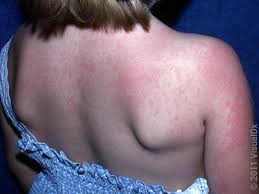
The distinctive skin change is usually a collection of small, closely spaced raised bumps that feels rough, rather like sandpaper. On lighter skin the rash may look pink or red. On brown or black skin, the colour change can be harder to see, so the bumps and texture are important observations. It often begins on the chest or abdomen and spreads, sometimes appearing 12–48 hours after the first symptoms. A white coating on the tongue can later clear, leaving a red, bumpy appearance often called strawberry tongue. These features support an assessment but are not a stand-alone home test. Not every person follows exactly the same visible sequence, and looking for a vivid red colour can miss subtler changes. As the rash fades, some skin peeling may occur. Tell the clinician about the timing and feel of the rash, rather than relying only on whether its colour matches an online image. 2
Before the rash is noticed, a child may have fever, throat pain, chills, headache, vomiting or abdominal pain. Those early symptoms can resemble other childhood illnesses. Scarlet fever can also be associated with an infected wound, so mention any sore or broken area of skin as well as throat symptoms. A clinician considers the history and examines the child, using throat testing when appropriate. The useful picture includes what appeared first, whether swallowing hurts, and how the child has been behaving. A stomach complaint does not by itself establish a different diagnosis, and a bumpy tongue does not establish scarlet fever by itself. Bring the sequence of symptoms to the assessment, including any medicines already started. This helps the clinician interpret findings that may have changed between the first fever and the visit. The aim is to assess the whole illness, rather than name a disease from a single feature. 10
Why symptoms may change after an earlier visit
A London community survey of families affected by scarlet fever found that the rash often appeared after other symptoms. Some parents reported an earlier assessment in which the illness had been described as viral. The practical lesson is to update the clinician when the illness changes, especially if a new rash develops after a visit for fever or throat pain. It does not mean that every early viral diagnosis was unreasonable or that a photograph should replace a second assessment. The study relied on recalled family experiences and had limited participation, so its findings cannot supply a universal rate of missed diagnoses. What matters for an individual family is the new information: when the rash began, whether the child is drinking, and whether their overall condition is improving or worsening. Give those changes clearly when seeking further advice rather than simply repeating the original diagnosis. 16
What causes scarlet fever, and how does it spread?
Group A strep is the name of a bacterium that can cause several different illnesses, including throat and skin infections. Scarlet fever describes its characteristic rash-associated illness. Invasive group A strep disease is a different clinical category: the organism is found in a part of the body that would normally be sterile, such as the blood. These terms should not be treated as interchangeable. Reading that group A strep can cause serious invasive disease does not mean every child with scarlet fever has that complication. Conversely, a familiar diagnosis should not obscure serious deterioration. Whether an infection is invasive is a question for clinical and laboratory assessment, not something a parent can determine from the shade or extent of a rash. 24
The bacteria spread through respiratory droplets and contact with infected secretions or skin sores. Close contact, shared drinks and unwashed utensils can create opportunities for spread. Some people can carry and pass on the bacteria without appearing ill, so it may be impossible to identify a single source of exposure. This is a reason for practical prevention, rather than blame within a household or classroom. Recent flu or chickenpox, wounds, a weakened immune system and some chronic illnesses can increase the risk of serious group A strep infection. Tell the treating clinician about these circumstances, but do not assume that exposure means a complication will occur. Risk factors guide the level of concern and assessment; they do not predict an individual outcome. Cups, plates and utensils do not need to be discarded after use: once properly washed, they can be used again. 8
The interval between exposure and symptoms is usually about two to five days. That range describes the usual incubation period; it cannot identify exactly when or from whom someone caught the infection. Untreated scarlet fever can remain infectious for two to three weeks, which is one reason a rash should not simply be watched without seeking advice. Antibiotics are prescribed to treat the infection, with a course commonly lasting ten days, although the actual medicine and duration come from the prescriber. Neither an exposure date nor the day the rash appeared should be used to invent a shorter course. 4
How scarlet fever is diagnosed
United States: testing for group A strep
Current CDC guidance uses a positive group A strep test to confirm scarlet fever. Options include a rapid antigen test, a nucleic acid amplification test (NAAT), and throat culture. Antigen tests can miss infections, so a negative result in a child or adolescent may need a backup culture. That follow-up is not routinely required in adults. A negative molecular test is not automatically handled like a negative antigen test. Testing in younger children depends on clinical suspicion and exposure. Ask which test was used and how any pending result will reach you. 1
United Kingdom: clinical assessment and selected swabs
UK guidance describes clinicians often recognizing scarlet fever from the characteristic illness, with a throat swab when confirmation is useful. A diagnosis without a swab therefore does not automatically indicate inadequate care. Local practice matters: clinical-diagnosis advice from the UK should not be used to disregard the US testing recommendation. In either setting, assessment must consider the person’s symptoms and possible alternative explanations. 4
A positive test requires interpretation in context. Some people carry group A strep without being ill; if they develop a viral sore throat, testing can still detect the bacteria. This is why the clinician combines the result with symptoms and examination instead of treating a laboratory finding as the whole diagnosis. It is not a reason to dismiss a positive result yourself or stop prescribed treatment. People who are asymptomatic carriers generally do not need antibiotics. Culture can identify infections that an antigen test misses, so clarify whether a negative rapid result is final or whether another result is expected. 7
Why an online sore-throat score is not a diagnosis
Clinical scoring systems can help clinicians estimate the likelihood of group A strep in someone with a sore throat. They do not confirm scarlet fever. The 2025 IDSA update notes that household exposure, a history of rheumatic fever or features suggesting scarlet fever can justify testing even when a score would otherwise suggest a low probability. Its scoring recommendation is conditional and based on very low-certainty evidence; it is not intended for children younger than three. A parent should therefore not use an online score to cancel an appointment or decide that a rash-associated illness needs no testing. Tell the clinician about a sibling with confirmed infection, relevant previous illness and the evolving rash. Those details can change the assessment without changing every item in a simple symptom checklist. The guideline addresses who should be considered for testing, rather than supplying a home treatment plan. 14
General sore-throat advice is not necessarily the right pathway once scarlet fever is suspected. Many sore throats do not need an antibiotic, but NICE guidance specifically calls for reassessment when symptoms worsen and another diagnosis, including scarlet fever, may explain them. Severe illness or complications such as a throat abscess can require hospital care. This distinction matters if someone was initially advised to use comfort measures or received a delayed prescription for an ordinary sore throat. A new rash or worsening condition should prompt updated advice rather than automatic reliance on the earlier plan. The relevant questions are what diagnosis is now suspected, whether testing is needed locally, and what treatment is appropriate for that person. Do not borrow a recommendation for uncomplicated throat pain and apply it to every illness that includes a sore throat. New clinical information deserves a fresh assessment. 13
Antibiotic treatment and safe medicine use
Penicillin or amoxicillin is the CDC’s first-choice treatment. Appropriate antibiotics shorten symptoms, reduce spread and help prevent some complications. Allergy history and individual circumstances affect the prescription; do not choose a substitute independently. 1
Take the antibiotic exactly as prescribed. Do not use another person’s supply, share yours, or keep leftover medicine to treat a later illness. Antibiotics do not treat viruses, so a previous prescription is not a general remedy for the next fever or rash. If you are unsure how to take the medicine, ask the prescriber or pharmacist rather than guessing. That includes missed doses, difficulty swallowing a preparation, vomiting after taking it, or concerns about other medicines. Mild nausea, diarrhoea or a rash can occur with antibiotics, while more serious reactions also need recognition. Report side effects so that a professional can decide whether treatment should continue or change. A new skin change during treatment is information to discuss, rather than sufficient evidence for a self-diagnosed allergy. Following the prescription and asking about problems are complementary parts of treatment; neither means ignoring an emergency reaction. 27
When a possible reaction needs help
For someone taking amoxicillin, sudden swelling of the mouth, tongue or throat, breathing difficulty, fainting, or a child becoming limp and unresponsive can indicate a severe allergic reaction. Get emergency help immediately; do not keep giving the medicine simply to complete the course. A rash may accompany this reaction, but it need not be present. Nausea and diarrhoea are different from those emergency features, although severe diarrhoea or stools containing blood or mucus require urgent medical advice. Some serious side effects can appear after treatment has ended, so mention recent antibiotic use when seeking care. Do not add an anti-diarrhoeal medicine independently without checking with a healthcare professional. Tell the service the name of the medicine, when it was taken and what changed. These cautions concern amoxicillin; the leaflet and professional advice for the actual prescribed product remain important if a different antibiotic is used. 28
Home care: fluids, comfort and observation
Make drinking and urination part of the daily check
Offer small, frequent drinks if a sore throat or nausea makes drinking difficult. Reduced or unusually dark urine, fewer wet nappies, a dry mouth, missing tears or sunken eyes can indicate dehydration. Seek urgent advice when intake is poor or these signs appear, especially with unusual drowsiness, persistent dizziness on standing, or fast breathing. Cold skin, abnormal colour, confusion, major breathing difficulty or difficulty waking can indicate shock and require emergency help. Do not delay assessment while trying repeatedly to give more fluid. A pharmacist can advise about suitable oral rehydration products when vomiting or diarrhoea is causing fluid loss. The useful observation is the pattern of drinking and urine output over time, alongside behaviour and alertness. Dark urine after a recent infection also has other possible explanations, including the kidney complication described below; it should not automatically be treated as a reason simply to drink more. 20
Treat discomfort, not just the thermometer reading
Fever medicine can help a distressed child feel more comfortable, but a falling temperature does not show whether the illness is serious. It also does not reliably prevent a febrile seizure. Offer fluids regularly and keep checking the child, including during the night. Notice whether they interact normally, can settle, drink and breathe comfortably, rather than using a temperature number as the only measure of recovery. Do not give paracetamol and ibuprofen simultaneously or establish a routine alternating schedule on your own. A clinician can advise when medicine is appropriate and what to do if distress persists. Fever care supports comfort while the underlying illness is assessed and treated; it is not a substitute for reassessment when the child becomes less responsive or otherwise worse. 18
Use a preparation suitable for the child and follow its label or the instructions from the prescriber. Measure liquid medicine with the supplied oral syringe, rather than a kitchen teaspoon. Different products and children can need different instructions, so an adult’s medicine or another child’s prescription is not an appropriate shortcut. Avoid ibuprofen in a child who is dehydrated or has chickenpox, and seek professional advice about suitability if the child has asthma. Children younger than sixteen should not receive aspirin unless a doctor has specifically prescribed it. That exception is important for certain specialist-managed illnesses, but it does not authorize home aspirin treatment for suspected scarlet fever. Keep medicines safely out of children’s reach and make sure every caregiver knows which product has actually been prescribed or recommended. If the label and a remembered instruction seem inconsistent, resolve that with the pharmacist before giving a guessed amount. 25
Check the active ingredients in all medicines being used. Some cold-and-flu products already contain paracetamol, so adding a second product can accidentally duplicate it. If the child has liver or kidney problems, or is taking other medicines, ask a pharmacist or clinician whether the product is suitable. Do not give paracetamol and ibuprofen at the same time. Alternate them only when a health professional has advised it, and record what was given and when. A written record is particularly helpful when more than one adult is caring for the child: check it before the next medicine is given, rather than relying on memory. Giving more than the packet, leaflet or prescription allows needs urgent advice, even when an error seems small. Do not wait for symptoms to establish whether an extra dose matters. Use the child’s actual instructions instead of copying a schedule found online. 26
Recovery and when to be checked again
After treatment begins, the child’s general symptoms can improve before the rash completely clears. Skin recovery has its own pace, so continuing colour changes or peeling alone do not prove that the antibiotic has failed. Look at the overall direction: greater comfort, improving activity and easier drinking are more informative than comparing successive rash photographs. Complete the prescribed course unless the treating clinician changes it, even when the child seems much better. If improvement is not occurring, or you are concerned about the course of illness, contact the pediatrician or treating service. Other people at home who develop fever or throat pain should also be assessed, even if they do not develop a rash. A shared exposure can produce different symptoms, and waiting for everyone to look identical can delay useful advice. 11
Contact the treating clinician if there is no improvement after 48 hours of antibiotics. This is a review point for someone who remains stable, not permission to wait through deterioration. Seek help earlier if the illness worsens or a concerning new symptom appears. Explain when treatment began and what has failed to improve, rather than requesting a different antibiotic based only on the lingering rash. 7
Returning to school, nursery or work
| Guidance | Return conditions |
|---|---|
| United States (CDC) | Fever-free and at least 12–24 hours after appropriate antibiotics begin. The child should be well appearing; follow the applicable local rule. 1 |
| United Kingdom (UKHSA) | Stay away for at least 24 hours after antibiotics start. Continue recovery at home if still too unwell to attend. 6 |
Count the required time from starting antibiotic treatment, not from when the prescription was collected or the rash appeared. For example, beginning treatment late in the evening does not complete a twenty-four-hour exclusion period by the following morning. Ask the setting about its return arrangements and follow any additional public-health instructions. Under UK guidance, a sibling or household contact who has no symptoms can attend as usual. If that person becomes unwell, seek medical advice rather than assuming the same permission still applies. Where antibiotics have not been started, obtain individual advice; do not invent a short return interval based on the rash looking better. 6
Protecting other people without unnecessary treatment
Wash hands regularly, cover coughs and sneezes, and avoid sharing cups, utensils or bites of food while someone is ill. Clean items after use and keep cuts and other wounds clean and covered. These are proportionate ways to reduce opportunities for the bacteria to spread. Close contacts generally do not need preventive antibiotics after an ordinary group A strep infection. There are exceptions involving certain serious infections or a history of rheumatic fever, so a clinician may give a particular household different advice. Do not start a sibling on leftover antibiotics as a precaution. Previous group A strep infection does not prevent another infection, which is why familiar symptoms still deserve attention. Prevention is a combination of sensible hygiene, assessment of new illness and following the prescribed treatment. It should not become an attempt to medicate everyone who has been near the patient. 9
When cases are linked at a school or nursery
UKHSA’s September 2026 guidance asks settings to seek health-protection advice after an overnight admission or death because of scarlet fever or invasive group A strep; concurrent, linked scarlet-fever and chickenpox or flu cases; or an outbreak continuing beyond three weeks with rising cases despite controls. Follow the local team’s instructions. 6
An outbreak needs coordinated decisions rather than separate families organizing tests or preventive treatment. UKHSA guidance does not recommend routine mass throat swabbing during an ordinary scarlet-fever outbreak. Selected early cases may be cultured to help establish what is circulating. Likewise, blanket preventive antibiotics for contacts of non-invasive group A strep are not the default. A public-health team can consider exceptional measures when the circumstances warrant them. Suspected invasive disease follows a different contact-management pathway, so advice given after a serious case should not be generalized to every classroom exposure. Tell the setting about a diagnosis through its usual reporting route and follow the instructions it receives from health protection. If a child develops symptoms, their own clinical assessment remains important even while the wider outbreak is being managed. A class notification identifies a reason for awareness; it is not a prescription for each recipient. 5
Research helps explain why an outbreak may continue even when visibly ill children stay home. A prospective study in six London educational settings used repeated sampling and genetic comparison of bacteria. Investigators found outbreak strains in some classmates without symptoms and in classroom air samples. Those observations show why visible illness and surface contamination do not capture the entire transmission picture. They do not prove that every child carrying the bacteria will become ill or that every exposure leads to infection. The study involved selected outbreaks and did not test a particular ventilation programme or preventive-antibiotic strategy. It therefore supports thoughtful, coordinated outbreak management rather than a home rule that every classmate needs a swab. Practical measures should come from the responsible public-health service, taking account of the setting and the pattern of cases. 15
Complications during and after the infection
Acute rheumatic fever
Acute rheumatic fever is an immune-related complication that can appear about one to five weeks after a group A strep infection. It can affect the joints and heart, and sometimes causes abnormal involuntary movements. New painful joints, returning fever, chest discomfort, a rapid heartbeat or breathlessness after recovery deserve medical assessment. Mention the recent throat infection or scarlet fever rather than assuming the two illnesses must be unrelated. Appropriate diagnosis and treatment of the original infection help prevent rheumatic fever, but no article can guarantee zero risk for an individual. Heart-valve damage is a possible consequence of established disease, which is one reason new symptoms should not be ignored. Someone who has already had rheumatic fever may need a separate, longer-term prevention plan supervised by a clinician. That plan is different from the short course used to treat the current infection and should not be started or changed without professional advice. 21
Post-streptococcal kidney inflammation
Post-streptococcal glomerulonephritis is kidney inflammation caused by an immune response after infection, rather than bacteria directly invading the kidneys. It can arise after the original throat or skin illness has improved. Dark reddish-brown urine, passing less urine, or swelling around the eyes, face, hands or feet should prompt medical advice. Do not assume dark urine always means dehydration or try to manage swelling by changing fluid intake yourself. CDC guidance says the evidence is insufficient to establish that antibiotics prevent this complication. Treating scarlet fever remains important, but preventing every later kidney problem should not be promised as a benefit. If kidney inflammation develops, clinicians assess its effects and manage treatment; antibiotics may be used to clear remaining group A strep and reduce spread. Most affected children recover, while adults have a greater risk of lasting kidney impairment. The person’s recent infection history is therefore useful even after the rash has disappeared. 22
Other conditions can look similar
Kawasaki disease is an inflammatory illness affecting blood vessels that can also cause a rash and a red, bumpy tongue. Persistent fever, bloodshot eyes, cracked lips, irritability, and changes in the hands or feet are reasons for urgent clinical reassessment, particularly in a young child. Fever lasting five days or longer is an important warning pattern, but do not wait for that milestone if the child is already very unwell. There is no single definitive test for Kawasaki disease, and delays in treatment can lead to heart complications. The overlap in appearance is why a tongue change or skin photograph cannot safely distinguish every illness at home. Tell the clinician how long the fever has lasted and about any new eye, mouth or limb changes. Assessment may need to reconsider the initial explanation rather than merely extending an antibiotic because the rash remains visible. 23
Adults and pregnancy
Adults can get scarlet fever too. Do not dismiss a new sore throat and rash solely because the illness is commonly associated with children. In pregnancy, UKHSA reports no evidence that scarlet fever itself harms the baby, but symptoms still require prompt medical advice. That reassurance applies to scarlet fever, not to every undiagnosed fever-and-rash illness. Tell the clinician that you are pregnant so that assessment and medicine choices take this into account. The useful next step is to establish what is causing the illness and how it should be treated, rather than assuming either that all rashes are dangerous or that this one is harmless without an assessment. 3
Questions to take to the appointment
Ask which diagnosis is most likely, whether a test is needed, how results will be communicated, what to do if medicine cannot be taken, and which local return rule applies. Write down the answers and the contact route for further advice.
The NBC4 Columbus video below is retained as historical context. It is not a clinical source for this guide; use the current guidance and references for care decisions.





