
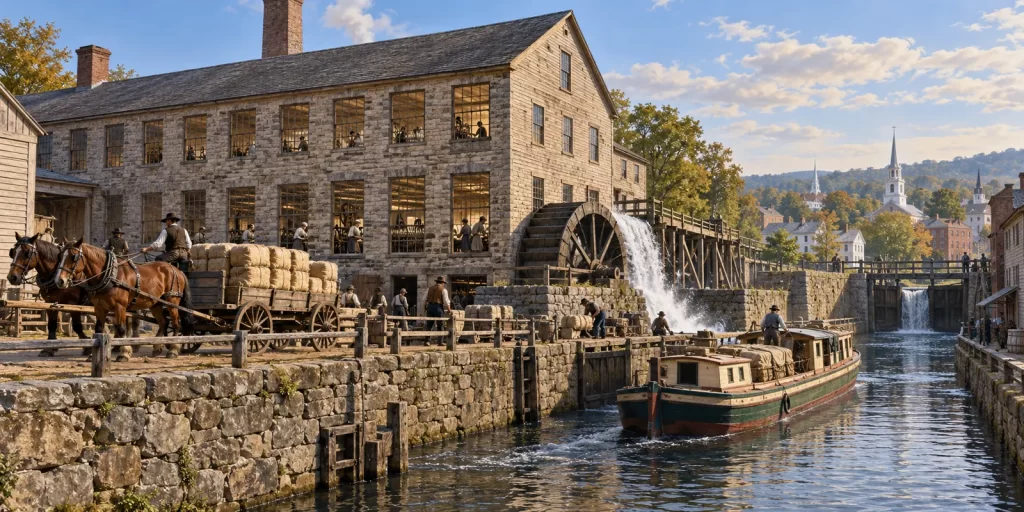
The market revolution did not arrive as a single invention or a sudden switch from farms to factories. Between roughly 1800 and 1848, American producers, merchants, governments, and workers built tighter connections among farms, mills, towns, and distant buyers. Understanding those connections makes AP U.S. History Topic 4.5 much easier than memorizing a list of machines.
What was the market revolution?
Historians use market revolution to describe the expansion of exchange across a growing United States in the early nineteenth century. More households produced for buyers they did not know, purchased goods made elsewhere, and relied on prices, credit, transportation, and commercial networks. A family might still grow food for itself, barter with neighbors, and make some clothing at home. The change was not universal or instantaneous. The important shift was that the market increasingly shaped decisions that had once been largely local or household-based.
Suppose a western New York farmer grows wheat. If the only practical buyers live nearby, the crop’s possible price is constrained by a small local market and the cost of carrying grain over rough roads. A reliable water route to the Hudson River can make a distant city an attainable buyer. The farmer may plant more wheat, buy a manufactured plow, borrow money for land, and depend on a merchant to get the crop to market. One transportation improvement can therefore change production, consumption, labor, and risk at once.
Industrialization is one part of that larger story. Factories brought machines, workers, capital, power, and materials together in an organized workplace. But the market revolution also included commercial farming, shipping, banking, retailing, and communications. The Smithsonian’s National Museum of American History describes how factories, mass production, expanded farms, cheap transportation, government policy, and slave-grown cotton interacted. Calling the era simply a “factory revolution” misses the commercial web that made factories viable.
The dates are best understood as an AP course frame, not hard boundaries. College Board places Topic 4.5 within Period 4, 1800–1848, and asks students to explain causes and effects of innovations in technology, agriculture, and commerce. Developments began before 1800 and continued after 1848. To learn the topic, track processes across time rather than expecting every change to begin and end in the same year. The broader AP U.S. History study overview can help place the topic in the course’s chronology.
A useful causal model: production, connection, and demand
A strong explanation starts with three questions: What could people make, how could it travel, and who could buy it? Productivity alone is not enough. A mill that turns out more cloth needs raw cotton, workers, power, a buyer, and a way to deliver finished bolts. A canal without farm surpluses or manufactured goods has little traffic. Growth came from feedback among these pieces, not from a machine acting by itself.
| Change | Immediate effect | Wider consequence |
|---|---|---|
| Mechanized spinning and weaving | More cloth could be made in a coordinated factory process | Greater demand for cotton, mill labor, capital, and customers |
| Canals and improved roads | Bulk goods could reach farther markets more dependably | More regional specialization and commercial farming |
| Steamboats, railroads, and telegraphy | Movement or information became less tied to old geographic limits | Merchants could coordinate wider networks and respond faster |
| Credit and investment | Entrepreneurs could fund land, equipment, and infrastructure | Expansion became possible, but debt and downturns carried wider risks |
Consider a textile chain. Enslaved people grow and harvest cotton in the South. Merchants ship it to New England. Investors finance a water-powered mill; workers spin and weave it into cloth. Wholesalers distribute the finished product to stores and households. The chain can raise output and lower the price of some textiles while simultaneously increasing the value of slave-grown cotton. The same process has different meanings depending on whether one is an investor, wage worker, small artisan, farmer, or enslaved person.
This is why students should avoid one-way explanations such as “the cotton gin caused factories” or “the Erie Canal caused industrialization.” The gin made processing certain cotton varieties easier, but expanding plantations also required land, coerced labor, credit, and demand. Canals enlarged trade, but trade justified further canal investment. In an AP response, state the direction of a particular relationship and then show how another factor reinforced it.
Textile mills and the organization of work
Textiles offer a concrete way to see early industrialization. Before large integrated mills, spinning and weaving could be divided among households or smaller workshops. Mechanized mills centralized equipment and work schedules, and waterpower limited the location of many early establishments. The Library of Congress describes a long transition from hand production in homes to machine-aided production in factories; it was not a moment when every independent craft disappeared.
The National Park Service traces an integrated cotton textile mill at Waltham, Massachusetts, to 1814. Investors then developed Lowell, where a network of canals, mills, housing, and other facilities made a planned industrial city. Lowell was a model of converging power generation, engineering, finance, architecture, and labor organization—not the birthplace of every American industrial innovation. That distinction matters because “first” claims can obscure experiments elsewhere and earlier.
For many young New England women, mill wages offered cash income outside the family farm and a different social environment. Work also meant regulated hours, supervision, noise, and dependence on company decisions. National Park Service accounts of Lowell’s early strikes show that women resisted wage cuts and organized petitions. A factory could create an opportunity relative to some alternatives while still imposing demanding conditions. Do not flatten the workers into either wholly empowered beneficiaries or passive victims.
The change from an artisan’s workshop to a mill can be described as a change in control. In a workshop, a skilled maker might choose the pace and sequence of many tasks. A factory divided work into repeatable operations, combined many workers under management, and tied production to machines and schedules. Some workers gained access to paid employment; others lost bargaining power or faced competition from lower-cost goods. These outcomes varied by occupation, place, sex, age, and time.
Mechanization also created new technical and managerial work. Mills needed repairs, water-management systems, bookkeeping, freight arrangements, and supplies. The growth of a factory therefore pulled on occupations beyond the loom. When explaining an innovation’s effect, ask what supporting activities became more important because the new method had to operate every day, not merely once in an inventor’s demonstration.
Beyond textiles: clocks, parts, tools, and steam
Textile machinery was prominent but not the entire industrial economy. The Smithsonian highlights clockmakers such as Eli Terry and associates, who used waterpower and interchangeable components to produce more standardized, lower-cost clocks. “Interchangeable parts” is often presented as though every early item became perfectly identical. In reality, standardization developed unevenly and required measurement, tools, skilled workers, and quality control. Its historical importance lies in the attempt to make assembly and repair more systematic.
Steam power widened possibilities. A water-powered factory depended on a suitable site and stream. Steam engines could power machinery or transport, although fuel, cost, maintenance, and engineering limited use. Steamboats were especially important on rivers because they could move against currents more effectively than craft dependent on current or human and animal power. Early railroads later offered another means of moving people and goods where water routes were absent. None instantly replaced older roads, canals, horses, and boats.
The telegraph belongs in the same analytical frame even though it did not haul a bale of cotton. Rapid messages let merchants and transport operators learn about prices, orders, and arrivals across distances. Information can reduce uncertainty and help coordinate exchange. The Library of Congress uses the first telegraphic message of 1844 among its primary-source materials for the wider industrial transformation. The change is not that everyone suddenly had instant communication; it is that a new infrastructure began altering what coordination could look like.
Inventions alone did not determine which businesses succeeded. A useful device had to be manufactured, financed, distributed, and adopted. Patent protection could reward inventors, but access to capital and markets mattered too. A historian should ask whether an innovation lowered a cost, solved a bottleneck, or changed the scale of production, and then identify who paid the new costs. This turns a list of names and devices into an explanation of economic change.
Transportation made distant markets practical
Distance in this era was partly a question of travel time and expense. A town might be geographically close to a farm but difficult to reach with heavy freight over muddy roads. Better turnpikes, canals, steamboats, and then railroads changed the effective size of a market. They did not make geography irrelevant; waterways, grades, seasonal weather, and tolls still shaped routes. The underlying concept of transportation as the movement of people and goods helps explain why economic maps follow networks rather than straight lines.
The Erie Canal is a useful worked example. New York State authorized construction in 1817, and the canal opened in 1825, connecting the Hudson River system to Lake Erie through a 363-mile route. A farmer near the Great Lakes could send bulky produce east toward Albany and New York City more cheaply than over many overland routes. Manufactured goods could move in the opposite direction. The canal helped New York’s commercial growth and encouraged settlement and other canal projects. Its importance was not merely that a boat could travel farther, but that the cost of exchange changed decisions about what and where to produce.
Roads still mattered. A canal boat could not collect grain from every individual farm. Wagons had to carry goods to a landing, while roads linked markets to places away from navigable water. Railroads began to supplement rather than immediately erase canals. Their routes could reach different terrain and did not require a continuous waterway, but early networks were limited. Students should resist describing 1830 as if it already had the mature nationwide rail system of the late nineteenth century.
Transportation investment also had political and human consequences. Government legislation and courts helped shape rights-of-way, charters, and internal improvements. The National Park Service notes that new roads, rivers, and rails were also used during the forced removal of Cherokees. A faster network could deliver consumer goods and carry people into coerced displacement. The word “progress” hides the question of progress for whom. A historically responsible paragraph can recognize expanded exchange while naming the policies and people harmed by expansion.
Regional specialization and the cotton connection
As markets widened, regions could specialize more heavily. Northern mills manufactured textiles; parts of the Midwest supplied grain and other farm products; Southern plantations expanded cotton cultivation. These are broad patterns, not a claim that each region performed only one activity. A Northern household might farm, a Southern town might manufacture, and a western community might lack a dependable route to any major buyer. Economic geography is more complicated than three colored blocks on a map.
College Board’s Topic 4.5 framework specifically links increasing Southern cotton production with Northern manufacturing, banking, shipping, and wider commercial ties. Cotton was not simply an input purchased at a neutral price. It was grown through forced labor on plantations whose expansion involved violence, dispossession, credit, and political protection. National Park Service interpretation of Lowell documents the direct reliance of many mills on enslaved labor for raw material; some firms also made cloth sold to enslavers. Describing Northern industrial growth without this connection produces an inaccurate moral and economic picture.
The cotton gin made separating seeds from short-staple cotton more efficient, but that technical gain did not make slavery fade away. By helping make more cotton commercially viable, it was part of an expanding cotton economy that increased demands on enslaved workers and encouraged plantation expansion. The outcome depended on markets and institutions, not on the machine alone. If an exam prompt asks about effects, distinguish higher processing capacity from the coercive system that supplied the crop.
Regional interdependence could create both cooperation and conflict. Merchants, planters, mill owners, bankers, and shippers had reasons to maintain commercial ties. At the same time, arguments over slavery’s expansion, tariffs, and the role of federal power sharpened. One later chapter in those tensions is the Compromise of 1850 and its contested settlement. Do not jump from 1825 directly to Civil War as though every actor saw that future, but do recognize that economic growth did not dissolve political contradictions.
Farms, households, and a changing consumer culture
The market revolution changed rural life as well as city factories. Some farmers produced more for sale because a viable route and buyer made surplus worthwhile. This might let a household purchase cloth, tools, or household items instead of producing every item at home. Yet market participation also exposed a family to changing prices, debt, and transportation disruptions. The farmer with a larger wheat crop could earn more in a good year and suffer more when a price fell or a harvest failed.
Household work did not vanish. Cooking, care, cleaning, mending, and small-scale production remained essential, much of it unpaid and commonly performed by women. When a textbook says production shifted out of the home, read it as a pattern in certain goods and places, not an erasure of domestic labor. Some women entered mills or did piecework, while others stayed on farms and managed household economies that depended increasingly on purchased goods.
Greater availability of manufactured goods altered consumption. Clocks, textiles, tools, and other items could be offered through expanding stores and commercial routes. A purchase carried an economic history of materials, labor, transport, and credit. Consumers might gain convenience or lower costs, but not all could afford the same goods, and the price did not reveal the full human cost of production. An artifact in a museum can become evidence of a supply chain rather than merely proof that people liked new products.
It is tempting to call this a shift from self-sufficiency to total dependence. That goes too far. Households combined home production, wage income, exchange, and market buying in different proportions. The useful historical question is which decisions became more dependent on distant conditions. A farmer who buys mill cloth and sells wheat to New York is more exposed to transport and prices than a household selling only to neighbors, even if both still grow vegetables and mend clothes.
Workers, reform, and the uneven distribution of gains
A larger market could offer new paid work, yet the terms of that work were contested. Lowell’s women workers offer evidence. The National Park Service records an 1834 wage reduction and a collective response by workers. Their efforts did not immediately secure lasting victories, but organization, petitions, and strikes revealed that workers challenged management rather than simply accepting factory rules. Later labor reform grew out of such experiences.
Artisans could face competition from standardized goods. Small producers might adapt by specializing, adopting tools, or finding new customers; others lost work or control over the labor process. Entrepreneurs and investors could profit from greater scale, but some failed when sales slowed or debts became unmanageable. “Industrialization benefited everyone” is therefore unsupportable. A better question is who captured a particular productivity gain and who bore its risk.
Race and legal status shaped those answers profoundly. An enslaved person did not bargain over the sale of cotton or receive a wage from it. Indigenous communities faced removal and territorial pressure as settlers and governments opened lands to commercial agriculture and transport corridors. Immigrants and free workers entered labor markets with different options and constraints. To connect the market revolution to social history, identify a group, a specific new condition, and the mechanism linking them.
Nor should every outcome be described as an inevitable consequence of machinery. Wages, hours, education, land rules, transport routes, and slavery were shaped by law, public policy, employer choices, and collective action. Technologies create possibilities; institutions distribute power. That distinction is useful well beyond Topic 4.5 and keeps an AP argument from becoming a celebration or condemnation of machines in the abstract.
What government did—and what it did not do
“Private enterprise” did not mean government was absent. States chartered corporations, authorized canals, and made legal decisions affecting commerce. Governments also funded, regulated, or debated roads and other internal improvements. Patent rules protected certain inventions. Tariff policy could favor some domestic producers while raising objections from others. College Board includes legislation and judicial systems among the forces enlarging markets and shaping regional interdependence.
The Erie Canal demonstrates public choice in practice: New York’s legislature authorized a major state project rather than waiting for each farmer or merchant to build a private water route. Public investment did not guarantee equal access or uniformly positive effects, but it changed the cost structure that private participants faced. The government’s role can be analyzed as enabling a network, allocating risk, and favoring some routes and places over others.
Arguments over federal internal improvements and protective tariffs reflected different ideas about constitutional power, regional benefit, and who should pay. Students do not need to assume a single national policy made the market revolution happen. Instead, give a specific example of a law or project and explain its effect. A canal authorization, patent protection, or court-backed corporation is more convincing evidence than the vague statement that “the government supported business.”
Government also enforced slavery and helped dispossess Indigenous peoples during this era. These policies were not peripheral to economic expansion. Land, labor, and transport networks are not natural resources that markets simply discovered; rights to control them were contested and enforced. Including this fact makes an economic explanation more accurate rather than changing the subject to a different historical theme.
Worked examples for AP U.S. History
Example 1: explain a cause and an effect
Prompt: Explain one way transportation innovations contributed to economic change between 1800 and 1848. A strong response might argue that the Erie Canal connected Great Lakes communities with Atlantic markets through New York. Because bulk freight could travel on a continuous water route, some western farmers had greater incentive to grow crops for distant sale. The answer uses the canal as evidence, states a mechanism—more feasible shipment—and identifies an effect—greater market-oriented production. It does not need to claim every farmer prospered.
Example 2: compare two perspectives
Prompt: Compare how industrial growth affected a mill investor and a mill worker. An investor could benefit from increased output and broader cloth sales, while a worker gained wages but faced disciplined hours and possible wage reductions. Lowell’s 1834 labor protest supports the worker side. To deepen the response, show the relationship: investors’ response to weak sales could include wage cuts, transferring market pressure to employees. A comparison becomes analysis when it explains why perspectives diverged.
Example 3: connect regions without erasing coercion
Prompt: Explain one economic connection between the North and South. Northern textile mills purchased Southern cotton, while Northern banks and shippers participated in related commerce. Cotton production depended on enslaved labor. That single example shows regional interdependence and its unequal human foundation. Avoid saying the North and South had wholly separate economies, or that every Northerner opposed slavery despite commercial dependence on it.
Common misconceptions to correct
- “The market revolution means farming ended.” Farming remained central; some farms became more commercial and specialized.
- “Industrialization occurred everywhere at the same pace.” Waterpower, capital, transport access, labor systems, and demand varied across places.
- “A single inventor caused the transformation.” A useful invention mattered because finance, labor, raw materials, and distribution supported adoption.
- “Cheap cloth was simply a benefit.” Buyers might pay less while mill workers faced difficult conditions and enslaved people produced much of the cotton.
- “Canals and railroads replaced all older routes.” Farms still needed local roads, and waterways and newer rail lines overlapped for decades.
- “Northern industry and Southern slavery were separate.” Textile manufacturing, credit, shipping, and cotton production formed connected markets.
A useful comparison is with later industrialization elsewhere. The AP World History guide to industrialization’s beginnings can help distinguish Britain’s earlier mechanization from the particular U.S. mix of canals, expanding settlement, federal and state policy, and slave-grown cotton. Comparison should reveal context, not turn two histories into identical timelines.
How to study the topic without memorizing disconnected facts
Build one chain from raw material to buyer. For cloth, write: cotton production → merchant and shipper → water-powered mill → wage labor and machinery → merchant → household. Under each arrow, add a question. Who controlled land? Who paid for transport? Who earned wages, and who was coerced? What happened when demand fell? This method turns a list of terms into a network of causes and consequences.
Then draw a second chain for grain: western farm → local road → canal or river → eastern city → cash or credit → manufactured purchases. Compare it with the cloth chain. One emphasizes commercial agriculture and transportation; the other foregrounds factory organization and slavery. Both show widening markets. The comparison also prevents the misconception that industrialization was the only engine of change.
Use a small evidence bank rather than thirty unsorted dates. Waltham’s integrated mill in 1814 illustrates organization of production. The Erie Canal opening in 1825 illustrates transport and regional exchange. Lowell’s 1834 labor protest illustrates worker response. The telegraph’s emergence in the 1840s illustrates communication. The dates give examples, not a claim that each process began on that day. Always connect an example to a causal statement.
For a short-answer response, identify exactly what the question asks—cause, effect, comparison, or continuity—and answer in a few precise sentences. For a longer essay, group evidence by mechanism rather than listing inventions in chronological order. A defensible thesis might say that new production and transportation networks widened markets and opportunities while strengthening coercive cotton labor and creating new workplace conflicts. Each body paragraph can then develop one dimension and address complexity with a specific counterpoint.
The larger takeaway
The market revolution changed the scale and organization of American economic life. New machinery increased some kinds of output; transport and communication linked producers and consumers; public policy and private capital built networks; households faced new choices and new dependencies. The gains were real but not evenly shared. Mill wages, cheaper goods, and wider markets coexisted with labor conflict, Indigenous displacement, and slavery’s expansion.
Remember the relationship rather than a slogan: production needs inputs and buyers; transport changes which buyers can be reached; institutions and power determine who benefits. That framework explains Topic 4.5 more accurately than either a triumphant story of inventions or a list of harms without economic mechanisms.
Sources and further reading
- College Board, AP U.S. History Course and Exam Description, Topic 4.5
- Smithsonian National Museum of American History, “A Market Revolution”
- Library of Congress, “The Industrial Revolution in the United States”
- National Park Service, Boott Cotton Mills of Lowell
- National Park Service, “Southern Ties & Northern Gospels”
- National Park Service, Lowell labor reform and early strikes
- New York State Canal Corporation, Erie Canal history
- National Park Service, transportation during Cherokee removal