
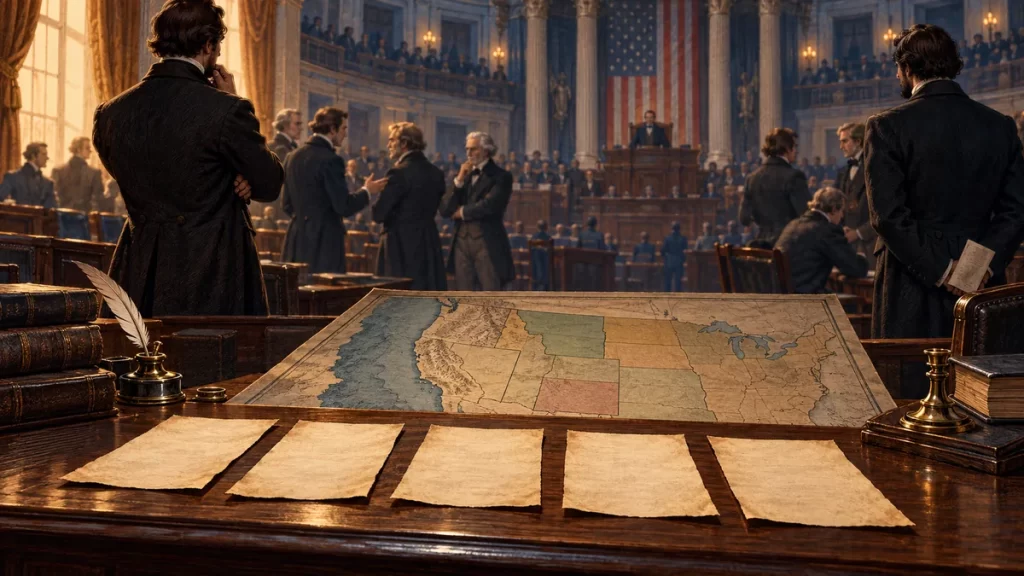
What was the Compromise of 1850?
The Compromise of 1850 was not one law and it did not settle the question of slavery. It was a set of five federal statutes enacted in September 1850 after months of argument about lands acquired from Mexico, California’s proposed statehood, the border claimed by Texas, the status of slavery in the national capital, and the pursuit of people who escaped enslavement. The laws temporarily eased an immediate congressional crisis. They also strengthened federal enforcement of slavery and left the central conflict unresolved. A useful historical explanation must hold those facts together rather than calling the package either a complete peace or a simple victory for one section.
The five laws admitted California as a free state; organized Utah Territory; settled Texas’s boundary claim while organizing New Mexico Territory; prohibited the slave trade, but not slavery itself, in Washington, D.C.; and enacted a harsher Fugitive Slave Act. This is the grouping in the National Archives’ statute collection. Some summaries list six provisions by separating the Texas settlement from the New Mexico territorial government, but the National Archives presents those two matters in one statute. That counting difference should not obscure what the enacted laws actually did.
For a student, the guiding question is: how did a rapidly expanding United States attempt to decide whether slavery would expand, and who had the power to make that decision? The answer involves state admission, territorial government, federal enforcement, and the lives of enslaved and free Black people. It also involves different time scales. In 1850 a coalition could pass legislation; in the years that followed, the laws provoked resistance and renewed political conflict. The Compromise is a turning point precisely because short-term legislative success coexisted with profound long-term failure.
Why the crisis arose before 1850
The United States had argued over slavery’s expansion for decades. The Missouri Compromise of 1820 admitted Missouri as a slave state and Maine as a free state while drawing a line for slavery in much of the Louisiana Purchase territory. That arrangement did not answer what should happen to territories later acquired from Mexico. Nor did it resolve the moral and constitutional conflict over treating people as property. It is tempting to imagine an orderly map on which each new boundary solves the last dispute. In practice, each addition of land reopened disagreements about representation, federal authority, and slavery.
The Mexican-American War and the 1848 Treaty of Guadalupe Hidalgo brought a large area of the Southwest under U.S. control. Congress then faced a question that could not be postponed indefinitely: would slavery be permitted in the new territories? The proposed Wilmot Proviso, which sought to bar slavery from territory acquired from Mexico, never became law, but it exposed how sharply lawmakers disagreed. Some antislavery politicians opposed expansion without necessarily advocating immediate abolition in states where slavery already existed. Proslavery politicians sought federal protection for slaveholders’ claims. Those positions cannot be reduced to a single North-versus-South vote, although sectional alignments were increasingly important.
California added urgency. Gold discoveries accelerated migration and the territory sought admission as a free state without first passing through the usual long territorial stage. Admitting it would change the Senate balance between states that allowed slavery and those that did not. Texas, already a state, claimed a western boundary that overlapped land to be administered as New Mexico; it also faced substantial debt from its earlier period as an independent republic. The national capital made the slave trade visible near Congress itself. Meanwhile, slaveholders complained that northern communities and state laws hindered the capture of people escaping bondage. These distinct issues were politically linked because each faction wanted gains in exchange for concessions.
To understand why the compromise was so difficult, distinguish territory from statehood. Congress could establish a territorial government, but the ultimate status of a future state remained contested. A law that omitted an immediate ban on slavery did not necessarily create widespread slavery there; nor did it permanently exclude it. California, by contrast, entered as a state with slavery prohibited. This difference between a present decision and an unresolved future one allowed some legislators to support a package without agreeing on its long-term meaning. It was also a recipe for later disputes.
For broader chronological context, Sly Academy’s Market Revolution overview examines the economic transformations of the earlier nineteenth century. Those changes did not cause the 1850 laws on their own, but westward migration, commercial growth, and the politics of labor shaped the setting in which the territorial crisis unfolded. A student should connect broad economic context to a specific statute only with a clear causal explanation, not merely place two events in the same century.
From Henry Clay’s plan to five enacted laws
Senator Henry Clay of Kentucky introduced resolutions in January 1850 intended to combine concessions on several disputes. Clay is often called the “Great Compromiser,” but that nickname can conceal the hard bargaining and the people whose freedom was at stake. His original omnibus approach did not pass. The U.S. Senate’s account of Clay’s final compromise explains that Stephen A. Douglas of Illinois divided the package into separate bills and assembled different majorities for them. The enacted compromise was therefore not simply Clay’s handwritten proposal turned into law.
The debates involved prominent senators with sharply different priorities. Daniel Webster of Massachusetts urged preservation of the Union and accepted a stronger fugitive law, a stance that alienated many antislavery constituents. John C. Calhoun of South Carolina argued that southern interests were endangered and that northern concessions were required, although he was too ill to deliver his final speech himself. William H. Seward of New York resisted sacrificing antislavery principles for a legislative truce. These figures matter not as a cast of heroes and villains to memorize, but as evidence that “compromise” meant very different things to participants.
President Zachary Taylor died in July 1850, and Vice President Millard Fillmore succeeded him. Fillmore supported the compromise measures. Still, it is too simple to attribute the outcome to one death or one leader. The legislative route changed because a broad omnibus could not command a majority, whereas separate bills could attract shifting coalitions. One senator might vote to admit California while another supported the fugitive measure; a third might approve a territorial arrangement for reasons unrelated to either. This explains how five disputed statutes could pass even though there was no stable consensus on slavery’s expansion.
The chronology is worth keeping straight. Clay introduced his resolutions in January; Congress debated through spring and summer; the omnibus failed; Douglas and allies advanced separate measures; the laws were enacted in September. The Library of Congress primary-source guide provides a route from the familiar label “Compromise of 1850” back to the actual laws and contemporary documents. When reading a primary source, ask whether it is an unpassed proposal, a speech arguing for a proposal, or the final enacted text. Treating those as interchangeable creates avoidable factual errors.
Law one: California entered as a free state
California’s admission meant that slavery was prohibited under its state constitution. In the immediate Senate arithmetic, it also added two senators from a free state. That was politically important because sectional power in the Senate had been closely watched for years. Yet “free state” did not mean racial equality or secure freedom for every Black resident. California’s later history included discriminatory laws and contested freedom claims. The National Park Service’s study of freedom in the West shows why legal state status and lived experience must be analyzed separately.
California also illustrates the pressure of rapid demographic change. Gold Rush migration made statehood an immediate practical question: who would govern, under what constitution, and with what representation? The compromise allowed state admission without first resolving the status of the remaining Mexican Cession. Thus one area received a definite answer while other regions remained open to dispute. Students sometimes memorize “California free” as the whole northern gain. It was a significant provision, but a complete explanation must place it alongside the territorial and fugitive laws that accompanied it.
Law two: Utah received a territorial government
Congress organized Utah as a territory rather than admitting it as a state. Its organic law did not impose a blanket congressional exclusion of slavery. The statute contemplated that a future state could be admitted with or without slavery according to its constitution at the time of admission. This arrangement is often described through “popular sovereignty,” the idea that local settlers would determine the issue, but the exact legal path was disputed and affected by congressional authority, courts, and political power. It should not be described as a clean popular vote in 1850 that immediately decided slavery’s status forever.
This provision mattered because it postponed rather than solved a contested decision. Advocates could present postponement as a way to avoid national deadlock; opponents could see it as leaving the door open to slavery’s spread. Geography and climate were sometimes invoked to predict that plantation slavery would be unlikely in parts of the Southwest, but prediction is not the same as a legal prohibition. A historian should separate what lawmakers claimed would happen from what the statute actually guaranteed. The Utah law supplied a government and an ambiguous future, not a final answer to the moral question.
Law three: Texas’s boundary and New Mexico’s government
Texas agreed to a defined boundary and relinquished claims to territory to its west. In exchange, the federal government arranged a payment of ten million dollars under the enacted terms, tied in part to Texas’s debts. The same statute organized the Territory of New Mexico. This is why a list of “five laws” can include several distinct policy results within one item. The boundary dispute was not a minor cartographic detail: overlapping claims created the possibility of confrontation over who would administer the land and whether Texas’s legal regime would extend into it.
The New Mexico territorial government, like Utah’s, left the question of slavery unresolved for future state admission rather than imposing a straightforward federal ban in 1850. The statutory language is more valuable than a slogan: it stated that a future state could enter with or without slavery as its constitution might prescribe. However, that did not settle every legal and political dispute that could arise before statehood. The compromise removed one immediate Texas-New Mexico flashpoint, but it did not produce a durable national rule for all western territories.
Students should be wary of maps that label New Mexico simply “slave” or “free” after 1850. A map can be useful for visualizing borders, yet it can also flatten an unsettled legal situation. Ask what the colors represent: an existing state’s constitution, a territorial statute, a proposed restriction, or a later outcome? The distinction between a settled boundary and an unsettled slavery question is central to understanding this law. Texas received financial and boundary terms; New Mexico received a territorial government; neither result ended the wider conflict.
Law four: the slave trade ended in Washington, D.C.
Congress prohibited the buying and selling of enslaved people in the District of Columbia under the specific trade provisions of the 1850 act. It did not abolish slavery in the District. This distinction is one of the most frequently tested and most frequently misstated features of the compromise. The national capital could no longer serve in the same way as a market for the slave trade, but people remained enslaved there. Full emancipation in the District came only in 1862, during the Civil War.
Why did a restriction on trade matter politically? The presence of slave markets close to federal institutions was a visible target for antislavery criticism, and Congress had direct legislative authority over the District. Restricting commerce in enslaved people offered a concession without requiring southern states to abolish slavery. Yet from the perspective of someone still held in bondage in Washington, the distinction between prohibiting a market transaction and ending enslavement was immense. Historical evaluation should therefore ask both what changed in law and whose daily condition did or did not change.
Law five: the Fugitive Slave Act of 1850
The strongest federal enforcement provision in the package was the Fugitive Slave Act. The Constitution already contained a clause concerning people escaping from forced labor, and Congress had passed an earlier law in 1793. The 1850 act expanded federal machinery for capture and return. It authorized federal commissioners to hear claims, required assistance from officials and bystanders in enforcement, and penalized people who aided escape. It reduced the ability of an accused person to defend against a claim. These legal details explain why the act was not merely a symbolic concession to slaveholders.
The act reached into free states. For an enslaved person who had escaped, crossing a state line did not secure freedom from capture. For a free Black person, mistaken or fraudulent identification as a fugitive could be disastrous. The National Archives teaching collection on fugitive-slave records helps show the documentation and human stakes behind abstract legal language. Historians should be careful with sources written by claimants and officials: a record that labels someone “fugitive” reflects an assertion and a legal process, not necessarily a complete or fair account of that person’s identity and life.
The hearing process itself was deeply unequal. The alleged fugitive’s testimony was not permitted in the proceedings under the federal statute, and the system gave commissioners financial incentives that differed by outcome. Local communities saw federal officers and private claimants enforcing a law many regarded as morally wrong. Slaveholders regarded noncompliance as proof that their claimed constitutional rights were insecure. Thus the act did not quiet the sectional argument; it brought the argument into streets, courts, churches, and homes beyond the slave states. A package intended to reduce conflict included a law that made the conflict more visible.
The act also illustrates a tension in claims about “states’ rights.” Some proslavery politicians defended local autonomy when opposing federal limits on slavery’s expansion, yet supported strong national power to enforce claims to human beings in free states. Some northern states and residents tried to resist that federal reach through law and collective action. This does not mean all participants used the same constitutional arguments or that every northern resident opposed slavery. It means students should examine which level of government each speaker wanted to empower on a specific issue, rather than assuming a section always preferred state or federal authority in the abstract.
Black resistance and the limits of a congressional bargain
The five laws were negotiated and passed by lawmakers, but the people most affected did not have equal power in that process. Enslaved people resisted captivity and sought freedom; free Black communities organized warnings, legal aid, mutual protection, and public protest. Abolitionists and other allies also helped people evade capture, at personal legal risk. The National Park Service account of the fugitive laws in Boston describes community organizing soon after the 1850 law. Such action belongs in the history of the compromise, not in a footnote after a list of senatorial speeches.
The term “compromise” can sound balanced when applied to statutes, but balance between legislative factions is not the same as justice for those treated as property. California’s free-state admission and the District’s trade restriction did not compensate an individual forced back into enslavement. That judgment is not an excuse to ignore political causation; it is a reminder to state whose interests a law served and whose choices it constrained. A rigorous account can explain why legislators accepted a bargain while also explaining why many Black Americans and antislavery activists rejected its premise.
Resistance took different forms and had different risks. Petitioning, public meetings, legal challenges, protective networks, and escape routes all reveal agency, but they did not make the danger disappear. Federal enforcement could provoke clashes that drew national attention. The National Park Service discussion of the Constitution and the Underground Railroad places these conflicts in a longer legal history. When studying a specific case, ask what evidence survives from the person threatened with capture, not only from officials, newspaper editors, or politicians. Gaps in the archive are themselves part of the historical problem.
Immediate reactions and political consequences
The compromise gave some national leaders a reason to declare the crisis contained. California joined the Union, the Texas boundary was settled, and Congress had created territorial governments. Yet the five statutes did not create a shared understanding of the future of slavery. Northern opponents viewed the fugitive law as an intolerable extension of slaveholders’ power. Southern critics doubted that the territorial provisions adequately protected slavery’s expansion. Moderates who defended the package often defended different parts of it for different reasons. A temporary ability to pass bills should not be confused with durable agreement.
The next years made that fragility clear. Enforcement of the fugitive law generated visible protest and sharpened antislavery politics. Debates about the western territories continued. In 1854, Douglas advanced the Kansas-Nebraska Act, which relied on popular sovereignty and effectively displaced the Missouri Compromise’s earlier restriction for those territories. The Senate’s road-to-war account traces this renewed controversy. The 1850 package did not directly cause every later event, but it left important questions open and created enforcement conflicts that helped destabilize the truce.
Nor did the laws make the Civil War inevitable on a precise schedule. Historical causation is not a stopwatch. The Civil War began in 1861 after further political, legal, and social crises, including the Kansas conflict, Dred Scott decision, John Brown’s raid, and secession. What the Compromise of 1850 did was delay an immediate rupture while illustrating that the sectional conflict could not be solved by distributing legislative concessions alone. In the longer story, the postwar struggle over freedom and equality continued well after slavery’s abolition; Sly Academy’s New South overview is a next-period starting point, not a claim that 1850 and Reconstruction were the same event.
How to read a primary source on the compromise
Begin by identifying the document type and date. Clay’s January resolutions were proposals; September statutes were enacted law; a senator’s speech was an argument; a newspaper report may have selected facts to persuade readers. Ask who wrote the source, to whom, and for what purpose. The National Archives collection places Clay’s original resolutions alongside the final statutes, making a direct comparison possible. A strong analysis can point to a specific difference—for example, a proposed approach to territorial slavery versus the actual language of a territorial act—instead of saying vaguely that “Congress compromised.”
Next, translate legal language into a concrete effect without claiming more than the text supports. “With or without slavery” at future state admission means the statute did not impose a permanent blanket prohibition at that moment; it does not prove every resident favored slavery or that a later decision was predetermined. “Trade prohibited” in the District concerns buying and selling; it does not mean emancipation. “Admitted as a free state” describes California’s legal status; it does not erase discriminatory treatment or cases involving people held in slavery. These distinctions are excellent material for a document-based essay because they tie precise evidence to an argument.
Finally, compare elite political sources with accounts of enforcement and resistance. A senatorial speech may focus on Union, constitutional power, or sectional balance; records of a capture or a Black community meeting reveal different stakes. Neither kind of source should be read without context. If you are preparing for an AP U.S. History course, the Sly Academy AP U.S. History overview can help place the event in the wider sequence. Then return to the actual 1850 documents to build a specific, supportable claim rather than relying on a one-line study-guide summary.
Common misconceptions to correct
“The Compromise of 1850 abolished slavery in Washington, D.C.” is false. It prohibited the slave trade there, while slavery itself remained legal in the District until 1862. “California was a territory whose settlers voted later on slavery” is also misleading: California entered as a free state in 1850. “The compromise was one bill written by Clay” confuses a failed omnibus proposal with the separate enacted statutes. A reliable exam answer names the five legislative results and distinguishes what passed from what was proposed.
Another misconception is that popular sovereignty was a complete, peaceful solution. The Utah and New Mexico territorial laws left key questions for the future and did not secure agreement about whether or how slavery might exist there. The Kansas-Nebraska crisis later showed how explosive similar language could become elsewhere. Avoid stating that the 1850 laws immediately held a single referendum deciding both territories. The important causal point is deferral: Congress organized government without imposing a final, nationally accepted settlement on slavery in the territories.
It is equally misleading to say the laws simply “kept the peace for ten years.” They helped avert one immediate congressional breakdown, but the Fugitive Slave Act intensified conflict almost at once, and violence and political crisis followed in the 1850s. A better sentence is: the package temporarily stabilized national legislation while extending federal enforcement of slavery and leaving territorial disagreement unresolved. That sentence makes room for both the short-term outcome and the unequal human cost. It also avoids treating the Civil War as a single event that either began or was entirely prevented in September 1850.
A study-ready explanation and practice approach
If asked why the compromise happened, begin with the Mexican Cession and California’s free-state application, then add the Texas boundary, District trade, and fugitive-law disputes. If asked what it did, name the five statutes accurately. If asked whether it succeeded, define success by time horizon and by whose interests count. It was successful at passing laws and addressing some immediate administrative questions; it did not end sectional conflict or protect the freedom of people threatened by the fugitive law. That structure is clearer than a list of disconnected “pros and cons.”
A useful thesis for a short essay might be: “The Compromise of 1850 postponed a congressional break by pairing California’s free-state admission and a restriction on the District’s slave trade with territorial deferral and stronger federal fugitive enforcement, but its unequal terms and unresolved territorial question made the settlement unstable.” To support it, use one piece of statutory evidence for each part of the claim and one piece of later evidence, such as resistance to the fugitive act or the Kansas-Nebraska debate. Avoid saying that every northerner or southerner agreed with a single position.
Try three self-check questions. First, why is the Texas-New Mexico settlement counted as one of five statutes even though it produced multiple effects? Second, what exactly ended in Washington, D.C., and what continued? Third, how could lawmakers call the package a settlement while Black residents and abolitionists experienced intensified danger? A sound answer identifies the legal text, the political coalition that passed it, and the people who bore its costs. If your answer can explain all three without collapsing them into “North won” or “South won,” you have moved beyond memorization.
The Compromise of 1850 is best remembered as a temporary legislative settlement over territorial expansion and slavery, not as the end of the slavery question. It admitted California, organized two territories through separate statutes, resolved a Texas border claim, restricted the District’s slave trade, and strengthened the machinery for returning people to bondage. Its history is about lawmaking and maps, but also about freedom, resistance, and the limits of bargaining over human rights. Read the statutes, check the chronology, and ask whose perspective is missing whenever a summary calls it a simple compromise.