Change is the process or result of something becoming different. It can affect a person, object, system, organization, environment, or society. Change may be planned or unexpected, gradual or sudden, and helpful or harmful depending on its cause, context, and outcome.
In everyday language, the word can describe both an action—“to change a plan”—and an outcome—“a change in temperature.” The common idea is a difference between an earlier state and a later one.
What does change mean?
The Cambridge Dictionary defines change as making or becoming different, or as the process or result of becoming different. A useful way to understand the concept is to compare two points:
- Before: the original state, condition, behavior, or arrangement.
- After: the new state that exists following an event, decision, or process.
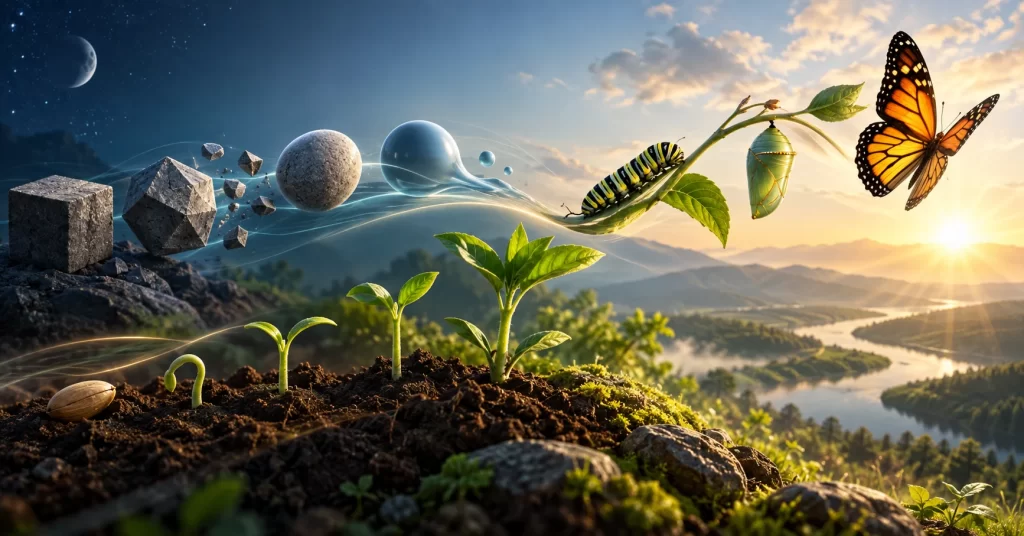
If the two states differ in a meaningful way, change has occurred. A seed growing into a plant, a student developing a new skill, a company adopting new technology, and a community introducing a new law are all examples.
Main types of change
Change can be classified in several ways. These categories often overlap.
Planned and unplanned change
Planned change is intentional. A student creates a revision schedule, a family moves to a new home, or an organization redesigns a process to improve it. Unplanned change follows events that were not expected, such as an equipment failure, sudden illness, market disruption, or extreme weather.
Gradual and sudden change
Gradual change develops through many small steps. Learning a language, building fitness, and erosion are gradual processes. Sudden change happens over a short period, such as a power outage, a policy announcement, or an abrupt change in temperature.
Incremental and transformational change
Incremental change improves an existing condition without replacing the whole system. Examples include refining a study routine or updating one stage of a production process. Transformational change alters the structure, identity, or direction of a system—for example, moving from paper records to a fully digital service.
Internal and external change
Internal change begins within a person or system, such as a shift in beliefs, habits, leadership, or goals. External change is driven by outside conditions, such as new technology, laws, competition, demographic trends, or the environment.
Examples of change in different areas
| Area | Example | What becomes different? |
|---|---|---|
| Personal | Learning to manage time | Habits and daily decisions |
| Biological | A child growing into an adult | Body, abilities, and development |
| Educational | Understanding a difficult concept | Knowledge and skills |
| Organizational | Introducing a new workflow | Roles, processes, or tools |
| Technological | Replacing manual work with software | How a task is completed |
| Social | A new law or social norm | Rules, expectations, or behavior |
| Environmental | A shift in rainfall patterns | Conditions within an ecosystem |
How does change happen?
Most change can be described as a simple cycle:
- A trigger appears. A problem, opportunity, decision, or external event creates pressure for something to become different.
- A response begins. A person or system adjusts its behavior, structure, or resources.
- A transition takes place. The old state may continue for a time while the new state develops.
- A new state forms. The change becomes visible and its effects can be assessed.
- Feedback leads to further adjustment. Results reveal what should be continued, corrected, or changed again. Learn more in our guide to what feedback is.
Not every change follows a neat sequence. Real situations can involve reversals, delays, resistance, and several causes operating at once.
Why can change feel difficult?
Even positive change can create stress because it reduces predictability. Familiar routines give people a sense of control; a new situation may require fresh decisions before the outcome is known. People may also worry about losing safety, freedom, status, belonging, or fairness.
Different people can react differently to the same event. The American Psychological Association notes that tolerance for uncertainty varies and recommends focusing on what can be controlled, maintaining healthy routines, drawing on past successes, and seeking support when needed.
Resistance does not automatically mean that a person is unreasonable. It may reveal missing information, a genuine risk, an unfair process, or a need for more time and support.
How to adapt to change
- Name what is changing. Separate confirmed facts from assumptions about what might happen.
- Identify what you can control. Focus effort on decisions and actions that are within reach.
- Break the transition into smaller steps. A manageable next action is more useful than trying to solve every uncertainty at once.
- Keep helpful routines. Regular sleep, movement, meals, study, and social contact can provide stability.
- Ask for information and support. Teachers, colleagues, family members, specialists, or trusted friends may offer practical help.
- Review the results. Use evidence and feedback to keep, revise, or reverse an approach.
The UK National Health Service also recommends focusing on the short term, recognizing what is still working, creating a new rhythm, and using practical support when dealing with uncertainty. See its guide to dealing with change and uncertainty.
Change, growth, and progress are not the same
These words are related but not interchangeable:
- Change means becoming different. It is neutral and can have positive, negative, or mixed effects.
- Growth usually means an increase or development in size, ability, value, or maturity. Read our explanation of what growth means.
- Progress means movement toward a desired goal or improved condition.
Every instance of growth or progress involves change, but not every change produces growth or progress.
Frequently asked questions
What is change in simple words?
Change is when something becomes different from how it was before.
Is change always positive?
No. Change can be positive, negative, or mixed. Its value depends on its effects, who is affected, and the criteria used to judge the outcome.
Can change be measured?
Yes. You can compare relevant indicators before and after a change. Depending on the situation, these might include time, cost, temperature, test scores, behavior, satisfaction, quality, or environmental conditions.
What is the difference between change and transition?
Change is the difference in circumstances or condition. Transition is the period and process of moving from the old state to the new one.
Why do people resist change?
Common reasons include uncertainty, possible loss, lack of trust, insufficient information, limited control, disruption of routines, or concern that the proposed change may not work.
Key takeaway
Change is the process or result of becoming different. Understanding its cause, scale, pace, and effects makes it easier to respond thoughtfully. Effective adaptation does not require pretending that every change is welcome; it requires clear information, realistic choices, support, and a willingness to adjust as new evidence appears.