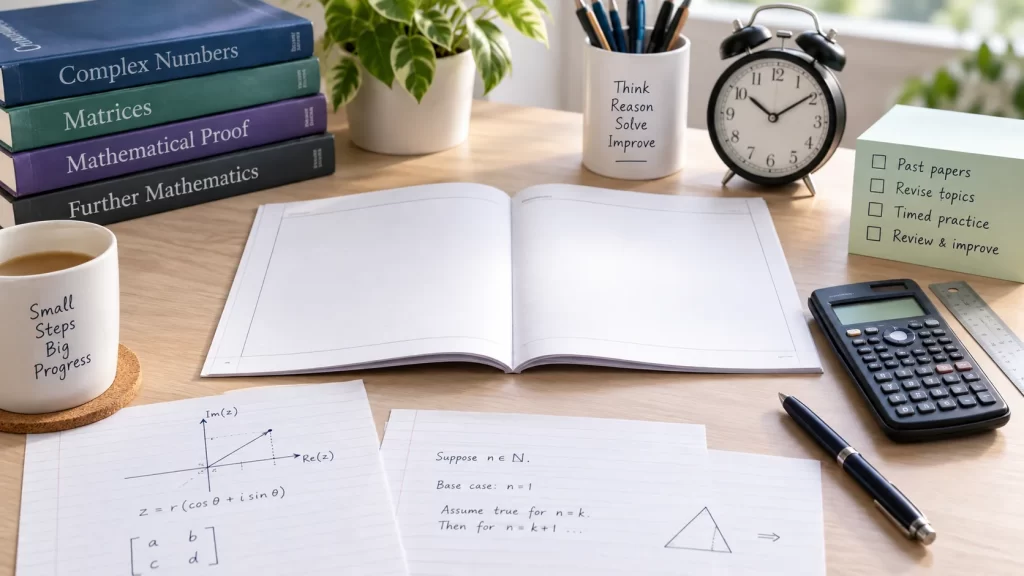
Start here: Pearson Edexcel AS Further Mathematics is qualification 8FM0. Its assessment has a compulsory Core Pure Mathematics paper and a second paper built from the option combination entered by your school or centre. Use the exact component code on your entry when selecting a past paper; a Further Mechanics question paper is not a substitute for Further Statistics merely because both are called Paper 2. The archive below keeps the available question papers and mark schemes together, while this guide explains how to choose, attempt, mark, and learn from them.
This is an AS guide, not a guide to the full A level. If you need full A-level Core Pure papers, use our separate Edexcel A-level Further Maths Core Pure archive. For a wider starting point across qualifications, the Sly Academy past-papers hub helps you navigate. Never combine two qualifications’ mark schemes just because the topics look similar: the specification, paper code, available formulae, and mark allocation may differ.
What the 8FM0 assessment actually contains
Pearson’s current AS Further Mathematics specification (Issue 5, July 2025) sets out two externally examined papers. Paper 1, code 8FM0/01, is Core Pure Mathematics. It lasts 1 hour 40 minutes, has 80 marks, and contributes half of the AS qualification. Paper 2 also lasts 1 hour 40 minutes, has 80 marks, and contributes the other half. For Paper 2 the entry code reflects a permitted combination of two optional content areas. Check the specification and your centre’s entry rather than choosing an option from this archive by preference at the last minute.
Core Pure content includes proof, complex numbers, matrices, further algebra and functions, further calculus, and further vectors. That list is a map, not a promise that every topic appears equally on every paper. Some questions combine ideas: a matrix transformation may be interpreted geometrically, or a complex-number result may require careful algebra. Revision by isolated chapter is useful at first, but timed papers expose whether you can choose the right method when the question does not announce the topic.
The options in the specification are Further Pure, Further Statistics, Further Mechanics, and Decision Mathematics units. Pearson lists permitted pairings under Paper 2 codes 2A through 2K, omitting 2I: 2A is FP1 with FP2; 2B FP1 with FS1; 2C FP1 with FM1; 2D FP1 with DM1; 2E FS1 with FM1; 2F FS1 with DM1; 2G FS1 with FS2; 2H FM1 with DM1; 2J FM1 with FM2; and 2K DM1 with DM2. The archive often labels individual option components as 21 through 28. Those component PDFs are building blocks for the pair your centre enters, not ten separate AS examinations that every student sits.
For example, a student entered for 8FM0/2E needs the Further Statistics 1 and Further Mechanics 1 material alongside Core Pure. A student entered for 8FM0/2A needs Further Pure 1 and Further Pure 2. Downloading every available option can be useful for exploratory practice later, but your first timed mock should match your actual route. A useful first action is to write your complete paper codes at the top of a revision tracker and compare them with the cover of each PDF.
Paper and component labels matter because the original archive mixed informal titles and codes. We have corrected clear “Paper 23” labels attached to Further Statistics 2 files to “Paper 24.” One October 2021 file was historically labelled “Paper 2 (Core Pure)” in the source archive; treat that label cautiously and verify the qualification code printed on its cover before using it as AS practice. Pearson’s specification, not an archive label, is the authority on assessment structure.
How to choose the right paper from this archive
First identify the qualification: look for 8FM0, not 9FM0 or International Advanced Level codes. Next identify the year or exam series and the content component. Then open the question paper and inspect its front cover for the exact code and session. Finally, open the linked mark scheme from the same row or series. Some early archive filenames use “MS,” others “RMS,” and some are dated several months after the exam; the pairing should be confirmed from the documents, not guessed from the file naming pattern.
If you find a PDF whose cover, content, or mark scheme does not match its row, stop and use the Pearson qualification’s official exam-materials listing to locate the correct paper. A working HTTP link tells us a file is reachable, not that its label is pedagogically correct. The links in this archive were checked for availability during this refresh, but individual document identity still deserves a quick cover check before a timed session. Where access to a recent locked paper is restricted, ask your teacher or exam centre for legitimate access; do not use leaked materials.
Choose practice by purpose. For learning a new unit, use one component at a time and work untimed with notes, then compare the method with the scheme. For exam readiness, use a whole paper or the permitted option combination, put away notes, and honor the official time. For diagnosis, choose a paper that tests an identified weakness rather than the one whose questions you already remember. Reattempting the same paper too soon measures memory more than transferable understanding.
A three-pass way to use each past paper
Pass one: sit it honestly. Print the question paper or use a PDF setup that does not let you accidentally see the mark scheme. Use the time stated for the relevant paper, have the calculator permitted by the current specification, and work on clean paper. If a question stalls you, mark its number and move on rather than spending a quarter of the sitting on one unfamiliar manipulation. Record the start and finish times, the paper code, and whether you needed extra time. That context matters when you compare attempts.
Pass two: mark for method, not just answers. Use the scheme for the correct session and code. Read the notation and the sequence of acceptable steps. A correct final number without a justified method may not earn every method mark; a slip in arithmetic after a sound method may still earn credit. Mark your own response in a different color and note where you inferred a mark rather than clearly meeting the criterion. Do not inflate the score because the idea “felt right.” If a scheme is difficult to interpret, ask a teacher for help with that marking point.
Pass three: repair and retest. For each lost mark, write the actual cause: content gap, wrong method choice, algebra slip, unclear notation, misread instruction, or time pressure. Then solve a fresh problem on the same idea without the solution in view. Return to the original question a few days later and write a clean version. An error log should identify an action, such as “state the modulus condition before solving the complex-number equation,” not merely “revise complex numbers.”
Keep raw marks separate from a predicted grade. Boundaries change by series, and a sample or altered timed practice is not a formal grade prediction. A useful trend is whether your method marks, completed questions, and confidence on unseen variants improve. Your teacher may use official grade-boundary documents for a specific series, but do not apply a different year’s boundary to a current practice score as if it were fixed.
Core Pure: what to look for in your solutions
Proof and algebra
A proof question assesses the chain of reasoning, not just the last line. Before calculating, identify what is assumed and what must be shown. If you prove a statement by induction, clearly state the base case, the induction hypothesis, the step from n to n+1, and the conclusion. If you work by contradiction, show why the assumption leads to an impossible result rather than merely asserting that the answer is obvious. After marking, compare your written logic with the scheme’s required justification and edit your solution for clarity.
Further algebra and functions often punish skipped domain restrictions. When manipulating a rational expression, write which values are excluded. When solving an equation obtained by squaring or multiplying by a variable expression, check candidates in the original equation. For a transformation or inverse function, be clear about the input and output sets. A past paper is a good place to practice these habits because the method may be familiar while the context is new.
Complex numbers and matrices
Complex-number questions may move between Cartesian, polar, and geometric representations. Do not treat those as three unrelated chapters. Draw an Argand sketch when a locus or argument is involved, then use algebra to verify the sketch. For a modulus equation, notice whether a geometrical distance interpretation offers a quicker route. If the result is expressed in a different form from yours, convert carefully before assuming it is wrong. A legitimate alternative method should still be supported by the reasoning the question requests.
In matrices, keep the order of multiplication visible; AB and BA are not generally interchangeable. If a matrix represents a transformation, test its effect on a simple vector to check whether your geometrical description is plausible. When computing an inverse, verify by multiplication if time permits. Past-paper marking can reveal whether you lost credit for the calculation, the interpretation, or an omitted condition such as an invertibility requirement. Those are different revision tasks.
Calculus and vectors
Further calculus questions can combine technique with interpretation. Before differentiating or integrating, identify the function’s form and whether a substitution, product rule, partial fractions, or another method is warranted by the syllabus. After an integration, differentiate your result as a quick check. For a differential equation, the arbitrary constant and any initial condition should be handled explicitly; a neat numerical answer is not enough if the general solution was requested.
Vector work rewards clear definitions of lines, positions, and parameters. Write the vector equation before solving component equations, check whether a claimed intersection is actually on both objects, and state whether the question asks for a position vector, a distance, or an angle. An answer can be algebraically consistent yet address the wrong quantity. Labeling the diagram and units, where relevant, saves time during review.
The official sample assessment materials show the style of questions and accompanying mark schemes. They are useful when you have exhausted a small set of live papers, but mark them as samples in your tracker so you do not compare their raw marks directly with a later exam series. Samples illustrate assessment design; they do not establish a fixed grade boundary.
How to revise the option components intelligently
Option practice should follow your actual 8FM0 Paper 2 pairing. For Further Pure, work through the relevant definitions and standard methods before attempting a timed mixed paper. For Further Statistics, identify the model, assumptions, and parameter meanings before pressing calculator keys. For Further Mechanics, start with a force or motion diagram and a sign convention. For Decision Mathematics, record the algorithmic steps and show how each choice follows from the method. These are broad habits, not substitutes for the detailed content list in the Pearson specification.
If your route includes Further Statistics 1, our A-level Further Statistics 1 archive may offer extra practice after you have checked topic overlap and paper code. It is not a replacement for an AS paper: assessment structure and mark allocations can differ. A strong sequence is to master AS-specification questions first, then use relevant A-level component questions selectively with a teacher’s guidance.
Do not answer an option question from another route merely because it looks easier and then count that score as a realistic mock. It can still be valuable for enrichment or for diagnosing a shared skill, but label it separately. In particular, mixed option-paper preparation must account for the exact pair entered by the centre. For a 2E student, a high score on Further Pure 2 does not compensate for an unpracticed Further Mechanics 1 component. Spend the last revision weeks on the route you will actually sit.
A worked error-analysis example
Suppose you attempt a matrix transformation question and obtain the correct transformed vector but lose two marks for failing to explain the invariant line. Write down the error as “I calculated images of basis vectors but did not test a general point on the proposed line.” On the repair attempt, represent a point on the line with a parameter, apply the matrix, and show that the result satisfies the same line equation. Then try a fresh transformation question. This is more useful than copying the mark scheme into a notebook because it targets the missing reasoning step.
For a statistics example, imagine obtaining a plausible probability but using the wrong parameter because the random variable describes successes in a different number of trials. Do not simply memorize the corrected value. Rephrase the story in terms of “what one trial is,” “what counts as success,” and “how many trials occur.” Write the model with named parameters and check whether independence and a constant probability are justified. These short checks protect method marks even when the arithmetic is routine.
For a mechanics example, if a velocity calculation has the wrong sign, revisit the diagram and sign convention before redoing algebra. Decide whether the direction of travel changed and whether a negative result is physically meaningful for the coordinate system. Put the result back into the original equation to test it. When you track such errors, separate conceptual misunderstanding from a single sign slip; they need different revision responses.
Turn a mark scheme into a learning tool
Mark schemes are compact documents designed for examiners, not complete textbooks. Their letters and shorthand may describe method, accuracy, or independent marks; the exact application can depend on examiner guidance. Read the scheme alongside the question and your own line of working. If several methods are allowed, identify why each reaches the required result. If the scheme says an equivalent form is acceptable, check equivalence algebraically rather than assuming your version qualifies.
Look for the earliest line at which your working diverges from a valid route. Later errors may be consequences of that first decision. For instance, choosing the wrong distribution can make every subsequent probability look wrong, but the learning issue is model selection. Conversely, a copied number can spoil a correct method without indicating a topic gap. Classifying the first divergence prevents a revision plan from becoming a vague list of entire chapters.
Use examiner reports when available. They can explain common errors, interpretations of wording, and what successful responses did well. Pearson’s 2024 report for component 21 is an example of an official resource. Match the report to the same component and series; an examiner comment about Further Pure 1 is not a universal rule for every option. Your teacher can help interpret a report where the marking language is terse.
After each paper, make one page of transferable lessons. Include a maximum of three priority skills, an example of a corrected method, and one next practice task for each skill. A twenty-page transcription of every mark scheme is hard to revisit. A short, specific record can be used before the next timed paper and shows whether the same mistake recurs.
Timing, calculator use, and presentation
Each AS paper is designed for 1 hour 40 minutes and 80 marks, so pace matters. A rough average is a little over a minute per mark, but actual questions vary; use that only as a warning against spending too long on a low-mark part. Read the whole question before choosing a technique. Mark an unfinished part clearly so you can return to it. Leave enough time to check calculations and transfer any final answers accurately, especially where a later part depends on an earlier result.
The specification allows calculators subject to its stated conditions. Read the current calculator appendix and exam instructions rather than assuming any device is acceptable. Practice with the model you expect to use. Know how to enter complex or statistical calculations, but be ready to show mathematical reasoning where the paper requires it. A calculator-generated answer without the required method may not earn the available credit.
Write enough working for another person to follow your logic. Label substituted values, carry exact forms when the question requests them, and round only at the stated stage. If you use a result from an earlier part, reference it accurately. If you cannot finish, write the method you intended rather than leaving a blank page: a correct setup can still demonstrate understanding. Do not add unrelated formulae in the hope that one earns a mark; clarity helps both you and the examiner.
Build a revision schedule from evidence, not guesswork
Start by placing your examination date, school assessments, and other subjects on one calendar. Allocate early sessions to learning missing content and later sessions to mixed, timed practice. If the exam is close, prioritize the skills that appear repeatedly in your error log and the components you will actually enter. Avoid assigning every day a full paper; marking and repairing a paper can take as long as sitting it. Without that review, a stack of completed PDFs may create an illusion of progress.
A useful two-week cycle is: first diagnose one Core Pure paper and one relevant option component; then spend several sessions on the highest-impact weaknesses; then sit fresh questions to test whether the method has transferred. Repeat with a new series. Keep the cycle flexible. If proof is consistently strong but Further Statistics model choice is weak, spend more time on the latter even if it feels less comfortable. If the weakness is speed rather than content, practice short groups of questions under a clock before another full sitting.
Use a tracker with the paper code, series, date attempted, timing, raw score, three principal errors, and retest date. Add a column for conditions: full timed, partial timed, open book, or repeated. A 70-mark open-book attempt is not directly comparable with a 58-mark first timed attempt; the conditions explain the difference. Track topic confidence separately from scores, because a single paper has limited topic coverage. The goal is to make your next study decision more informed.
Some older papers are still excellent practice, but check the current specification before treating every historic question as a perfect blueprint. Specifications and assessment arrangements can change, and an unusual series may not represent a standard summer examination pattern. The live Pearson specification and your teacher’s course plan should decide what is in scope. When a past question sits outside your taught route, label it as extension work instead of allowing it to distort your confidence.
Using official materials alongside the archive
The archive is a convenient set of question-paper and mark-scheme links, but Pearson remains the authority for the qualification. Its Mathematics and Further Mathematics qualification page leads to specifications, teaching resources, and exam materials. An official Paper 1 example is the May 2022 8FM0/01 question paper. Compare a downloaded archive file with an official version where available, especially if a filename or cover looks inconsistent.
Save the question paper and matching mark scheme in a folder named by qualification, series, and code, such as “8FM0-01 May 2022.” Keep a separate folder for sample assessment materials and examiner reports. This simple naming convention prevents marking a 2019 response with a 2020 scheme or mixing AS with A-level files. If a document opens in your browser without downloading, confirm the code on the cover before saving it. Never rely solely on an abbreviated link label.
Some schools have access to secure materials that are not public. Respect those access rules; use publicly released papers or resources your teacher has legitimately provided. Unreleased papers can compromise mock assessments and do not help you build a durable revision habit. There is ample learning value in working an older released question deeply, explaining the method, and solving a fresh variant.
When a past paper feels impossible
Stop the full-timed cycle temporarily if you cannot start many questions. Pick one concept and work from the official specification or a trusted textbook example back toward an exam question. Ask: what definition does the question use, what result is expected, and which earlier skill is missing? Sometimes the barrier is not “further maths” at all but algebra fluency, graph interpretation, or unfamiliar notation. Repair that prerequisite before increasing speed.
Work one question with notes, then cover the model solution and reproduce the argument. Explain aloud why each line follows. The following day, attempt a related but not identical question. If you can only reproduce the first question word for word, the method is not yet secure. This progression from guided practice to independent transfer is more productive than repeatedly staring at a full paper under time pressure.
Study with a peer only if both of you show working and challenge assumptions. Comparing answers without comparing methods can reinforce a shared mistake. A useful peer review asks: “Where did you choose this model?”, “Which condition justifies this step?”, or “Does the final value make sense?” If your methods disagree, consult the mark scheme and specification, then ask a teacher when neither resolves the issue. The objective is a defensible argument, not a quick consensus.
Questions about these AS Further Maths papers
Are Paper 21 through Paper 28 all compulsory?
No. They identify optional content components in the available materials. Your AS entry pairs two optional units for Paper 2, while every 8FM0 student studies Core Pure Paper 1. Confirm your route with your exam centre. Downloading every option for general interest is fine, but a realistic timed mock needs the specific pair you will sit.
Is an A-level Further Maths paper interchangeable with an AS paper?
No. There can be useful topic overlap, but the qualification code and assessment design differ. Use an A-level question only as clearly labelled supplementary practice and check it against the AS content you have been taught. For a different exam board altogether, our Cambridge AS Further Maths collection is a separate route, not an Edexcel mark-scheme substitute.
Why are some archive series labelled October rather than June?
The archive reflects the sessions represented by the linked files. Check the paper cover for the actual examination date and qualification code; historic or exceptional series should not be treated as a guarantee of the next exam’s schedule. For your own exam date, use current information from your school and Pearson rather than extrapolating from the archive.
What if the mark scheme seems to disagree with my correct answer?
First check that the scheme matches the question paper’s series and code. Then simplify both answers into a common form and examine whether the question demanded a particular method or exact form. If the response is genuinely equivalent but you cannot tell whether it meets the marking criteria, ask a teacher. Do not silently award yourself the mark or assume the published scheme is wrong.
Past-paper archive: question papers and mark schemes
The links below preserve the earlier archive’s available PDF resources. Open the question paper first, verify 8FM0 and the option component on its cover, and use the paired mark scheme only after completing your attempt. All linked files responded successfully during the initial availability check for this refresh. Availability can change, and a live link does not by itself verify a label; if a document appears mismatched, cross-check the official Pearson exam-materials page.