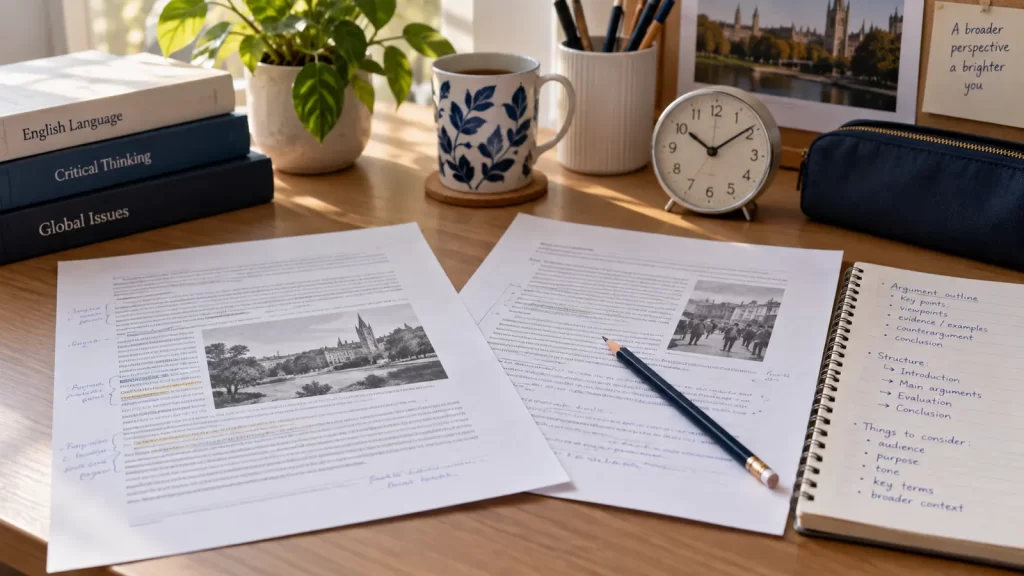
Cambridge International AS Level English General Paper (8021) is an exercise in informed judgement, not a test of memorised quotations. Past papers help most when you use them to practise choosing an argument, weighing evidence, reading an unfamiliar source closely and explaining a conclusion under time pressure. This guide takes you from the official paper archive to a practical revision routine for the 2025–2027 syllabus. If you will sit an exam in 2028 or later, read the separate syllabus for those years before adopting the timings and assessment details below.
Start with the correct official materials
The safest starting point is Cambridge International’s English General Paper 8021 past-papers page. It groups question papers, mark schemes and, where available, inserts and examiner reports under the qualification. The 2025–2027 syllabus PDF is the authority for what the current assessment asks candidates to do. Keep both open: a historical question paper shows the kind of task you may encounter, while the syllabus explains the skills and current format against which you should plan.
Do not assume that a paper from a previous syllabus has exactly the same number of questions, command words, layout or mark distribution as your forthcoming examination. Cambridge itself warns that older papers may not fully reflect the current syllabus. The archive is still valuable for practising general-paper reasoning, but it should not override the current specification. Your school may also have access to additional materials, so ask a teacher which specimen papers, examiner reports and current supporting documents are appropriate for your cohort. Avoid websites that relabel a paper or detach it from its insert and mark scheme: that makes it harder to know what you have actually practised.
A useful download folder has four subfolders: the syllabus, Paper 1 tasks, Paper 2 tasks with their inserts, and feedback. Name each file by series, year, paper and variant. Open the question paper first and hide the mark scheme until you have completed an attempt. For comprehension, check that you have the matching insert, not merely a similarly named paper from another variant. A realistic practice session fails if the source text is missing.
Understand the two papers before you practise
Under the 2025–2027 syllabus, Paper 1 is the Essay paper. It lasts 1 hour 15 minutes, carries 30 raw marks and contributes 50% of the qualification. The paper offers ten questions spanning three broad topic areas. You choose one question and write an essay, with about 600–700 words advised by Cambridge. Paper 2 is Comprehension. It lasts 1 hour 45 minutes, carries 50 raw marks and also contributes 50% of the qualification. It contains two 25-mark sections, and you answer all questions. A dictionary is not allowed in either paper.
These numbers reveal an important trap. Paper 2 has more raw marks than Paper 1, but the papers have equal overall weighting. Do not allocate your preparation solely in proportion to 30 versus 50. You need a balanced plan: an excellent essay will not compensate for consistently weak source reading, and polished comprehension answers cannot replace an underdeveloped argument. Because Cambridge converts paper marks to the stated weightings, compare performance against the relevant mark schemes rather than adding the raw marks as if each paper had identical influence.
Read the current syllabus’s assessment objectives as skills, not as a checklist of facts to memorise. In both papers, accurate understanding, relevant selection, coherent explanation and clear English matter. Paper 1 asks you to shape a sustained position; Paper 2 asks you to extract, interpret, analyse, evaluate and sometimes persuade in response to specific source material. A student who knows many examples but cannot connect them to a question will lose ground to a student who chooses fewer, more pertinent examples and explains them well.
Paper 1: choosing a question strategically
The three broad Paper 1 areas cover economic, historical, moral, political and social issues; science, technology, mathematics and the environment; and literature, language, arts and media. These are domains for thinking, not three fixed sets of questions you can predict. Reading widely across them helps you recognise unfamiliar angles. However, the best question on the day is not necessarily the one whose topic you know most about. It is the one for which you can answer the precise demand with a defensible, qualified argument.
Before choosing, underline limiting words in several candidate questions: “to what extent,” “in your country,” “always,” “today,” “more important,” or “should.” A question about whether governments should fund the arts requires a value judgement and trade-offs; a question about whether art does influence society asks you to assess effects. If you confuse those demands, even relevant facts can drift away from the task. Make a quick two-column list of reasons and counterarguments for the strongest two questions. Choose the one with the better explanation, not the longer list of facts.
For example, an essay on whether social media has improved public debate could examine access to voices, speed of information, incentives for outrage and differences among platforms and audiences. The phrase “improved public debate” needs a working definition: better participation, better evidence, more respectful exchange or better policy outcomes are not identical. A nuanced thesis might say that social media broadens participation while often weakening the conditions for careful deliberation, so its effect depends on platform design and users’ media literacy. That gives the essay a line of reasoning rather than a simple yes-or-no opinion.
Do not choose an issue simply because you once memorised a model essay. Examiners are assessing your answer to the set question, not whether you can reproduce a prepared paragraph. A prepared example is useful only when you can explain exactly why it supports this claim, identify its limits and integrate it with other evidence. If the example requires a long detour to become relevant, omit it.
Build an essay that reasons rather than lists
Spend a short opening period planning. Write a provisional thesis, two or three central reasons, a plausible objection and a conclusion that can follow from the argument. Put the strongest analytical paragraph first. Each body paragraph should make a claim, develop it with a concrete example or defensible reasoning, and return to the question. A paragraph that says technology “has many pros and cons” announces a topic; one that explains why a particular technology changes access, incentives or consequences makes an argument.
Suppose the question concerns whether cities should restrict private cars. A weak paragraph lists pollution, traffic and noise. A stronger paragraph explains that congestion imposes time and air-quality costs on people who do not drive; it then considers whether restrictions work where public transport is unreliable. The example becomes a test of a policy claim rather than decoration. You may compare a central business district with a rural area to show why a blanket answer would be too broad. That kind of qualification is not indecision. It shows you understand conditions under which your judgement holds.
Use evidence honestly. You can refer to a well-known public example, a clearly labelled local case or a general mechanism you can explain. Do not invent statistics, studies or quotations. If you cannot recall a number accurately, write about the relationship you can defend instead. For current affairs, a reliable news report may help your revision, but the essay still needs your analysis. Researching the context is valuable; reproducing a headline without explanation is not.
Transitions should carry the reasoning forward. “However” should introduce a real tension; “therefore” should draw a conclusion earned by the preceding explanation. Between paragraphs, show how a new consideration changes the overall judgement: cost may limit a policy that is environmentally promising, or equity may alter a technically efficient solution. A concise introduction that defines terms and states direction is usually more useful than a grand claim about humanity. End by answering the exact question again, with the qualifications your discussion established.
Manage Paper 1 time without letting the clock write the essay
Seventy-five minutes is enough for one planned essay, but only if you avoid writing a lengthy introduction and then rushing the evaluation. A reasonable rehearsal split is about 8–10 minutes to choose and plan, roughly 55–60 minutes to write, and the final 5–10 minutes to reread. This is a practice strategy, not a Cambridge rule; adjust it after timed attempts. The advised 600–700 words are a guide to scope, not a target that excuses repetition. Clear development and relevance matter more than hitting an exact number.
During the last check, locate your thesis, topic sentences and final judgement. If one paragraph does not advance the answer, revise its link to the question if time allows. Correct errors that change meaning before polishing minor style. Keep handwriting legible if taking a paper exam, and follow any current exam-centre instructions about materials and administration. In revision, practise writing without a dictionary because none is permitted for these papers. Learn to paraphrase an uncertain word rather than freezing over it.
Paper 2: two different kinds of reading
Paper 2’s sections each carry 25 marks, but they do not ask you to read in exactly the same way. Section A involves interpreting information from sources and producing a persuasive response that expresses an opinion and reaches a justified conclusion. Section B asks for detailed comprehension: meaning at the level of words, sentences and paragraphs, language and register, analysis, evaluation and inference. The unseen insert is no longer than 900 words under the 2025–2027 syllabus. The paper may call for short answers and a response of up to 120 words, so concise expression is a testable skill.
Begin by reading the question instructions and identifying the source’s purpose, audience and situation. Mark claims, evidence, contrasts and any information that changes the apparent argument. A table, notice or passage may be straightforward at first glance but contain an exception that determines the answer. Make a distinction between what the source explicitly states, what it reasonably implies and what you personally believe. The exam rewards evidence-led interpretation, not an unrelated opinion about the general topic.
For a persuasive task, decide what the audience needs to know and what decision you want them to make. Select the most relevant details from the source, acknowledge a serious counterconsideration where appropriate and conclude with a reasoned recommendation. For instance, a source about transport options may show that the cheapest route is slower but more reliable at peak times. A persuasive recommendation should not just repeat the numbers; it should explain why reliability matters for the named audience. Audience and purpose also shape register. A formal recommendation to a school committee differs from a message to fellow students, although both must remain clear.
In detailed comprehension, answer the command word. “Identify” may need one accurate point. “Explain” needs the meaning and its connection to the passage. “Analyse” asks how a choice of words or structure produces an effect, while “evaluate” requires a supported judgement about effectiveness or significance. Copying a long sentence from the passage is seldom enough. Select the small piece of evidence that matters, paraphrase where requested, and make your inference explicit. If the passage says a speaker paused before an answer, you might infer uncertainty only if surrounding cues support that reading; a pause alone could also indicate reflection or emphasis.
Use the mark scheme as a diagnostic instrument
Complete a paper before opening its mark scheme. Then compare what you wrote with the level descriptions and accepted responses. The point is not to count identical words. A good answer may phrase a valid idea differently, while a superficially similar answer may omit the reasoning that earns credit. Mark schemes sometimes include examples, alternative answers and guidance for judgement. Read the general principles and the specific question notes together, and ask a teacher to moderate borderline responses when possible.
For an essay, annotate each paragraph against the question: what claim does it make, what supports that claim, and how far does it evaluate? Look for patterns across attempts. If your introductions are strong but conclusions thin, the issue may be time management. If your essays contain numerous examples but receive limited credit for analysis, the issue may be explanation. A single grade tells you less than this pattern. Keep a one-page error log with columns for question, missed demand, evidence gap, next practice and whether the correction worked.
For comprehension, separate reading errors from writing errors. Did you overlook a qualification in the insert, misread the question, offer an unsupported inference, or express a correct thought too vaguely? Revisit the exact passage lines that led to the wrong answer. Then write a revised answer in your own words and compare it with the marking guidance. This turns review into a second learning attempt rather than passive exposure to an answer key.
Read examiner reports for habits that matter
Where Cambridge supplies an examiner report, use it after you have tried the paper and mark scheme. Reports discuss how candidates handled tasks, including common strengths and difficulties. They are not a secret list of next year’s questions. Their value lies in repeated habits: answering the wording actually set, supporting claims, selecting information, observing an audience and keeping a persuasive response purposeful. Make notes on transferable lessons instead of copying a report’s sample content.
Compare reports from different series cautiously. One series may feature particular source types or topical contexts that do not recur. A comment on a weak response can still teach a general principle, such as the difference between describing a source and evaluating it. If a report seems to contradict a social-media study tip, favour the official specification and teacher guidance. Revision advice should serve the assessment, not become an alternative syllabus.
A four-week past-paper practice cycle
In week one, read the 2025–2027 syllabus and complete one untimed task from each paper. The aim is to understand the task types. For Paper 1, practise choosing among prompts and building outlines before writing an essay. For Paper 2, work slowly through the insert and identify what each question requires. Review with the mark schemes and log misunderstandings. Do not start with repeated full simulations if you have not learned how the sections work.
In week two, practise targeted weaknesses. If Paper 1 analysis is thin, write two body paragraphs on different prompts with explicit counterarguments and conclusions. If Paper 2 inference is weak, take a short passage, highlight cues and write one-sentence inferences supported by those cues. Add one timed Paper 1 essay and one timed Paper 2 section. The goal is to transfer the isolated skill into a realistic task. At the end of each session, identify one change for the next attempt.
In week three, complete one full paper of each type under the published time limits, using the appropriate question paper and insert. Review only after finishing. Score with the mark schemes, but do not treat a self-awarded grade as official. Record where time went: question selection, planning, reading, writing and checking. If a section consumed excessive time, work out whether slow reading, uncertainty about the command word or overwriting was the cause.
In week four, repeat with different papers and prioritise quality of corrections. Re-answer one previously missed comprehension question and rewrite the weakest essay paragraph before taking the next full timed attempt. Finish by making a short exam-day checklist: check the syllabus year, confirm paper and variant, read instructions, choose the question deliberately, support each claim and reserve time to check. This plan is adjustable. A learner with more time can repeat the cycle; one with less time should still include diagnosis and correction rather than completing papers without review.
Build general knowledge without cramming trivia
English General Paper rewards the ability to think about public questions across disciplines. Follow a small range of credible sources on society, science, culture and policy. As you read, write down an issue, a claim, evidence for it, a counterclaim and the conditions under which each might hold. This is more useful than memorising a list of fashionable topics, because the exact essay wording is unpredictable. Read opinions alongside reporting and try to identify where facts end and interpretations begin.
Keep an examples notebook organised by themes rather than by supposed future questions. A case about renewable energy might illuminate innovation, environmental trade-offs, government funding or inequality, depending on the prompt. Note why it is relevant and what it cannot prove. Dates and figures should be checked against reliable sources before you reuse them. If you cannot verify a statistic during preparation, remove it from your bank. A precise but false number is worse than a careful qualitative explanation.
Reading well also improves Paper 2. Practise asking who wrote a source, for whom, with what purpose, and what has been left unsaid. Pay attention to changes in register and persuasive technique. Our short explanation of rhetorical questions can help you recognise one language choice, but the exam answer still needs to explain its function in the actual passage. Likewise, reading comprehension is not just locating words; it includes interpreting relationships, implications and tone.
Worked Paper 1 example: from prompt to judgement
Consider a practice prompt: “Should public libraries devote more space to digital services than printed books?” First clarify “more space”: physical floor area, funding and staff support are not interchangeable. Next define the decision criterion. A library exists to support access to information and learning, but access differs among communities. A thesis might argue for expanding digital services where demand and connectivity justify it while preserving print collections and quiet study space for people who depend on them. The position is conditional, yet clear.
One paragraph could explain the benefits of digital access: remote catalogues, accessible formats and practical skills training. It should then test who can use those benefits. A second paragraph could examine print’s role for young readers, people without reliable devices and materials unavailable through licences. A third could compare opportunity costs: a library cannot fund every service equally, and a local needs survey may be more informative than a universal rule. The conclusion should answer “should” by recommending a principle for allocation, not simply repeat that both formats matter.
Notice what the example does not require. You do not need to invent a percentage of digital borrowers. You can demonstrate reasoning by tracing effects and acknowledging limits. If you do have a verified local example, integrate it briefly and explain whether it generalises. This is how a past-paper prompt becomes a rehearsal for analysis rather than a trigger for memorised phrases.
Worked Paper 2 example: evidence and inference
Imagine a source says a community garden offers free plots but has a two-year waiting list and relies on volunteers to maintain shared paths. A question asks whether a council should expand the programme. “It is popular” is a relevant observation, not a complete argument. The waiting list supports demand, but it may also reveal administrative capacity limits. A convincing response would distinguish the demand for plots from the resources needed to manage more plots. It might recommend a trial expansion with a clear volunteer or maintenance plan.
If a detailed question asks what “relies on volunteers” implies, do not overclaim that the scheme is failing. It implies that continued operation depends at least partly on unpaid labour; whether that is a weakness depends on evidence elsewhere in the source. This illustrates a core reading discipline: inference should extend from text, not outrun it. When a question asks about persuasive effect, explain why the writer selected the waiting-list detail and how a reader might react, while allowing that another reader could worry about cost.
In a timed response, keep the explanation proportional to the marks and any stated word limit. Two clear sentences answering the precise point may be better than a long discussion of urban agriculture. Past-paper practice should train that proportionality. After marking, compare the content you selected with what the question rewarded.
Common mistakes and how to correct them
Using an old paper as a new-format blueprint. Read the current syllabus first and treat older papers as skill practice. File the paper with its year so you remember its context. Choosing an essay for familiar vocabulary alone. Spend a few minutes testing whether you have a defensible answer to the exact question. Listing examples without analysis. After each example, explain the mechanism that links it to your claim and consider its limit.
Writing a one-sided essay where the question calls for evaluation. Address a serious alternative view fairly, then show why your position still follows or how you have qualified it. Copying source phrases in comprehension. Paraphrase when asked, and make the inference or language effect explicit. Ignoring audience in persuasive writing. State who should act, why the evidence matters to them and what conclusion is justified.
Marking too generously. Use published mark schemes and, where possible, teacher feedback. Ask what evidence in your answer fits the level description, not merely whether you mentioned the topic. Practising endlessly without revising errors. Reattempt missed questions and compare a later answer with an earlier one. This is where past papers become instruction rather than just a performance score.
What changes from 2028?
Cambridge lists a separate 2028–2030 syllabus. That means a candidate entered for 2028 or beyond should not copy the 2025–2027 paper details in this guide as if they were permanent. For example, the later syllabus changes Paper 1’s raw marks and other assessment details. Check the syllabus valid for your examination year and your school’s current guidance. This article deliberately keeps the 2025–2027 structure separate from later changes, rather than mixing them into a misleading universal format.
Also distinguish a presentation change from a syllabus change. Cambridge notes that some paper layouts have been updated for accessibility. A different-looking page is not automatically a different assessment objective. Compare content, timing and mark allocation against the correct dated syllabus before deciding that an older practice task is unusable.
A reliable next step
Open the official 8021 past-papers hub, download one matched question paper and mark scheme for each component, and confirm the syllabus year for your cohort. Attempt the tasks, identify one recurring weakness and correct it before taking another paper. If you need broader context about the qualification family, Sly Academy’s Cambridge International qualifications overview is a starting point; the official 8021 syllabus remains the authority for this examination. The strongest preparation is not the largest archive of PDFs. It is a repeatable cycle of accurate reading, reasoned writing, evidence-based feedback and revision.