Looking for CIE A Level Maths Mechanics past papers? Start with Cambridge International Mathematics 9709 Paper 4, check the session and variant printed on each PDF, and pair every question paper with its matching mark scheme. This guide links to verified Cambridge material and shows how to turn a paper into a diagnosis, a focused revision plan and a more accurate second attempt. It is for students taking the Mechanics option at AS Level or in the full A Level route; it is not a substitute for the syllabus issued for your own examination year.
The quickest reliable route is Cambridge International’s 9709 past-papers and examiner-reports page. It carries a selection of official papers and warns that older papers may not represent the current syllabus. Registered schools have access to a broader range through the School Support Hub. If a third-party archive labels a file differently from the PDF cover, trust the cover and Cambridge’s own listing rather than the archive label. A paper labelled as the wrong year can make a revision log and a mark-scheme comparison misleading.
What exactly is 9709 Paper 4 Mechanics?
Paper 4 is the Mechanics component of Cambridge International AS & A Level Mathematics 9709. Under the official 2026–27 syllabus, it is a 1 hour 15 minute written paper worth 50 marks, with six to eight structured questions. It contributes 40% of an AS Level taken with Pure Mathematics 1, or 20% of the full A Level where Mechanics is one of the four components. The full A Level Mechanics route includes Papers 1, 3, 4 and 5. Another valid full A Level route uses Papers 1, 3, 5 and 6 instead; Cambridge does not allow Paper 4 and Paper 6 as a pair. Check your centre’s entry before assuming that every 9709 student sits Mechanics.
The five syllabus areas are forces and equilibrium; kinematics of straight-line motion; momentum; Newton’s laws of motion; and energy, work and power. Those headings matter more than a generic list of physics formulas because they define the boundary of this mathematics paper. The syllabus assumes algebraic methods from Pure Mathematics 1. It includes resolving forces, calculus applied to one-dimensional motion, direct impact of two bodies, connected particles and energy changes. It does not require knowledge of impulse or the coefficient of restitution in its momentum section. Those ideas can appear in other mechanics courses, so do not import them into a Paper 4 checklist without checking the syllabus.
Cambridge says the questions are mainly numerical and test mechanical principles without demanding difficult algebra or trigonometry. That does not make them plug-in exercises. Most of the marks depend on choosing a model, defining a direction, drawing or interpreting forces, and writing an equation that fits the situation. If you can explain why a friction force points one way, when acceleration changes, or why energy is not conserved in a rough-surface problem, you are doing the work that the paper actually assesses.
Official Paper 4 documents to open first
For a complete example, use the May/June 2024 question paper 9709/41 with its matching 9709/41 mark scheme. Both are Cambridge-hosted PDFs and their covers identify the same component and session. A separate Paper 4 specimen paper for examination from 2020 and its specimen mark scheme are useful for a second practice set, but compare any older specimen with your current topic list before treating it as a perfect blueprint. Cambridge may also adjust page layout: it says accessible formatting changes from March 2026 do not change assessment content, demand or question types.
Open the question paper first and download or print it without consulting the mark scheme. Note the year, series and variant in your practice log: 9709 identifies the syllabus, the digit 4 identifies Mechanics, and the final digit distinguishes a paper variant. Keep 41 with 41, rather than mixing a 41 question paper with a 42 scheme. If your school’s entry uses another variant, the mechanics skills still transfer, but the question numbers and answers do not. The official Cambridge hub is the better starting point for finding what is currently public than an old static table of mirror links.
Make a paper a diagnostic, not just a score
Choose one recent official question paper that matches the syllabus you are studying. Set a 75-minute timer and attempt every question in order, using the formula list and calculator permitted by the paper instructions. Write full working even when you can do arithmetic mentally. Mark schemes often distinguish a valid method from a correct numerical answer; a final number alone hides the information you need for improvement. When time expires, draw a line after your last attempted step and finish any incomplete questions in a different pen. That separates time pressure from knowledge gaps.
Mark your timed work against the corresponding official scheme, one line of reasoning at a time. The published 2024 scheme says it is an aid indicating what examiners were instructed to reward, and that it should be read together with the question paper and examiner report. It cannot describe every acceptable alternative method. Give yourself a conservative mark, but do not call a correct answer fully secure if its explanation would be hard for another reader to follow. Conversely, a numerical slip after a sound equation is a different revision problem from using the wrong physical model.
For each lost mark, log the exact question, syllabus area, error type, corrected principle and next practice date. Useful error types are modelling, diagram, sign convention, algebra, calculus, units, rounding and timing. For example, “9709/41, question 3: used constant acceleration after resistance changed; draw forces and identify whether net force remains constant” leads to a different study task from “forgot a minus sign when solving two simultaneous equations.” A short error log of specific decisions is more powerful than copying every correct solution into a notebook.
Redo the same question without looking at the mark scheme after a day or two, then try a new question on the same idea. A memorised answer is not transferable understanding; the new question shows whether you can choose the equation independently. Once a topic is stable, revisit it in a timed mixed paper. Rotate recent papers, specimen material and topic practice so that you learn both the underlying principle and the speed needed to recognise it in an unfamiliar setting.
Read the model before reaching for a formula
A mechanics question compresses a real situation into assumptions. “Particle” means the body’s dimensions and rotation are ignored for the calculation. “Smooth” means no frictional force at that contact. “Light inextensible string” is a model that normally gives a common magnitude of acceleration to connected particles, while a smooth pulley lets the same tension act through the string in the standard model. “About to slip” points toward limiting friction, not necessarily motion already under way. Read those words before you calculate: using a memorised formula while missing one modelling word can reverse an inequality or introduce a force that does not exist.
Make a one-line inventory: objects, forces, directions, known quantities, unknowns, phases of motion and the requested answer. If two bodies interact, draw separate diagrams; an interaction force can have opposite directions on the two bodies. If motion changes after a string slackens or a body reaches a surface, split the question into phases. If resistance varies with speed, do not apply constant-acceleration equations across the whole journey. This inventory costs seconds but prevents long calculations built on the wrong assumptions.
The notation also deserves care. Distance and speed are non-negative totals; displacement and velocity have directions in a one-dimensional sign convention. Mass is measured in kilograms, while weight is a force measured in newtons and modelled as W = mg. In the 2026–27 Paper 4 syllabus, numerical questions generally expect g approximately 10 m s⁻². Read the actual paper’s instructions before starting, because the paper is authoritative for the value and required rounding in that sitting. Keep extra precision in intermediate steps and round at the end.
Topic 1: forces, equilibrium and friction
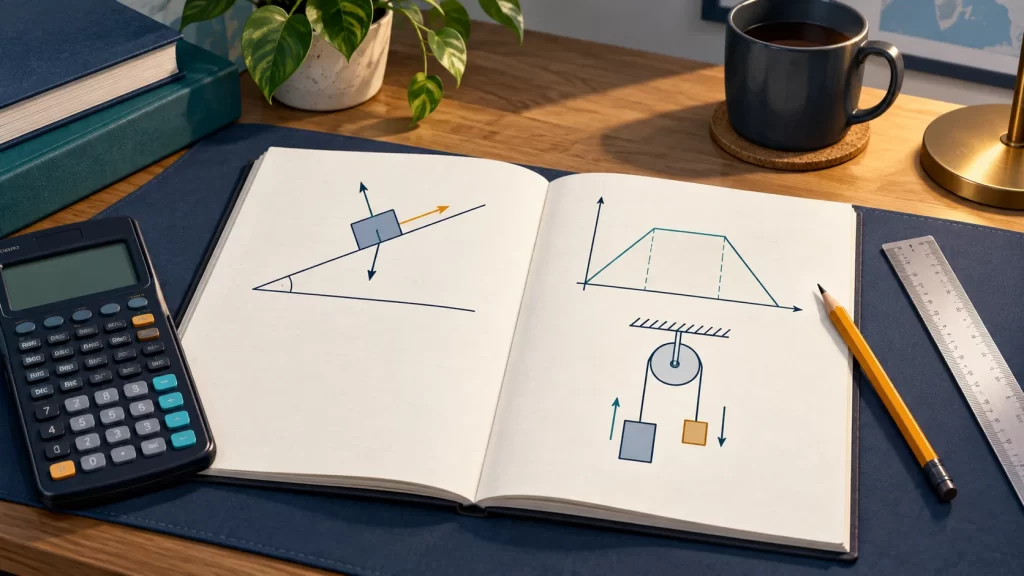
Begin any forces question with a free-body diagram of the object you have chosen. Show weight vertically downward, a normal reaction perpendicular to a contact surface, tension along a string, and friction along the contact opposing the tendency to slide. An arrow’s location on a particle sketch need not reproduce a real object’s geometry; its direction and label do matter. Resolve along axes that simplify the question, usually parallel and perpendicular to an incline. Equilibrium means the sum of force components is zero in each independent direction, not merely that two visible force arrows happen to look similar.
Consider a 2 kg particle resting on a smooth plane inclined at 30 degrees to the horizontal. Using g = 10 m s⁻², its weight is 20 N. The component down the plane is 20 sin 30 degrees = 10 N; the component into the plane is 20 cos 30 degrees, about 17.3 N. A smooth contact has no friction, so the plane’s normal reaction balances the perpendicular component, while an additional 10 N up-plane force would be needed for equilibrium along the plane. This is an original illustrative example, not a Cambridge question. The key step is choosing the axes before using sine or cosine, rather than memorising that one function always belongs to one force.
For a rough plane, friction is not automatically equal to the coefficient of friction times the normal reaction. The relationship F ≤ μR describes its maximum magnitude in the static model, with equality at limiting equilibrium. If a particle is stationary and the other forces demand only 4 N of friction while μR is 9 N, the actual friction is 4 N, not 9 N. A question may instead say the particle is just about to move; then the limiting value is appropriate. Mark schemes reward recognition of that distinction because setting F = μR unconditionally produces wrong answers even when the subsequent algebra is flawless.
Before deciding friction’s direction, imagine what the particle would do if the contact were frictionless. Gravity can pull a particle down an incline, but an applied pull might be strong enough to make it tend upward; friction acts against the relevant tendency, not always “up the slope.” Once you select a direction, keep the same sign convention through every equation. A negative solution for an assumed force direction does not necessarily mean the mathematics failed; it may tell you the force acts opposite to your chosen arrow. Interpret it in words and check the physical story.
Newton’s third law is another recurring trap. The normal reaction on a block and the block’s force on the plane are an action–reaction pair on different bodies. The block’s weight and the normal reaction can balance on the same block, but they are not a third-law pair. If your force diagram contains both members of a third-law pair on one isolated particle, revisit which object each force acts on. For a broader conceptual refresher, Sly Academy’s free-body diagram and Newton’s third-law guide can help, although its AP Physics examples are not a substitute for the Cambridge 9709 syllabus.
Topic 2: straight-line kinematics
The current Mechanics syllabus restricts kinematics here to one-dimensional motion. That makes the sign convention especially important: choose a positive direction, then assign positive or negative velocity and acceleration consistently. A particle travelling left can have negative velocity even while its speed increases. “Decelerating” describes decreasing speed; it does not by itself identify the sign of acceleration until you say which direction is positive. State the direction at the start of a worked solution so your equations are interpretable.
For constant acceleration, equations such as v = u + at and s = ut + ½at² connect initial velocity u, final velocity v, acceleration a, elapsed time t and displacement s. They are not universal motion equations. Suppose a particle starts at 4 m s⁻¹ and accelerates at 2 m s⁻² for 3 seconds in the positive direction. Then v = 10 m s⁻¹ and s = 4(3) + ½(2)(3²) = 21 m. The result is displacement over that interval, not automatically total distance over a more complicated journey. If it later reverses direction, split the time interval at the turning point before calculating distance travelled.
Velocity–time graphs encode the same story visually. Their gradient gives acceleration and signed area between the graph and the time axis gives displacement. Area below the axis counts negatively for displacement; when asked for distance, add the magnitudes of the areas on either side of the axis. A displacement–time graph has velocity as its gradient. Sketching a graph can therefore expose a sign error before an algebraic calculation. If a question supplies a piecewise graph, describe each segment in plain language first: constant velocity, uniform acceleration, uniform deceleration or direction reversal.
Paper 4 also uses simple calculus from Pure Mathematics 1: velocity is the time derivative of displacement, acceleration is the time derivative of velocity, and integration reverses those relationships when the appropriate initial condition is supplied. Imagine v(t) = 3t² − 4t in m s⁻¹, with t measured in seconds. Then a(t) = 6t − 4 m s⁻². If the displacement at t = 0 is zero, integrating gives s(t) = t³ − 2t². At t = 2, displacement is zero, although the particle may have moved away and back. This example shows why an integrated displacement and a travelled distance are different quantities.
When the problem includes two moving particles, choose a common origin, clock and positive direction. Write a separate position expression for each, then set their positions equal only when they meet. If one begins later, define its time variable carefully rather than quietly using the first particle’s elapsed time. Most lost marks in these questions come from mismatched time origins or from treating speed as signed velocity. For an introductory explanation of the distinction, Sly Academy’s position, velocity and acceleration guide is useful concept practice, with the Cambridge syllabus still governing what this examination can ask.
Topic 3: momentum and direct impact
Linear momentum is mass multiplied by velocity, so it carries a direction in a one-dimensional calculation. For a short direct collision in the model used by the syllabus, write total momentum before = total momentum after for the interacting bodies. Choose right as positive, for example, and do not turn every speed into a positive number merely because the question gives magnitudes. A 3 kg trolley moving right at 4 m s⁻¹ and a 2 kg trolley moving left at 1 m s⁻¹ have total initial momentum 3(4) + 2(−1) = 10 kg m s⁻¹, not 14.
If those two trolleys stick together after impact, their combined 5 kg mass has velocity 10/5 = 2 m s⁻¹ to the right. This is a simple original example of coalescence, a case explicitly included in the syllabus. Momentum conservation does not imply kinetic-energy conservation: the initial kinetic energy is ½(3)(4²) + ½(2)(1²) = 25 J, while the final kinetic energy is ½(5)(2²) = 10 J. The 15 J difference is not “missing momentum”; mechanical kinetic energy can be transferred to deformation, sound and other forms during the modelled impact. Keep the two conservation statements separate.
The 2026–27 syllabus states that knowledge of impulse and the coefficient of restitution is not required for this component. A past-paper mirror or a general physics lesson may mention those concepts, but they should not displace the direct-impact skills that Paper 4 names. If you meet a collision question you cannot solve, start by writing both velocities with signs and identifying whether the bodies separate or coalesce. Only then solve the momentum equation. A negative final velocity is a direction, not automatically an error.
Topic 4: Newton’s laws and connected particles
Newton’s second law gives the central equation: resultant force on a particle equals mass times acceleration. The word “resultant” matters. On a slope, a driving force, friction, resistance, gravity’s parallel component and tension may all contribute with different signs. Write the equation in your declared positive direction. For example, a 4 kg body on a horizontal surface pulled by 18 N with 6 N of opposing resistance has net force 12 N and acceleration 3 m s⁻². If the same 18 N pull is angled, first resolve its horizontal and vertical components; do not reuse the horizontal example unchanged.
For two particles joined by a light inextensible string over a smooth pulley, draw two separate free-body diagrams. In the standard ideal model the string has one tension magnitude and the connected particles have equal acceleration magnitudes, but their chosen positive directions may be opposite on the page. Suppose masses 3 kg and 2 kg hang on either side, with g = 10 m s⁻² and the 3 kg side descending. The equations are 30 − T = 3a and T − 20 = 2a. Add them to eliminate tension: 10 = 5a, so a = 2 m s⁻². Substitution gives T = 24 N. Check that tension lies between the two weights and that the heavier side accelerates downward.
That example illustrates a general method, not a formula to memorise for every pulley. A particle on a rough table joined to a hanging body needs friction in one diagram; a tow-bar can exert thrust instead of string tension; a string that becomes slack ends the common-acceleration phase. Read the model and isolate each body before eliminating unknown internal forces. If a calculated acceleration conflicts with the assumed direction, revisit the force signs and the physical interpretation rather than silently changing a sign in the final line.
Topic 5: energy, work and power
Work is energy transferred by a force acting through a displacement. For a constant force of magnitude F at angle θ to the displacement, the work is Fs cos θ. It is positive when the component of the force aids the displacement and negative when it opposes it. A 12 N force acting at 60 degrees to a 5 m displacement does 12(5) cos 60 degrees = 30 J of work. A perpendicular force does zero work in this simple calculation, even though it may be essential to the object’s path or equilibrium. State what force is doing the work; “work done” without an agent can hide a sign mistake.
Kinetic energy is ½mv²; gravitational potential energy changes by mgh when the height changes by h in a uniform gravitational field model. For a smooth descent through 3 m, a 2 kg particle starting from rest loses 2(10)(3) = 60 J of gravitational potential energy, so its kinetic energy increases by 60 J and v² = 60. On a rough path, friction transfers some of that mechanical energy elsewhere, so equating the whole potential-energy loss to kinetic-energy gain would overstate the speed. Write an energy balance that accounts for work by non-conservative forces instead of declaring “energy is conserved” without defining the system.
Power is the rate of doing work. Average power over an interval is total work divided by elapsed time; instantaneous power for a force in the direction of motion is P = Fv. These are related but not interchangeable. A 500 N driving force acting in the direction of travel at 8 m s⁻¹ delivers instantaneous power 4000 W, or 4 kW, at that moment. If the speed varies during a climb, multiplying that 4 kW by the entire travel time is not generally a valid total-work calculation. For conceptual reinforcement, Sly Academy’s power explainer is a companion, but apply Cambridge’s own Paper 4 conventions and question wording.
Energy methods often avoid solving for time or acceleration. If a question asks for a speed after a known change in height, try a whole-journey energy balance before writing a string of constant-acceleration equations. If it asks for acceleration at one instant when a driving force depends on speed, use P = Fv to find the force at that instant and then apply Newton’s second law. These are different tools for different questions: energy compares states, while a force balance describes local acceleration. Explain why your choice fits the requested quantity.
Build a four-week Paper 4 revision cycle
In week one, use the Cambridge programme overview as orientation, then read the official 9709 Mechanics syllabus headings. Take a short untimed diagnostic across all five areas and categorise errors. Review algebraic rearrangement, elementary trigonometry and the Paper 1 calculus that Mechanics assumes. You are not trying to finish the entire archive; you are finding the few concepts that block many questions.
In week two, practise forces, friction and Newton’s laws together because the models overlap. Draw force diagrams before solving each question, then write equations parallel and perpendicular to the chosen direction. Include at least one connected-particle question and one limiting-friction question. After marking, redo the first step of every incorrect solution without the scheme. If you cannot explain why each force exists, revisit the model before doing another timed paper.
In week three, work on kinematics, momentum and energy. Alternate graph interpretation, calculus-based motion, direct impacts and work-energy balances so that you must select a method rather than follow a chapter label. Try the official specimen and a recent 9709/4 question paper, noting any old-syllabus mismatch. Review units, sign conventions and rounding alongside content. A short mixed set repeated on separate days tests recall better than one uninterrupted block of the same algebraic pattern.
In week four, complete at least two full timed papers under the instructions printed on the PDFs. Mark them with matching schemes and compare your error log: are conceptual errors disappearing, or are the same diagram and sign mistakes recurring? Spend the final sessions on those recurring decisions. Keep a compact one-page checklist of model words, common force directions, permitted formulae and personal error triggers; do not rely on a giant copied answer book. Your teacher can confirm which papers and variants best fit your centre’s exam series.
Exam-day habits that protect method marks
Before calculating, read the instruction line on the current paper. Cambridge’s published Paper 4 materials call for clearly shown necessary working; a calculator result without support cannot demonstrate the method. Underline the quantity requested and write its unit beside your working, not only after the final number. On a multi-part problem, keep unrounded intermediate values in your calculator or notebook and round the final non-exact answer according to the paper’s instructions. If a later part uses an earlier result, label that result clearly so you can follow your own logic.
Use a diagram whenever the forces or motion are not obvious from the sentence. Label the body, the positive direction and every external force. It is better to spend a few seconds on a clear diagram than several minutes solving an equation with a missing normal reaction or resistance. In graph questions, shade or identify the interval whose area you are calculating; in collision questions, mark each initial and final direction. These small marks make an explanation readable to the examiner and make your own errors easier to catch.
When a question stalls, write the governing principle you do know. Equilibrium gives zero resultant force; Newton’s second law gives resultant force = mass × acceleration; conservation of momentum compares totals before and after a direct impact; a work-energy balance compares energy changes and work. Choose one that fits the model and substitute known values with signs and units. If the algebra remains difficult, move on and return later. A coherent partial method can earn credit; a long unsupported numerical guess usually cannot.
Do not judge readiness only by the raw total on a single practice paper. Check whether you can repeat correct methods on a new variant, whether every paper is matched to its scheme, and whether your timing leaves room to revisit a sign or arithmetic error. The Cambridge June 2024 examiner report is a useful companion for seeing how actual candidate methods were discussed, but read the report beside the exact variant it covers. Examiner commentary is more valuable when you compare it with an attempt you made independently than when you use it as a substitute for practice.
Which resource should you use next?
If you are new to Paper 4, start with the official syllabus and one specimen paper to learn the format. If you already know the content, go straight to a recent official paper and create an error log. If one topic repeatedly fails, study that syllabus section and solve short targeted questions before another full mock. If a PDF link is missing or changes, return to Cambridge’s official 9709 past-papers page rather than assuming an old mirror is complete. Sly Academy’s related lessons can explain concepts, but Cambridge’s syllabus, paper cover and mark scheme take priority for examination details.
The goal is not to collect the largest possible folder of past papers. It is to make each verified paper produce a specific improvement: a clearer model, a better force diagram, a reliable sign convention, a faster choice of method or more complete working. When the second attempt is both correct and explainable without the scheme, move to a fresh question. That is how past-paper practice becomes exam preparation rather than a list of downloaded PDFs.