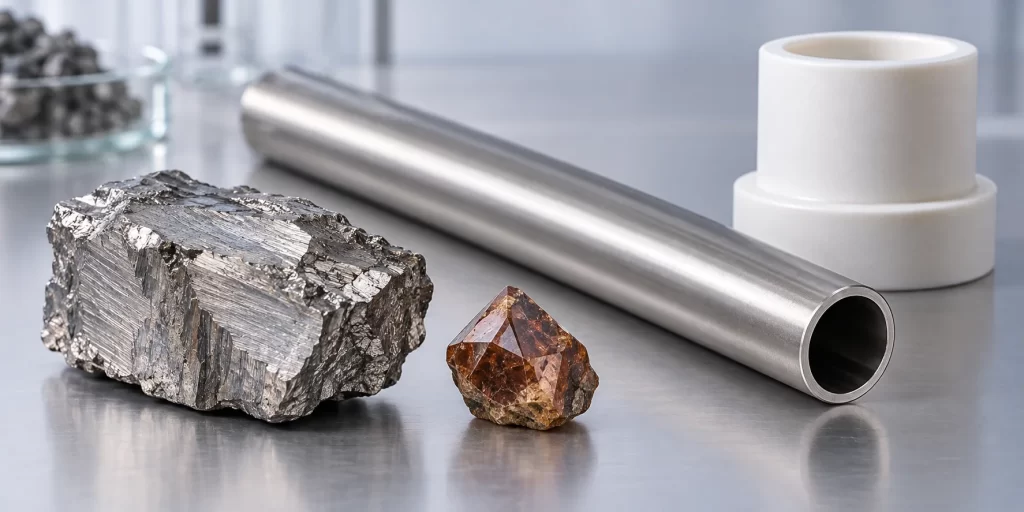
Zirconium is element 40: a silvery transition metal whose most important properties are easier to understand when you separate the metal from the minerals and ceramics made with it. A piece of zirconium metal can resist corrosion because a protective oxide forms at its surface. A zircon crystal is a naturally occurring zirconium silicate. Zirconia, or zirconium dioxide, is a manufactured or naturally occurring oxide used in ceramics. These related materials are not interchangeable, and confusing them obscures why zirconium appears in everything from heat-resistant linings to nuclear fuel cladding.
This guide builds from the periodic-table facts to the underlying chemistry, extraction, applications, and limitations. It is intended for students and curious readers who want more than a list of numbers. Where a property depends strongly on temperature, purity, or the exact material form, that qualification matters. The values below describe the element under ordinary reference conditions unless stated otherwise, and engineering decisions require a specification for the actual alloy or ceramic.
Zirconium at a glance
Zirconium has the chemical symbol Zr and atomic number 40. Every zirconium atom therefore has 40 protons; a neutral atom has 40 electrons. It sits in period 5 and group 4 of the periodic table, in the d-block. Its ground-state electron configuration is [Kr] 4d2 5s2. The Royal Society of Chemistry lists a density of about 6.52 grams per cubic centimetre, a melting point near 1,854°C, and a boiling point near 4,406°C. These are useful reference figures, but real components vary with composition and conditions.
The standard atomic weight deserves special attention because older tables and pages may disagree. In 2024, IUPAC revised zirconium’s standard atomic weight from 91.224 ± 0.002 to 91.222 ± 0.003. The atomic number, 40, did not change: it counts protons. Atomic weight is a weighted average influenced by the natural isotopic composition of the element. If a classroom resource still shows 91.224, that is an older recommended value rather than evidence that zirconium has been reclassified.
For a quick visual orientation, use Sly Academy’s interactive periodic table. Its position helps explain why zirconium resembles other group 4 elements. The table is a map of recurring chemical patterns, not a promise that neighboring elements behave identically in every industrial setting.
What does the periodic-table position tell us?
Being in group 4 means zirconium commonly forms compounds in the +4 oxidation state. In a simplified electron picture, it can use its two outer 5s electrons and two 4d electrons in bonding. This is a teaching model, not a literal account of four electrons being removed in every reaction. Actual bonding depends on the compound. Zirconium dioxide, ZrO2, is an especially important +4 compound; zirconium tetrachloride, ZrCl4, is another. Zirconium can show other oxidation states, but +4 dominates introductory chemistry and many industrial applications.
Its period tells you that its occupied electron shells extend farther than those of titanium, the group 4 element above it. Going down a group often changes atomic size and physical properties, yet the pattern is complicated by the transition-metal electrons. Zirconium is particularly close in size and chemistry to hafnium, the element immediately below it. This relationship is unusually important because the two elements occur together in ores and can be difficult to separate. See the site’s hafnium element overview for the companion element, while keeping in mind that specialized applications demand much more exact purity data than a general element page supplies.
What is zirconium, and what is it not?
Elemental zirconium is a metal. In bulk form it is greyish-silver, workable under suitable conditions, and valued for corrosion resistance. Its surface readily develops a thin, adherent oxide film. That film helps slow further attack in many environments, much as protective surface films help some other metals. Resistance is conditional: a claim that zirconium is simply “corrosion-proof” would be wrong. Particular acids, high temperatures, surface damage, and fabrication details can change performance, so a chemical plant specifies a particular grade and service environment.
Zircon is a mineral with the formula ZrSiO4, zirconium silicate. It is the principal commercial source of zirconium and is found in heavy-mineral sand deposits. A zircon grain is not a small piece of pure zirconium metal. It already contains silicon and oxygen bound into a crystal structure, so obtaining useful zirconium chemicals or metal requires processing. Zircon crystals can also be gemstones. Their colour and appearance should not be used as a guide to the appearance of the refined metal.
Zirconia is zirconium dioxide, ZrO2. It is a ceramic material, not a metal, and its high-temperature behaviour, hardness, and electrical properties make it useful in applications very different from an unalloyed zirconium tube. Cubic zirconia is a deliberately stabilized cubic form of zirconium dioxide often used as a diamond simulant; it is neither natural zircon nor diamond. A dental zirconia crown is also not made from elemental zirconium metal. The material name may be shared across contexts, but the composition and microstructure determine the useful property.
Another source of confusion is “zirconium alloy.” Nuclear fuel cladding, for example, is commonly an engineered zirconium-based alloy with carefully controlled composition and manufacturing history, not a random piece of pure metal. An alloy can be designed for strength and oxidation performance while retaining the nuclear advantage associated with zirconium. The specification matters: a chemistry exam can use “zirconium” as a broad label, whereas an engineer must know the exact product.
Where is zirconium found?
Zirconium is not normally encountered as free metal in nature. It occurs in minerals, most notably zircon, in igneous rocks and in sediments produced as rocks weather. Zircon grains are hard and chemically durable enough to survive transport and become concentrated with other heavy minerals in certain sands. The U.S. Geological Survey describes zircon as zirconium’s principal commercial source and notes that zirconium and hafnium are commonly associated. Ore concentration is only the beginning of the supply chain: mining and separation of mineral grains are distinct from conversion into a ceramic powder or a low-hafnium nuclear-grade metal.
The chemistry of a zircon sand does not automatically make it appropriate for every use. Ceramic manufacturers may value zircon or zircon-derived zirconia, while reactor components require carefully processed metal and stringent limits on certain impurities. One of the most important is hafnium. Chemically, hafnium tracks zirconium closely enough to accompany it through many processing steps. Neutron behaviour, however, differs sharply: hafnium absorbs neutrons much more readily. In a nuclear fuel-cladding application, where neutron economy is important, hafnium must be removed to a very low specified level. In a control-rod application, strong neutron absorption can instead be useful. “Difficult to separate” and “different in use” can both be true.
Heavy-mineral sands are geological and economic resources, not inexhaustible piles of pure zircon. A deposit’s grain size, mineral assemblage, location, environmental constraints, processing route, and demand all affect whether it can be used. The location of a resource is also not the same as the location where purified chemicals, sponge metal, or finished tubes are manufactured. Those stages may occur in different countries. A current supply or price claim should therefore specify its year, product form, and source rather than treating all zirconium materials as one market.
How is zirconium produced from zircon?
Starting with zircon, a producer first separates zircon-rich mineral grains from other sands and heavy minerals. Chemical processing then breaks down the stable zirconium silicate structure to make zirconium compounds. Depending on the intended product, these compounds may be purified and converted to zirconia or processed further toward a metal. The exact industrial route differs by plant and product grade; there is no single household-scale “extract zirconium from sand” step. High-temperature chemistry, corrosive reagents, and strict quality control belong in industrial facilities, not classroom demonstrations.
One common metal-production concept converts purified zirconium compounds into zirconium tetrachloride and then reduces that chloride to zirconium metal. Further refining and fabrication produce the shape required by the customer. This outline explains the logic—break apart a durable ore mineral, purify the desired element, chemically reduce it, then make a qualified product—without suggesting that a crude intermediate is suitable for a reactor or medical device. Purity, oxygen content, trace contaminants, and processing history can all affect the result.
Hafnium separation is a distinct and technically demanding part of the nuclear-grade route. The two elements have similar chemical behaviour, so ordinary separation approaches are less effective than one might expect for metals with different atomic numbers. Industrial methods exploit subtle differences between their compounds. The details vary by process; the educational point is that a small difference in chemistry can be amplified through carefully designed separation stages. The final product must be tested against its intended specification rather than assumed pure because it started from a familiar mineral.
Not every application needs elemental zirconium. Ceramics can start from zircon or zirconia powders; foundry and refractory applications use mineral or oxide materials rather than purified metal. When reading a production statistic, look for the unit and material: tonnes of zircon concentrate, tonnes of zirconia, and tonnes of zirconium metal describe different points in a chain. Combining them as though they were one number would be misleading.
Why does zirconium resist corrosion?
Fresh zirconium reacts with oxygen at its surface and forms zirconium oxide. A coherent oxide layer can act as a barrier between the underlying metal and the environment, slowing continued reaction. This is called passivation. It explains why a chemically reactive metal can nevertheless last well in certain service conditions. The distinction between thermodynamic reactivity and practical corrosion rate is useful: a substance may have a strong tendency to form an oxide, yet that oxide can protect what lies beneath.
Passivation is not magic. If an environment dissolves the oxide, if the film cracks under unsuitable conditions, or if temperature and chemistry cause rapid oxidation, protection can be lost. A lab result in room-temperature water cannot be transferred uncritically to hot acid or an accident scenario. Engineers use corrosion data for the exact chemical concentration, temperature, pressure, material grade, joining method, and exposure time. Readers should also distinguish the protective oxide on a metal surface from a bulk zirconia ceramic, whose entire body is oxide.
This same distinction helps explain two apparently conflicting descriptions: zirconium metal is used for corrosion-resistant equipment, yet finely divided zirconium can present a fire hazard. A compact piece and a fine powder have very different surface area relative to mass. Powder exposes far more metal to oxygen at once, and its handling requires controls. Never use a classroom fact about bulk metal to infer that machining dust or powder is harmless.
Why is zirconium used in nuclear reactors?
In many nuclear power reactors, zirconium-based alloys form thin tubes around fuel pellets. These tubes, called fuel cladding, separate the fuel from the coolant during normal operation and contribute to the overall fuel-assembly design. Zirconium is attractive partly because it has a relatively low tendency to absorb the neutrons needed to sustain the reactor’s controlled chain reaction. It can also offer useful strength and corrosion performance in the specified operating environment. Those properties must be considered together; neutron behaviour alone would not make a practical cladding material.
This is why separating hafnium matters. Hafnium’s neutron-absorbing character is valuable in some reactor-control applications but undesirable in low-absorption cladding. An ore naturally containing both elements cannot simply be rolled into fuel tubes. Nuclear-grade production includes chemical separation, alloying, tube fabrication, and qualification. The phrase “zirconium is used in reactors” therefore describes a highly engineered product and regulated system, not a do-it-yourself use of a naturally occurring metal.
There are also limits to zirconium-based cladding. At sufficiently high temperatures, zirconium can react with steam, generating heat and hydrogen. That hazard becomes important in severe accident analysis and is one reason reactor designs include multiple safety systems and why research has explored improved cladding materials. Mentioning low neutron absorption without this limitation would present an incomplete picture. Ordinary reactor operation and severe-accident conditions should not be conflated: material behaviour changes as temperature and environment change.
A useful study question is: why not substitute hafnium if it is chemically similar? The answer combines chemistry and physics. Chemical similarity makes it difficult to remove from zirconium, but neutron absorption makes it a poor substitute for a part designed to avoid capturing neutrons. This example shows why the periodic table is a starting point for material selection, not a complete design manual.
How are zircon and zirconia used outside nuclear technology?
USGS identifies ceramics as a major destination for zircon. A ceramic glaze or tile body needs materials that respond predictably to firing and produce the desired appearance or properties. Zircon can act as an opacifier, making a glaze less transparent, and zirconium-bearing materials can contribute to high-temperature formulations. This is a different economic stream from purified zirconium metal. A statement that “zirconium goes into tiles” often means a zirconium compound or mineral goes into ceramic production, not that shiny metal is embedded in a tile.
Zircon also serves in foundry sands and refractory applications. In a foundry, a mold or facing material must tolerate molten metal long enough to create the intended shape. A refractory lining must retain useful properties at elevated temperature. Zircon’s mineral stability can help in these settings, although exact performance depends on grain quality, binder, thermal cycle, and the metal being cast. “Heat resistant” should be read as a material-selection property within a defined range, not as immunity to all heat or chemical attack.
Zirconia ceramics have their own important roles. Some grades can be engineered for strength and toughness compared with many conventional ceramics. A commonly taught mechanism is transformation toughening: an appropriate zirconia crystal phase can transform near a growing crack and consume energy, helping impede crack growth. The effect depends on composition and microstructure. Adding stabilizers and controlling processing can retain useful phases at service temperature. It would be inaccurate to say every piece of zirconia has the same toughness, or that cubic zirconia jewelry behaves like a structural engineering ceramic.
Dental restorations illustrate the distinction. The material is usually a carefully processed zirconia ceramic selected and designed for a specific restoration, then fabricated and finished to clinical standards. It is not made from a zircon gemstone or a chunk of zirconium metal. Appearance, translucency, mechanical reliability, surface finish, and patient-specific factors all matter. A general chemistry page should explain the material family but cannot recommend a dental treatment for an individual.
Zirconia also appears in thermal-barrier coatings and oxygen-sensing technologies. Stabilized zirconia can conduct oxide ions at high temperature, a property exploited in certain sensors and solid-oxide electrochemical devices. The phrase “conducts ions” does not mean an ordinary piece of zirconia behaves like a copper wire at room temperature. Temperature, phase, and composition are central. In thermal barriers, the objective is to reduce heat transfer to a protected component under demanding conditions; coating architecture, adhesion, and thermal cycling determine performance.
The metal has applications beyond reactors where corrosion resistance matters, including selected chemical-processing equipment. Zirconium alloy or metal parts can be useful when a process fluid would rapidly degrade a less suitable material. Engineers compare it with alternatives on lifetime, process conditions, fabrication, and cost. There is no universal ranking in which zirconium always “beats” stainless steel, titanium, or nickel alloys. For a student, the safe conclusion is that zirconium offers a useful set of properties; for a plant, the conclusion requires detailed testing and standards.
Is zirconium radioactive or dangerous?
Ordinary zirconium is not inherently radioactive just because it is used near nuclear fuel. Its role as fuel cladding is based on material and neutron properties, not because it supplies the reactor’s energy. Naturally occurring zirconium consists of several isotopes, and discussions of isotopes should not be confused with the behaviour of a reactor component after service. A material that has been inside a reactor must be managed according to the relevant nuclear-safety rules; that is a different context from a new commercial piece of zirconium metal.
Safety also depends on form. A bulk metal article, a heated surface, a fine powder, a soluble compound, and a respirable ceramic dust have different hazards. Fine metal particles can ignite more easily than bulk material, while airborne dust calls for exposure controls regardless of whether the same material is familiar from a tile or a dental crown. In a school setting, consult the actual safety data sheet for the exact product before handling it. Do not grind a sample to test its properties or assume that a “natural mineral” is safe to inhale.
Some zircon minerals may contain small amounts of other elements, including naturally occurring radioactive constituents, depending on their geological origin. That does not turn every zircon gemstone or zircon-containing object into a significant radiological hazard. It does mean that broad claims such as “all zircon is radioactive” or “no zircon material ever needs monitoring” are both too sweeping. Occupational and regulatory decisions rely on analysis of a particular material and its use.
How do zirconium, titanium, and hafnium compare?
All three sit in group 4, so they share some broad chemical tendencies, including an important +4 oxidation state. Titanium is above zirconium; hafnium is below it. For a quick neighboring-element comparison, Sly Academy’s titanium element guide gives a starting point. Yet group membership does not establish interchangeability. Density, melting behaviour, corrosion in a particular chemical, supply chain, manufacturing methods, and nuclear properties differ.
Zirconium and hafnium are especially close in chemistry and often travel together in mineral processing. Their near-match in size is related to the effect of the intervening lanthanide elements on atomic radii, sometimes called lanthanide contraction. At an introductory level, the important outcome is that a simple expectation—atoms get much bigger as you move down a group—does not fully predict this pair. Their similarity explains the separation challenge, while their different neutron interactions explain why the separation can be essential.
Titanium offers a different comparison. It is widely associated with high strength-to-weight performance and a durable oxide film. Zirconium is denser, and its industrial story is more strongly tied to zircon minerals, ceramics, and specific nuclear uses. Both metals can resist corrosion under appropriate conditions, but neither can be selected for a new environment solely from a periodic-table position. The right question is not “Which group 4 metal is best?” but “Which verified material meets the operating requirements at an acceptable total cost?”
A compact way to study the family is to list one shared feature and one application-specific difference for each pair. Shared: their +4 compounds are common. Difference: titanium and zirconium have distinct density and manufacturing economics; zirconium and hafnium have strikingly different neutron-absorption behaviour. That exercise prevents memorized labels from replacing causal understanding.
What do zirconium’s isotopes and atomic weight mean?
Atoms of an element all have the same number of protons, but may have different numbers of neutrons. Such versions are isotopes. Zirconium’s atomic number 40 therefore remains fixed across zirconium isotopes. The mass number of a particular isotope counts protons plus neutrons, whereas standard atomic weight summarizes the isotopic mixture found in normal terrestrial materials. It is not the mass number of one zirconium atom and need not be an integer.
This explains the IUPAC update without implying that a new element was discovered. As measurements and evaluations improve, a recommended standard atomic weight can change slightly. A difference between 91.224 and 91.222 is small for many classroom calculations, but it matters for a page claiming to give the current official figure. Report the value with its uncertainty when precision is the point; round appropriately when estimating a simple molar mass. Do not attach more decimal places to a computed answer than the input data justify.
For instance, a sample described as one mole of zirconium atoms has a mass of roughly 91.22 grams using the current standard atomic weight. That is an approximate statement about an amount of substance. It is not a claim that each individual zirconium atom weighs exactly 91.22 atomic mass units. An individual isotope has its own mass, and a natural sample mixes isotopes. Keeping those levels separate is a transferable skill for every element in the periodic table.
How was zirconium discovered and named?
The name is connected to zircon, the mineral. Martin Heinrich Klaproth identified zirconium oxide in a zircon sample in 1789, but identifying an oxide was not the same as isolating the free metal. Jöns Jacob Berzelius later produced an impure form of zirconium metal in 1824. Modern high-purity production developed through subsequent advances in chemical separation and metallurgy. Discovery dates often differ across short sources because they may mean recognition of a new element in a compound, isolation of an impure metal, or production of a pure usable product.
This history is a useful reminder of how chemistry progresses. A chemist can infer that an unknown component exists in a mineral before anyone can make a clean sample of the element. A natural gemstone, a laboratory oxide, and a refined metal are different evidence about the same underlying element. When studying element histories, ask what exactly was obtained and how the researchers knew it contained a distinct element.
Worked examples and common mistakes
Example 1: read an element box correctly
Suppose an element box shows Zr, 40, and 91.222. Zr is the symbol. Forty is the atomic number, so a neutral zirconium atom has 40 electrons and its nucleus has 40 protons. The number near 91.222 is the current standard atomic weight, not a count of neutrons. Subtracting 40 from 91.222 does not give a physically meaningful fractional neutron count for one atom. To find neutrons in a specific isotope, first use that isotope’s integer mass number.
Example 2: identify the material in a product
A seller describes a “zirconium” decorative stone. Before assuming anything, ask whether it is natural zircon, cubic zirconia, or another material entirely. Zircon is ZrSiO4; cubic zirconia is a form of ZrO2; zirconium metal is Zr. The fact that two names share a root does not make their chemical formulas, origins, or optical properties identical. The same check helps with industrial claims: identify the material formula and product grade before comparing performance.
Example 3: explain a reactor-material choice
A question asks why hafnium must be reduced in zirconium alloy used for fuel cladding. A strong answer has two steps. First, zirconium is useful in that role partly because it absorbs relatively few neutrons. Second, hafnium accompanies zirconium in ores but absorbs neutrons much more strongly, so unwanted hafnium would undermine that design advantage. The answer should not say hafnium is removed because it is chemically unrelated; their close chemical similarity is precisely what makes removal challenging.
Example 4: interpret a corrosion claim
A catalogue says zirconium is “immune to corrosion.” Translate that into a testable question: immune in which liquid, at what concentration and temperature, for how long, and in what grade and surface condition? Zirconium’s protective oxide can provide excellent resistance in many environments, but no material can be chosen safely from an absolute slogan. This approach applies to stainless steel and titanium too. The mechanism gives a reason to investigate the material; the application data establish whether it fits.
How to study zirconium without memorizing disconnected facts
Start with a three-column note: element, mineral, and oxide. Put Zr metal under element; zircon, ZrSiO4, under mineral; and zirconia, ZrO2, under oxide. Then attach each major use to the actual material. Fuel cladding belongs to a zirconium alloy, tile opacification often to zircon-bearing material, and a dental restoration to an engineered zirconia ceramic. This one distinction resolves many otherwise puzzling descriptions.
Next, connect property to application. Low neutron absorption helps explain fuel cladding; the need to keep hafnium low follows from the opposite neutron behaviour. A stable oxide film helps explain corrosion resistance, while its limits explain why a service specification is still needed. High-temperature ceramic properties help explain refractories and coatings. Rather than collecting ten unrelated “uses,” build a causal chain for three of them. It is more memorable and less likely to produce incorrect substitutions.
Finally, date-check numerical claims. IUPAC’s 2024 standard-atomic-weight revision is a clear example of a small but real update. Some older chemistry pages continue to display 91.224, and that may be acceptable when quoting an old edition; a current guide should label the current recommendation. Market figures, countries leading production, and application shares change even faster. For those, use the latest clearly dated USGS commodity report rather than copying a number from an undated summary.
Key takeaways
Zirconium is element 40, a group 4 transition metal. Its present IUPAC standard atomic weight is 91.222 ± 0.003. Natural zircon is zirconium silicate, while zirconia is zirconium dioxide; neither is synonymous with elemental metal. Zircon is an important ore and industrial mineral, zirconia is a versatile ceramic, and carefully purified zirconium alloys have specialized uses including fuel cladding. Hafnium’s close chemistry but very different neutron behaviour is central to the nuclear-grade story. The useful habit throughout is to ask which material form, purity, temperature, and application a claim describes.
Sources and further reading
- IUPAC: revised standard atomic weights of technology-critical elements (zirconium update, 2024).
- Royal Society of Chemistry: Zirconium element profile (periodic-table properties, compounds, uses, and discovery; note its atomic-weight display predates the IUPAC revision).
- U.S. Geological Survey: Zirconium and Hafnium Statistics and Information (minerals, association, and major applications).
- U.S. Geological Survey: Mineral Commodity Summary 2026, Zirconium and Hafnium (dated supply-chain and use context).