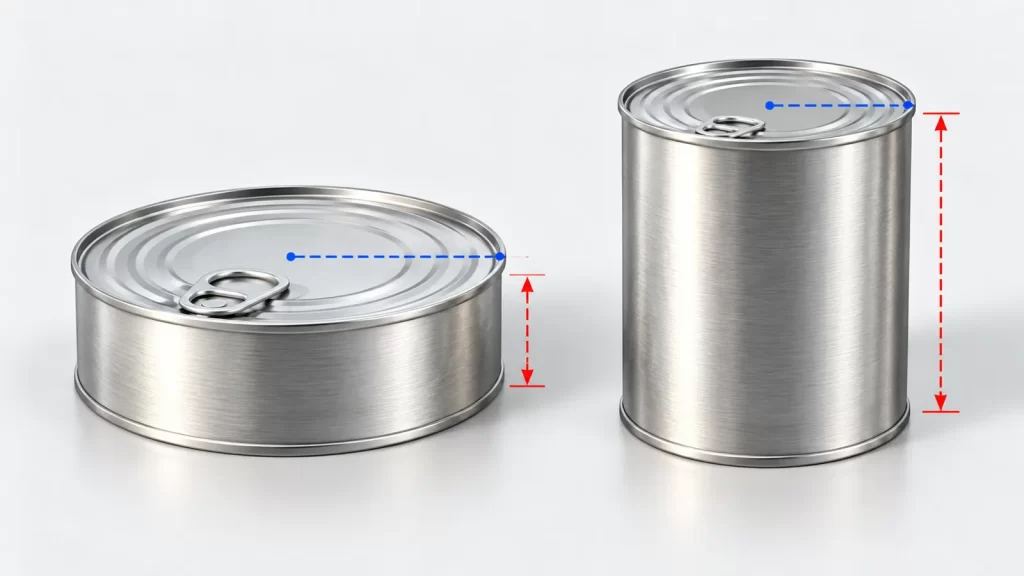
A closed cylindrical can can have many combinations of radius and height while using the same idealized area of material. Which combination contains the most? For a right circular cylinder with a top and a bottom, the answer is simple: its height should equal its diameter, or h = 2r. Reaching that answer responsibly takes more than quoting a formula. We must define what “fixed surface area” includes, express volume using one variable, check that the stationary point is a maximum, and separate the mathematical model from the practical decisions a manufacturer would make.
This guide develops the full argument and then applies it to measurements from an existing tuna can. It explains the roles of units, rounding, derivatives, graphs, and percentage comparisons. It also shows why an open-top container has a different optimal proportion. Readers who want to review the underlying technique can start with our introduction to differentiation; those checking the capacity of a particular container can use the site’s volume calculator after doing the reasoning by hand.
1. Identify the objective and the constraint
An optimization problem asks for the largest or smallest possible value of an objective subject to a restriction. Here the objective is interior volume, measured in cubic units. The restriction is a fixed total surface area, measured in square units. Let r be the radius, h the height, A the fixed area, and V the volume. Both r and h must be positive. We assume a closed right cylinder, with circular top and bottom perpendicular to its axis. Under this ideal geometry, the area consists of the two circular ends plus the curved side.
The two formulas are V = πr2h and A = 2πr2 + 2πrh. The end circles contribute 2πr2. If the curved wall is cut and unrolled, it is a rectangle of width 2πr, the base circumference, and height h; its area is 2πrh. OpenStax’s cylinder formulas provide a useful independent check. Writing both expressions down before differentiating is essential: using the area of only the wall, or counting one end instead of two, changes the problem.
Holding A fixed does not hold V fixed. A short, wide can devotes a large share of its area to the two ends, leaving less for the side wall. A tall, narrow can spends relatively little on its ends but needs a large area of wall to reach its height. Neither extreme uses the area efficiently for enclosed volume. The best proportion lies between them. Notice that “same surface area” is a geometric constraint, not a complete cost model. Real packaging has seams, tabs, material thickness, cutting waste, and sometimes different materials for the wall and lid. Those effects can change the economically preferred dimensions without making the mathematical result wrong.
2. Reduce the problem to one variable
The volume formula contains both r and h, so differentiating it while pretending the other dimension remains fixed would violate the area constraint. Instead, solve the constraint for h. Subtract the area of the two ends from A, then divide by the wall circumference: h = (A – 2πr2)/(2πr) = A/(2πr) – r. This expression tells us the only height compatible with a chosen radius and the fixed area. It also shows that the allowed radius is not arbitrary. A positive height requires A – 2πr2 > 0, so 0 < r < √(A/(2π)).
The lower boundary r = 0 is not a cylinder with a usable circular base. At the upper boundary, the two circular ends consume all the available area and h becomes zero. Both limits produce zero enclosed volume. We will use that fact when deciding whether a local maximum is also the global maximum within the physical model. Restricting the domain is not a cosmetic step: a cubic formula can have mathematical behavior outside the range of positive-radius, positive-height cans, but those values have no physical interpretation in this problem.
Substitute the height expression into V = πr2h. After cancellation, V(r) = (A/2)r – πr3. This is a one-variable function representing every admissible closed cylinder with the specified surface area. For a small radius, increasing r makes more effective use of the area and volume initially rises. For a sufficiently large radius, the cubic term reflects the growing amount of material consumed by the ends, so volume falls. The calculation below locates the turning point precisely instead of relying on visual intuition.
3. Differentiate, test, and interpret
Treat A as a constant. The derivative of the one-variable function is V'(r) = A/2 – 3πr2. Set it equal to zero: A/2 = 3πr2, hence r2 = A/(6π) and r = √(A/(6π)). Only the positive root belongs to the physical domain. Substitute that radius into the area constraint. Since A = 6πr2 at the stationary point, 6πr2 = 2πr2 + 2πrh. Divide by 2πr to obtain 3r = r + h, and therefore h = 2r.
Why is this a maximum rather than a minimum? The second derivative is V”(r) = -6πr, negative for every allowed positive radius. The volume curve is concave down throughout the physical domain, so its only stationary point is a local maximum. Moreover, volume approaches zero at both domain boundaries. The continuous curve rises from zero, reaches that one peak, and falls back to zero, making the stationary point the global maximum for this idealized fixed-area family. A first-derivative sign test gives the same result: V’ is positive before √(A/(6π)) and negative afterward.
The condition h = 2r means height equals diameter. It does not mean height equals radius. It also does not prescribe a single numerical size, because the fixed area determines the scale. Once A is known, the optimal radius is √(A/(6π)), the optimal height is twice that radius, and the maximum volume is Vmax = 2πr3 = A3/2/(3√(6π)). The last formula is optional in many school solutions; the proportion and the justified maximum are the central results.
4. Worked example: an existing tuna can
The original post measured a tuna can with height 4.1 cm and circumference 27.2 cm. Those are observations from a particular can, not universal tuna-can dimensions. We can use them to estimate its volume and surface area, then ask what ideal closed cylinder would maximize volume if that same area were redistributed. Measurement precision matters: a circumference read to a tenth of a centimeter does not support reporting a manufactured design to eight decimal places. We keep extra digits during calculation to avoid compounding rounding errors, but round the reported comparison sensibly.
Step 1: recover the radius from circumference
For a circle, C = 2πr. With C = 27.2 cm, r = 27.2/(2π) cm, approximately 4.329 cm. The diameter is about 8.658 cm. This can is wider than it is tall: its height of 4.1 cm is much less than its diameter. That observation alone suggests that, under the closed-cylinder model, changing the proportions could raise capacity. It does not yet tell us how much, because the new radius and height must satisfy the same total-area constraint. Always use the radius, not the measured circumference or diameter, in the volume formula.

Step 2: compute the starting volume and area
Substituting the measured radius and height into V = πr2h gives Voriginal = π(27.2/(2π))2(4.1), approximately 241.39 cm3. One cubic centimeter is one milliliter, so the geometric capacity is about 241 mL, subject to the accuracy of the measurements and ignoring wall thickness. The fixed closed area is A = 2πr2 + 2πrh, approximately 229.27 cm2. The two end faces account for about 117.75 cm2; the curved wall contributes about 111.52 cm2. Small differences in the last hundredth result from rounding the intermediate radius.
These two numbers answer different questions. Volume measures how much the can can hold, while surface area represents the ideal sheet area enclosing it. It would be incorrect to place 241.39 directly into the fixed-area optimization formula, because it is a cubic-unit quantity, not a square-unit constraint. The comparison will keep A = 229.27 cm2 fixed and allow r and h to change together. This is the part of a word problem where a quick units check often catches an otherwise plausible-looking error.
Step 3: find the optimal dimensions under the same area
Apply ropt = √(A/(6π)) using the unrounded area from the original measurements. The result is approximately 3.488 cm. The optimal height is 2ropt, approximately 6.975 cm. Thus an ideal redesign would be narrower and taller than the measured can. In the redesigned shape, height and diameter are equal to about 6.98 cm. Reinsert these dimensions into the area expression: 2πropt2 + 2πropthopt returns about 229.27 cm2, apart from rounding. That substitution verifies that the proposed redesign actually obeys the original constraint.
The corresponding maximum volume is Vopt = πropt2hopt, approximately 266.53 cm3. The difference from the measured can is about 25.14 cm3. It is important to phrase this carefully: under the idealized same-area model, those dimensions would hold more geometric volume. We have not tested whether they suit a production line, stacking case, consumer preference, shipping carton, stability requirement, or the actual filled amount marked on a food package.
Step 4: choose the percentage baseline explicitly
There are two sensible percentages, but they answer different questions. Relative to the original can, the potential volume gain is (266.53 – 241.39)/241.39 times 100%, about 10.4%. Relative to the theoretical optimum, the original can achieves 241.39/266.53 times 100%, about 90.6% of the maximum. The remaining gap expressed as a fraction of the optimum is about 9.4%. These numbers are not contradictory: the denominators differ. If someone asks “How much larger could the capacity be than it is now?”, use the original volume as the denominator. If someone asks “How close is the current design to the best possible?”, use the optimal volume.
The numerical conclusions are only as trustworthy as the measurements. A physical can may have a rim whose measured outer circumference differs from the interior radius, rounded edges, a recessed bottom, and nonuniform wall thickness. All of those can shift the actual fillable volume and actual material area. For a classroom optimization exercise, the ideal cylinder is exactly the intended model; for engineering, it is a starting benchmark that should be paired with manufacturing specifications and direct volume measurement.
5. What the graph says
For the tuna-can area, plot V(r) = (A/2)r – πr3 over its allowed positive-radius interval. The curve rises from near zero at a tiny radius, peaks near r = 3.488 cm, and falls toward zero as r approaches √(A/(2π)). The vertical height at the peak is about 266.53 cm3. The measured radius, about 4.329 cm, lies to the right of the peak. That placement makes the redesign intuitive: move left to a slightly smaller radius, then use the freed end area to add enough wall height to increase the enclosed space.
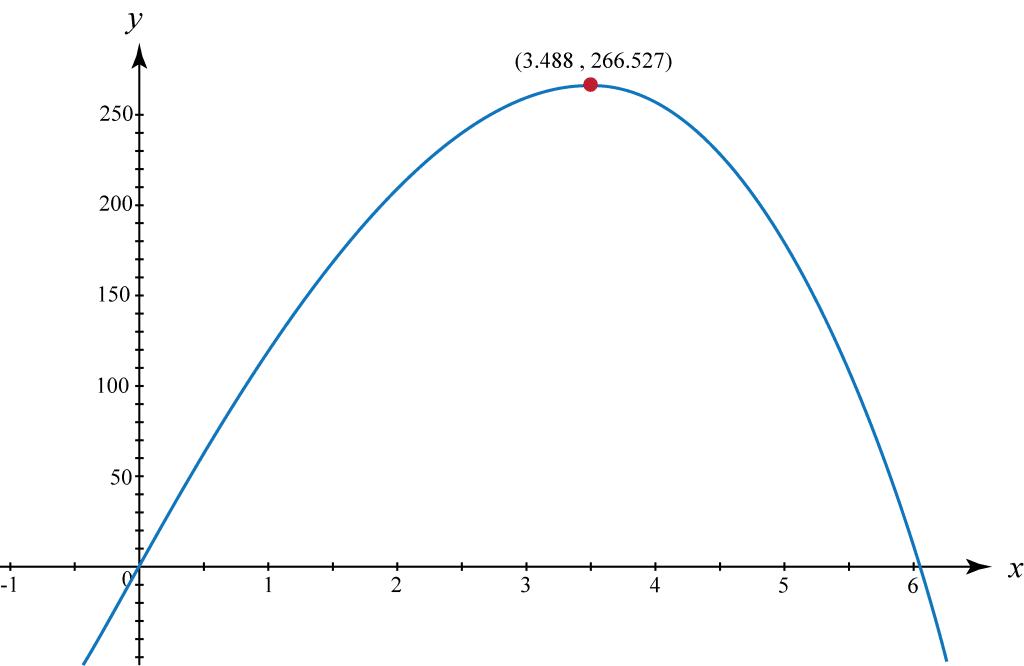
A graph is evidence about shape and a good error check, but it is not a substitute for stating the domain and differentiating. A graphing application may draw the cubic for negative radii or for radii that imply a negative height, both of which are mathematically defined by the algebraic expression but physically invalid here. Restrict the plotted horizontal range to the feasible domain, label both axes with units, and check that the plotted peak agrees with the derivative calculation. In AP Calculus AB practice, explaining this modeling step is often as valuable as obtaining the final numerical answer.
6. A second way to understand the optimal proportion
The calculus result h = 2r can be interpreted directly through the area allocation at the optimum. The end circles use 2πr2. Because h = 2r, the wall uses 2πr(2r) = 4πr2. Thus one-third of the ideal total area goes to the two ends and two-thirds goes to the wall. This is a consequence of the optimal geometry, not a separate rule to impose before solving. If the sheet area is A, the optimum end area is A/3 and the wall area is 2A/3. Plugging that ratio back into the circumference and height relationship recovers the same dimensions.
Another approach starts with the same constraint but solves it for r only after choosing a convenient nondimensional ratio k = h/r. Then A = 2πr2(1 + k) and V = πkr3. Holding A constant means r shrinks as k grows. After substituting r = √(A/[2π(1+k)]), the volume is proportional to k/(1+k)3/2. Differentiating this dimensionless expression yields its peak at k = 2. This route can be helpful when comparing containers of different absolute sizes: the best ratio is independent of the value of A. Be careful, however, not to treat k and r as independent once the area has been fixed.
The scaling behavior offers a useful check. If every linear dimension is multiplied by a factor t, surface area grows by t2 while volume grows by t3. Consequently, if the available area is multiplied by four, an optimal cylinder’s radius and height both double, and its maximum volume becomes eight times as large. That agrees with Vmax being proportional to A3/2. This scaling is a property of similar geometric cylinders. It should not be confused with the fixed-area comparison in the tuna-can example, where A does not grow at all.
7. What if the cylinder has no top?
“Cylinder” alone does not tell us whether the container is closed. A drinking cup, open storage bin, or uncapped tank has one circular base and a curved wall, but no top disk in the material-area constraint. Under the ideal open-top model, A = πr2 + 2πrh while V = πr2h still. Solve for height: h = (A – πr2)/(2πr). Substitution gives V(r) = Ar/2 – πr3/2. Differentiating produces V'(r) = A/2 – 3πr2/2. The stationary point satisfies r2 = A/(3π).
Put that radius into A = πr2 + 2πrh. Since A = 3πr2, the wall area is 2πr2, so 2πrh = 2πr2 and h = r. The open-top optimum has a height equal to the radius, not the diameter. Its second derivative is -3πr, negative for positive r, and its endpoint volumes again approach zero, so this is the global maximum in the ideal open-top family. Memorizing h = 2r without checking whether the lid exists would therefore give the wrong answer to a common variant of the problem.
Other constraints lead to still other proportions. If the cylinder has a separate lid made of another material, the wall and the end faces may carry different costs. If a fixed volume must be enclosed while area is minimized, the ideal closed-cylinder result is again h = 2r, but the algebra is arranged around a different objective. If the diameter is fixed by a production line, then radius is not a decision variable and the calculus problem may vanish. State the exact objective, included surfaces, and adjustable dimensions before applying any remembered rule.
8. Why a real can may not use the geometric optimum
A manufacturer may value many outcomes besides ideal volume per unit of outer surface area. Taller cans can be less stable on a narrow base, may not fit existing shelves or cases, and might require changes to a filling line. A very broad can may be easier to stack or scoop from. Seams and rolled rims add material in ways the smooth-cylinder formula omits. The lid may need stronger metal than the wall, and cutting circular pieces from sheet stock creates scrap that is not captured by the final surface area. Therefore the cost-minimizing design need not exactly match the pure geometric h = 2r rule.
The important educational lesson is not that all food cans should be remade. It is that a clear model isolates one tradeoff. With the total area held constant and the shape restricted to a closed right circular cylinder, the mathematical optimum is precise. An engineer can then add further constraints: target volume, shelf height, tooling diameter, material grades, allowable pressure, structural strength, accessibility, and shipping efficiency. Each addition should be represented honestly, rather than silently claiming the introductory formula accounts for it. This separation between model and reality makes a calculus answer more persuasive, not less useful.

9. Common mistakes to catch before finishing
Confusing radius and diameter: The answer h = 2r says the optimal height equals the full diameter. If a drawing labels diameter d, write h = d. Substituting d directly where a radius belongs in πr2h makes volume four times too large for the same height. Similarly, when circumference is given, divide it by 2π to obtain r. A quick sketch of the circular end can prevent this mistake.
Leaving a face out of the constraint: A closed can has two end circles. An open cup has one. A cylindrical sleeve with neither end has none. The volume formula may stay the same, but the area constraint—and hence the optimum—changes. Do not choose the formula by the word “cylinder” alone; describe the physical object. If a lid is a separate component but still counts toward the same area budget, include it. If it is not part of the budget, make that assumption explicit.
Optimizing two variables independently: At fixed area, r and h are coupled. Increasing the radius without adjusting the height adds material and violates the problem. Solve the constraint and substitute before differentiating, or use a legitimate two-variable constrained-optimization technique. The one-variable method is usually easier to audit. Check each algebraic step by inserting the final dimensions into the original area formula; if the recomputed area has changed, the answer is not feasible even if the derivative is zero.
Stopping at a critical point: A zero derivative identifies a candidate, not automatically the desired maximum. State the physical domain, apply a second-derivative or sign test, and consider limiting behavior at the domain boundaries. Here V” is negative and the volumes at both limits are zero, so there is one global maximum. In a different optimization problem with a restricted closed interval, an endpoint could win; always inspect endpoints when they belong to the domain.
Mixing precision and units: Surface area is in cm2 when dimensions are in centimeters; volume is in cm3. Keep the full calculator value of π and unrounded dimensions during intermediate arithmetic. Then report dimensions and volumes to a precision suitable for the original measurements. Exact formulas are often more informative than a long decimal. In the tuna-can example, reporting a gain near 10.4% is more honest than claiming dozens of significant figures from measurements recorded to one decimal place.
10. A reusable method for similar questions
First, draw and label the object. Note whether the cylinder is closed, open, or missing both ends. Second, write the objective in the requested units. Third, write the constraint, accounting for every included surface. Fourth, solve the constraint for one variable and substitute, so the objective depends on a single positive dimension. Fifth, determine the feasible domain from physical requirements such as positive height. Sixth, differentiate and solve for stationary points. Seventh, verify the type of extremum and compare boundary behavior. Finally, restore the original variables, check the constraint numerically, and interpret the answer with its assumptions.
If measured dimensions are provided, add a comparison stage: compute the original area and volume, keep that area fixed in the optimization, calculate the new dimensions and volume, then state which quantity is the denominator for any percentage. A neat calculation is not the same as a complete explanation. A reader should be able to see why the chosen equation matches the actual container and why the resulting dimensions represent the best member of the stated family. For more general optimization practice, the LibreTexts optimization chapter develops the one-variable method and the importance of checking extrema.
11. Questions about the result
Does a taller cylinder always hold more?
No. At a fixed radius, extra height would increase volume, but it would also increase wall area. Under a fixed total-area budget, making a cylinder taller requires making it narrower. A very narrow, tall cylinder eventually loses capacity because the base area becomes tiny. The full constraint must be considered, not one dimension in isolation.
Is the result the same for a cup and a sealed can?
No. The sealed ideal cylinder has two circular ends and reaches its best fixed-area capacity when h = 2r. An ideal open-top cup has one end and reaches its best fixed-area capacity when h = r. Real cups can have a lip, taper, handle, or base thickness, so even the open-top cylinder is only a starting model.
Can I use the maximum-volume formula without calculus?
You can use the derived relationship h = 2r after verifying the problem has the same assumptions, then solve the area constraint for the dimensions. To explain why that relationship maximizes volume, however, show a derivative argument, a valid inequality, or another proof. Quoting the ratio without justifying its conditions can be misleading when a constraint changes.
Conclusion
For an ideal closed cylinder with a fixed total surface area A, the greatest volume occurs at r = √(A/(6π)) and h = 2r. The measured tuna-can example illustrates the method: an area near 229.27 cm2 corresponds to an ideal maximum of about 266.53 cm3, compared with about 241.39 cm3 for the observed proportions. The approximate 10.4% potential gain is relative to the original geometric volume, not a guarantee about a manufactured container. The transferable skill is to define the surfaces, preserve the constraint, and prove that the candidate really is the maximum.