
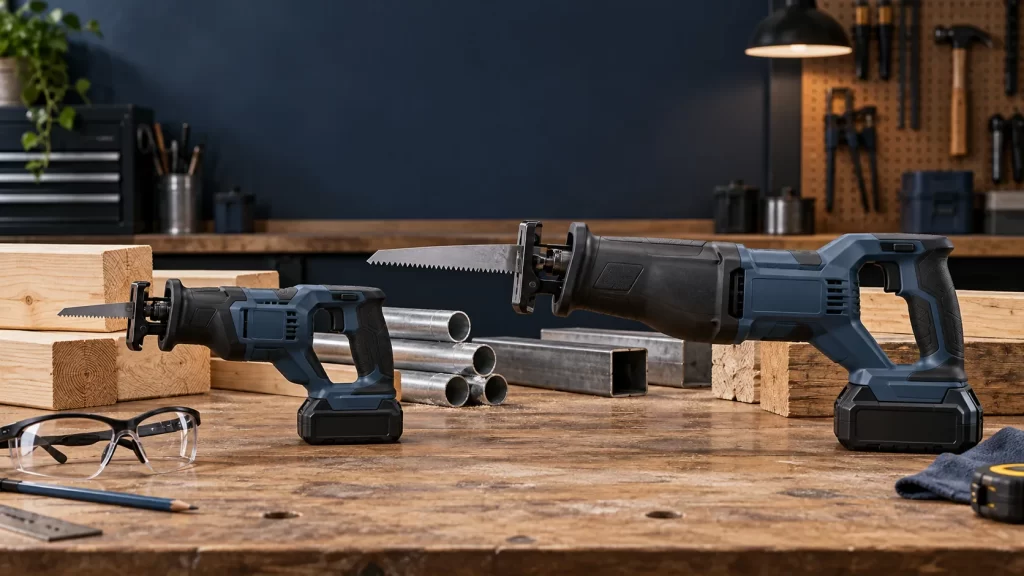
Hackzall vs Sawzall—quick answer: Choose a Milwaukee HACKZALL when the cut is accessible with a compact, one-handed reciprocating saw and mobility matters more than maximum cutting pace. Choose a full-size SAWZALL when the workpiece is large, repeated cuts are expected, or a two-handed grip and longer stroke make control easier. Neither name defines a single motor or power level: Milwaukee sells several models in each family, so compare the exact model, blade, battery and job rather than assuming every HACKZALL is weak or every SAWZALL needs a cord.
Both tools drive a straight blade back and forth. The shoe rests against the material while the blade teeth remove a narrow kerf. That makes them useful for remodeling, maintenance and rough cuts where a circular saw cannot easily reach. Their flexibility does not make them the best choice for every task: a pipe cutter may give a cleaner, more square pipe end, and a circular saw or miter saw is generally preferable for precise, repeatable lumber cuts. This guide explains what changes between the two formats and how to choose without relying on vague marketing labels.
HACKZALL and SAWZALL: what do the names mean?
HACKZALL and SAWZALL are Milwaukee Tool product-family names, not universal technical categories. The HACKZALL line is built around a compact one-handed form. A typical full-size SAWZALL has a longer body with a front gripping area, making two-handed handling natural. Both are reciprocating saws, and both can use suitable blades for wood, metal or plastic. Other manufacturers make compact and full-size reciprocating saws with similar layouts, even when they use different names.
The word “one-handed” describes the intended grip arrangement, not permission to hold a pipe or branch with your free hand next to the moving blade. Secure the workpiece with a clamp or another suitable method and keep hands outside the cutting path. A full-size saw’s second gripping position helps stabilize a heavier tool and resist the push-pull forces of longer cuts. It also demands more room behind the shoe. In a crowded cabinet, between studs or beside another service line, the shorter tool may be easier to position.
Likewise, “full-size” does not mean “corded.” Milwaukee’s current M18 FUEL SAWZALL and SUPER SAWZALL are cordless examples. A full-size saw can also be corded, depending on the model. Power delivery, weight and run time vary with the tool and battery. The sensible first question is therefore not “Which brand name is stronger?” but “Which specific tool can be placed safely at this cut with the correct blade?”
The comparison at a glance
For a concrete reference, Milwaukee lists a 7/8-inch stroke on its M18 FUEL HACKZALL 2719-20 and a 1-1/4-inch stroke on its M18 FUEL SAWZALL 2821-20. These are example models, not specifications for every tool sold under either name. Both product descriptions discuss wood and metal cutting, and the full-size saw is described for demanding jobsite applications. Published marketing speed comparisons use different test conditions, so they should not be treated as a universal promise about your particular cut.
A longer stroke can move the blade farther through the material per cycle, but blade teeth, sharpness, feed pressure, shoe contact, motor behavior and the material often matter just as much. A shorter stroke may be easier to manage in confined areas because less blade travel must be accommodated. The available room matters at both ends of the stroke: a blade that can reach the pipe when stopped may hit the wall behind it when running.
The usual trade-off is maneuverability versus capacity for sustained rough cutting. The compact tool is easier to carry and orient overhead, but a larger cross-section or repeated nail-embedded timber cuts may favor a full-size tool with a more stable two-handed stance. This is a use-case comparison rather than a ranking of build quality. A high-spec compact model can be a better choice than a basic full-size model in the right space, and a worn blade can make either one feel underpowered.
How a reciprocating saw actually cuts
Inside the housing, a motor drives a mechanism that converts rotation into a back-and-forth blade motion. Stroke length is the distance of that motion, not the length of blade fitted to the tool. Strokes per minute describe the unloaded or rated cycling speed under a stated condition; they do not directly tell you how fast a piece of steel will be cut. A variable-speed trigger helps the operator start a cut gently and adjust pace to the blade and material.
The shoe—the metal nose around the blade—should normally be pressed against the work. It sets a reference point, reduces the tendency of the tool to buck and helps keep the blade from wandering at the start. A pivoting or adjustable shoe can improve contact at an awkward angle or make use of another section of blade teeth. The blade clamp holds the blade tang; a quick-change clamp reduces downtime but does not remove the need to disconnect the battery or power before a blade change.
Reciprocating saws are especially effective when a neat finish is not the main objective. The blade is relatively narrow and can flex, especially when it is long or the shoe is far from the work. That flexibility helps reach awkward places but limits straightness. If a finished edge will be visible, plan for a secondary cut or finishing step. If the cut might strike something hidden, inspect the area and isolate services first instead of assuming the saw will stop safely on contact.
Where a compact HACKZALL earns its place
Imagine replacing a short section of PVC drain under a sink. The cabinet limits the space behind the pipe, and the pipe can be isolated and supported before cutting. A compact saw lets the operator position the shoe close to the intended cut without fighting a long motor housing. A short, suitable blade limits unnecessary projection behind the pipe. Even here, the answer is not automatically a powered saw: a manual or ratcheting pipe cutter may produce a cleaner end with less risk to nearby surfaces. If a reciprocating saw is used, check the pipe contents and what sits behind it first.
Another good example is trimming a small branch after confirming it is clear of cables, structures and people. A pruning blade is more appropriate than a fine-tooth metal blade, and the branch should be supported so it cannot whip toward the operator. A compact saw reduces fatigue when carried between cuts. It is not a substitute for safe ladder practice or a qualified tree worker. Do not reach above a stable working position simply because the saw is light enough to lift.
Maintenance work often involves short cuts on conduit, light framing, nails or brackets. For a single cut in an awkward location, setup and access can dominate the time spent cutting. A shorter tool may be the efficient choice even if a full-size saw could finish the actual cut more quickly. Conversely, if the material is thick and the blade repeatedly stalls or heats, moving to a larger saw and a better-matched blade may save time and produce a safer, more controlled operation.
The compact format does not guarantee fine precision. A HACKZALL still has an oscillating, flexible blade and can leave a rough edge. Its strength is access and handling, not cabinetmaking accuracy. It also does not make unsupported one-handed cutting safe. Keep the work immobilized, ensure a stable stance and guide the shoe against the surface before increasing trigger speed.
Where a full-size SAWZALL is the better tool
Suppose a remodeling crew must cut many pieces of nail-embedded lumber after utilities have been identified and isolated. There is room to hold the tool with both hands and place the shoe firmly against the framing. A full-size reciprocating saw is often the practical choice: it gives the operator more leverage against vibration, accepts an appropriately long and robust blade, and is designed around longer sessions of rough cutting. The exact advantage depends on the particular models and batteries rather than the names alone.
A second case is a larger-diameter metal pipe that is properly secured and confirmed empty. Metal cutting calls for a blade whose tooth pitch and material suit the wall thickness; excessive speed and pressure can overheat or dull it. The larger saw can be easier to stabilize through the full cut. It still may not be the best finishing tool if the pipe end must meet a precise specification. Deburr and inspect the edge afterward, and follow the applicable plumbing or fabrication procedure.
Full-size saws are also useful when a longer blade is needed to reach through a wall assembly or cut framing at an angle. But longer is not always better. Excess blade beyond the material may strike an unseen object or slap the back of a cavity. Select only the blade length needed for the cut and full stroke, plus reasonable clearance. When hidden utilities, structural elements or occupied spaces are involved, stop and inspect rather than plunging blindly.
A full-size tool has costs beyond purchase price. It takes more storage space, can be tiring overhead and may be awkward in a narrow bay. Some users also mistake its capability for permission to force a blade through anything. The tool, blade and workholding form a system. A powerful saw with the wrong blade can cut more slowly and less safely than a smaller saw correctly set up.
Power, speed, stroke and vibration: read the right specification
A specification sheet can help, but only if each number is interpreted correctly. Stroke length describes how far the blade moves in one direction before reversing. A longer stroke exposes more teeth to the work over each cycle and can clear debris effectively in wood; it is not an automatic measure of motor torque or cutting speed. Strokes per minute describe cycling frequency, typically under no load or a stated test. Real cutting speed changes with battery state, material hardness, blade design and user technique.
Milwaukee’s example M18 FUEL HACKZALL lists a 7/8-inch stroke, while the M18 FUEL SAWZALL lists 1-1/4 inches and 3,000 strokes per minute. Milwaukee also lists a 3/4-inch stroke and up to 3,000 strokes per minute for its non-FUEL M18 HACKZALL 2625-20. This alone shows why “HACKZALL” should not be treated as one specification. The newer or larger battery may change a tool’s balance and real run time, but it does not change the advertised mechanical stroke of a given saw.
Vibration matters because it affects fatigue, cut initiation and control. Milwaukee describes a counterbalance system on the M18 FUEL HACKZALL, while the full-size models incorporate their own features. Those claims are design descriptions, not a promise that one saw will vibrate less in every material. A sharp blade, steady shoe contact and secure workpiece usually do more for the user than comparing vibration slogans without matching the models and tests.
Motor class is another source of confusion. Brushless “FUEL” versions often differ from older or basic models, and a full-size tool may be either corded or cordless. Corded power avoids battery run-time limits but adds a cable and outlet requirements. Cordless convenience depends on the battery platform and charge state. Compare the actual model number, included battery, blade clamp, shoe and intended cut. Do not buy based on a photograph of the tool alone.
The blade often matters more than the saw body
Before selecting a tool, identify the material and the quality of cut required. Blades for clean wood, nail-embedded wood, thin metal, thick metal, plastic and abrasive materials differ in tooth count, tooth material, body thickness and length. A fast, coarse wood blade is not a sensible choice for thin-wall metal. A fine metal blade can load with chips and cut slowly in wet wood. Carbide teeth can make sense for abrasive or nail-filled material, but the exact blade maker’s application guide should govern the choice.
Teeth per inch (TPI) is a useful starting concept. Coarser tooth spacing tends to clear wood chips more aggressively. Finer spacing can keep multiple teeth engaged in thin metal and reduce snagging. This is a general principle, not a universal TPI prescription: metal thickness and alloy, blade design and manufacturer guidance all matter. Thin material can catch a coarse tooth; thick material can overheat a blade that is too fine. If the cut changes from wood to hidden nails, a blade designed for nail-embedded wood is safer than pretending a clean-wood blade will tolerate the surprise.
Blade length should be chosen from the depth of the workpiece and the full travel of the saw. The blade must remain engaged through the stroke, yet should not project so far that it can hit the back of a cavity. A shorter blade can be stiffer and easier to guide in a cramped space. A taller or thicker blade body may resist bending during demolition, while a thinner blade may turn more easily around a gentle curve. Neither geometry turns a reciprocating saw into a precision scroll saw.
Milwaukee states that its M18 HACKZALL quick-change clamp accepts SAWZALL and HACKZALL blades, and its accessory catalog describes many blades with a universal 1/2-inch tang. That is good evidence that many blades can be shared, but verify the exact blade tang and tool manual before buying. Physical fit is only the first question. A long heavy blade may fit a compact saw yet be hard to manage in the space that made the compact saw attractive. A specialty grit blade may fit either saw but require a slower, more patient technique.
Inspect blades before each use. Bent, cracked, missing-tooth or badly dulled blades can wander, seize or break. Replace the blade when cutting effort climbs or the cut edge becomes rougher than expected. Disconnect the battery or unplug the tool before touching the clamp. After a cut, let the blade cool; teeth and metal stock can become hot. The manufacturer’s blade catalog is more useful than a generic claim that one saw “cuts everything.”
Material-by-material decisions
Wood and framing. For a clean board in an open area, a dedicated woodworking saw may make a straighter edge. For an installed stud or a demolition cut that may encounter fasteners, a reciprocating saw with a nail-embedded-wood blade is appropriate after the cavity is inspected. A compact saw handles a short cut in a narrow opening; a full-size saw is easier to control through thick framing or repeated cuts. Keep the shoe against the timber and avoid using the blade as a pry bar.
PVC and other plastic pipe. Either format can cut plastic, but the material may melt, chip or leave a ragged edge if blade and speed are poorly matched. A proper pipe cutter is often preferable when a square, clean end matters. If a saw is necessary because the pipe is installed, support it, protect nearby services and deburr the end. Do not confuse the ability to make a cut with suitability for a code-compliant joint.
Thin-wall and thick metal. Select a metal blade that keeps enough teeth engaged. Thin conduit can vibrate violently if it is unsupported; secure it close to the cut. Thick black pipe or structural metal may call for a more robust blade and a full-size two-handed tool, but hardness and access may change that decision. Avoid pushing so hard that the saw stalls. For any pipe that may contain electricity, gas, water or another service, have the service positively identified and isolated before cutting.
Pruning. A pruning blade and a compact tool can be convenient for reachable branches. A full-size tool may be useful for larger wood from a stable ground position, but a chain saw, pole saw or arborist procedure may be more appropriate. Never use either reciprocating saw while trying to catch a falling branch with the other hand. Plan where the branch will move when the cut is complete.
Tile, masonry and concrete. The previous version of this article said a SAWZALL cuts concrete effortlessly. That is misleading. Milwaukee does sell specialty carbide-grit or diamond-grit blades for certain abrasive materials, including tile and masonry, but the blade’s specific application and the job’s size determine whether a reciprocating saw makes sense. Bulk concrete or reinforced structural concrete calls for a purpose-made method, dust control and competent assessment, not an ordinary wood-and-metal demolition blade.
Safety is part of the tool choice
First, confirm the workpiece can be held securely and that the operator can stand with balance and adequate clearance. One-handed tool design does not justify holding the material beside the blade. Use suitable eye protection and follow the tool manual for hearing, respiratory and hand protection. Keep bystanders outside the cutting and debris zone. A blade can break or a freed piece can fall even when the motor feels controlled.
Second, inspect the line of cut, including the space behind the material. Electrical cable, water, gas and communications lines can be hidden in walls, ceilings and cabinets. OSHA’s demolition preparation rule requires service lines to be shut off or otherwise controlled before demolition work under its scope. For home work, apply the same practical caution: identify and isolate services and obtain qualified help where the consequences of error are high. A wall scanner is not a substitute for certainty about live services.
Third, fit the blade with the tool de-energized, confirm the clamp is locked and test the trigger action away from the work. Start slowly with the shoe resting on the surface. Let the teeth establish a kerf before increasing speed. Do not twist the saw to force a curved path through a rigid blade. If it binds, release the trigger and wait until all motion stops before freeing it. Never reach behind the work to feel for the moving blade.
A practical five-question buying checklist
1. What will be cut most often? List the real materials and their approximate thicknesses. An occasional PVC cut inside a cabinet suggests a different tool from daily framing demolition. If the answer is mostly precise square cuts in loose stock, reconsider whether a reciprocating saw is the right category. Buying the largest saw is not a substitute for choosing the right cutting method.
2. How much access is available? Measure the room behind and beside the cut as well as the depth of the material. Visualize both the tool body and the blade at the extremes of its stroke. This may decide the question before motor specifications do. A compact saw that can place its shoe squarely against the work is often safer and faster than a full-size saw held at a poor angle.
3. Can the work be supported? A loose pipe or unsupported branch moves with the blade and makes any saw feel weak. Plan clamps, supports and a safe fall path. In pipe work, a hand hacksaw or pipe cutter may be easier to control and leave a better end; Sly Academy’s overview of pipe-fitting tools helps put the saw in context. Choose the process, not just the machine.
4. What battery platform or power source is already available? A bare tool can be good value if compatible charged batteries and a charger are already owned. A kit may cost more but include essentials. Check the exact platform: an M12 battery does not belong in an M18 tool. For corded models, plan cable routing and a suitable supply. Avoid treating current prices as permanent; they vary by seller, region and kit configuration.
5. What total setup will the job require? Budget for suitable blades, eye protection, clamps and replacement consumables, not only the saw. Compare tool weight with the battery you expect to use, not bare-tool weight alone. A retailer’s headline number may omit the battery or blade. Read the official model manual and warranty terms, especially if the tool will be used commercially or in dusty, wet environments.
Common mistakes that make either saw seem worse
When a saw cuts slowly, the first suspect is often the blade. A dull fine-tooth blade in thick wood or a coarse tooth grabbing thin metal can overwhelm a good motor. Confirm the blade is fitted in the correct orientation, is the appropriate type and has enough length for the full stroke. If a blade repeatedly bends, check that the shoe contacts the material and the work is clamped. Excessive unsupported blade length makes wandering more likely.
If the saw bucks at the start, reduce trigger speed and establish shoe contact before advancing. Do not begin with the blade tip vibrating freely against the work. If the tool stalls mid-cut, pressure may be too high, the work may be pinching the kerf, or the blade may be wrong. Release the trigger, let the blade stop, de-energize the tool and resolve the cause. Do not yank a live saw backward.
If cut quality matters, mark a clear line and plan a finishing operation. A reciprocating saw removes material rapidly but will not consistently deliver the straight, square edge of a guided stationary or track-based tool. Use the saw for access, rough removal and demolition where those are the priorities. For finished joinery or a joint requiring a smooth pipe end, use a more precise method.
Questions readers often ask
Can a HACKZALL cut metal?
Yes, with a compatible metal-cutting blade and a supported workpiece. Milwaukee describes wood, metal and PVC applications for its M18 HACKZALL. That does not mean every metal, thickness or cut is equally practical. A large, thick or repeatedly cut section may favor a full-size saw or a different metal-cutting tool.
Are all SAWZALL saws corded?
No. Milwaukee sells cordless M18 FUEL SAWZALL and SUPER SAWZALL models as well as other configurations. Check the exact model and kit contents. Cordless operation changes convenience and run time; it does not by itself tell you the blade stroke or cutting capacity.
Can the same blade fit both?
Often, yes. Milwaukee describes compatible SAWZALL and HACKZALL blades for its M18 HACKZALL clamp. Verify the tool manual, tang, blade length and material rating. A blade can be mechanically compatible yet poorly suited to the cut or available clearance.
Which is safer for a beginner?
Neither format is inherently safe without a suitable blade, secured material, clear cutting path and correct technique. A compact saw is easier to position in tight places, while a full-size saw can offer a steadier two-handed grip in open space. The safer option is the tool that permits proper stance, shoe contact and control for the specific job.
Bottom line
Think of HACKZALL versus SAWZALL as an access-and-handling decision first, then a model-and-blade decision. A compact one-handed design can excel at short cuts in confined spaces. A full-size two-handed design is usually preferable for prolonged rough cutting of larger stock when there is room to operate. Match the blade to the material, secure the work, inspect for hidden services and use the exact manufacturer’s manual for the model in hand. Those choices matter more than a simplistic claim that one name is always faster, stronger or better.