
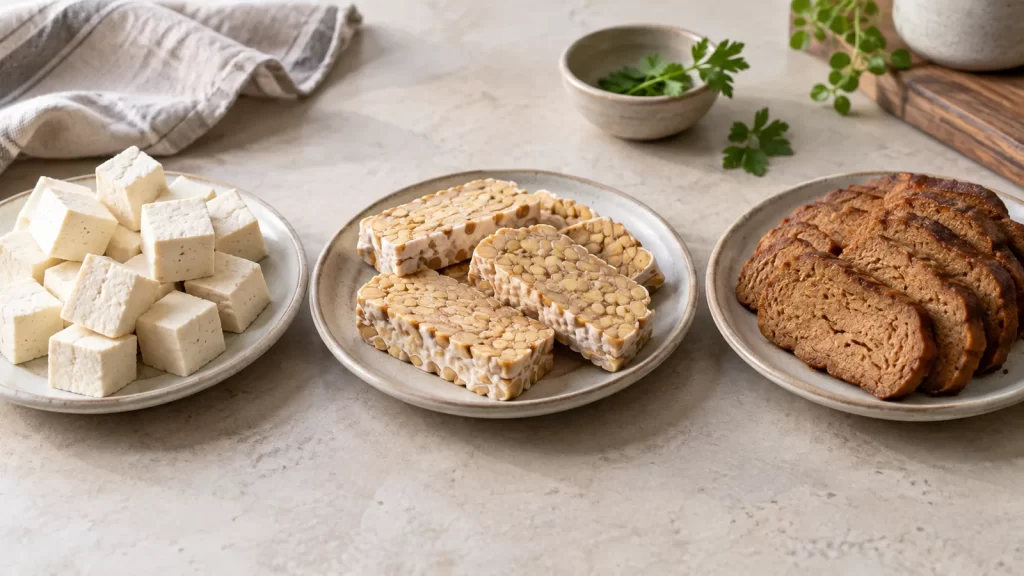
Tofu, tempeh, and seitan can all anchor a plant-based meal, but they are not interchangeable blocks of “vegan protein.” Tofu is made by curdling soy milk and pressing the curds. Tempeh is usually made by fermenting whole soybeans into a firm cake. Seitan is made mainly from wheat gluten, the elastic protein left after much of the starch has been removed. Those different starting materials explain their textures, flavors, allergen risks, and typical cooking methods. The best choice is the one that fits a particular dish, the eater’s medical needs and preferences, and the actual product label in your hand.
This guide compares how the three foods are made, what a label can and cannot tell you about their nutrients, how to shop and cook them, and where common claims go too far. It is general food education, not individualized medical or diet advice. If you have a diagnosed food allergy, celiac disease, or another condition that affects your diet, follow your clinician’s plan and check each product’s ingredients and cross-contact information. Soybeans and wheat are major allergens under U.S. labeling law; a “plant-based” label does not override that risk.
The quick answer
Choose tofu when you want a mild, adaptable ingredient. Silken tofu blends into sauces and desserts; firm or extra-firm tofu can be cubed, baked, pan-seared, or added to soups. Choose tempeh when you want a firmer bite, visible whole-bean texture, and a nutty, fermented flavor. It holds together well in slices or crumbles and works in grain bowls, sandwiches, and stir-fries. Choose seitan when you want a chewy, springy texture that can be sliced or shredded. It suits seasoned stews, sandwiches, and pan-seared dishes, but it is made from wheat gluten and is not appropriate for someone who must avoid gluten.
“Higher protein” is not a sufficient buying rule. A serving of dense tempeh or seitan may show more grams of protein than a water-rich silken tofu, yet a particular extra-firm tofu may compare differently once serving size and water content are accounted for. A prepared seitan product can also contain substantial sodium from broth or sauce. Compare Nutrition Facts per 100 grams or per the amount you actually eat, not merely the biggest number on three differently sized packages. Include the rest of the meal: vegetables, whole grains, beans, oils, and sauces affect its overall nutritional pattern.
What tofu is and how its texture changes
Tofu begins with soybeans that are soaked, ground with water, heated, and filtered to make soy milk. A coagulant then causes proteins and fats in the soy milk to form curds. The curds may be left delicate and custard-like or pressed to remove more water. The result is a family of products, not one fixed food. Silken tofu is soft enough to blend smoothly, while extra-firm tofu can retain a cube shape during frying. Manufacturers use different coagulants and moisture levels, so two products with the same firmness word may still behave differently.
The most useful question in a shop is not “Is tofu healthy?” but “What texture does my recipe require?” Silken tofu can replace part of a creamy sauce base, but it will usually fall apart if pressed and handled like a dense cutlet. Firm tofu absorbs a marinade at the surface and can be crumbled like a soft scramble. Extra-firm tofu is easier to slice and crisp. Freezing and thawing ordinary firm tofu changes its water structure and can create a spongier texture that takes up sauce, though it will not make tofu identical to seitan. Pressing can remove surface water from suitable firm styles, but pressing silken tofu is likely to destroy it.
Soybeans are a U.S. major food allergen, so tofu is not safe for a person with soy allergy unless their own clinician has given specific advice. Plain tofu is made from soy rather than wheat, but a flavored or restaurant dish may include wheat-containing sauce or cross-contact. Someone who needs a strict gluten-free diet should evaluate the whole product and preparation process, not assume a tofu dish is gluten-free because the tofu itself is soy-based. Ingredient labels and food-service questions matter more than a generic list of permitted foods.
What tempeh is and what fermentation does
Traditional soy tempeh is made from cooked beans inoculated with a suitable starter culture. As the culture grows, it binds the beans into a sliceable cake with a pale network visible around the beans. This is a controlled food process, not the same as leaving beans to spoil on a countertop. Commercial producers manage ingredients, temperature, time, and packaging. Some brands combine soy with grains or other legumes, so “tempeh” alone does not prove that a product is soy-only or wheat-free. Read the actual ingredient list, particularly when avoiding an allergen.
Tempeh’s whole-bean structure gives it a different bite from the smoother curd structure of tofu. It can be sliced thin and browned, cubed for a curry, or grated into a sauce. Its flavor can be earthy, nutty, or slightly bitter depending on the product and preparation. Steaming or simmering briefly before seasoning is a common culinary step when a cook wants to soften a strong flavor or warm the interior; it is not a universal medical requirement. A marinade then adds flavor mainly around the surface, while browning creates a crisp exterior. Crumbles can be especially useful in dishes where you want texture in each bite without trying to imitate a whole meat cut.
Fermentation is sometimes advertised as automatically making a food probiotic or nutritionally superior to every unfermented alternative. Those claims need care. Heating, processing, packaging, and cooking can affect live microbes, and a fermented food does not automatically deliver an established health benefit for every person. Tempeh may be a useful source of protein and other nutrients, but its composition varies with beans, added grains, moisture, and seasoning. Learn what fermentation means as a food process; then evaluate a specific product on its ingredients and Nutrition Facts rather than assuming its name guarantees a particular microbial or vitamin profile.
What seitan is and why gluten matters
Seitan is commonly made by hydrating vital wheat gluten, seasoning the dough, and cooking it in broth, steam, or another moist method until it becomes firm and chewy. Home cooks can also wash much of the starch out of wheat dough to concentrate the gluten. The elastic network that makes bread dough stretch is central to seitan’s texture. It can be sliced thin for sandwiches, shredded into a stew, or browned in a pan after cooking. The recipe and added liquids determine whether it is tender, dense, springy, or rubbery.
Because seitan is wheat gluten, it must be avoided by people with celiac disease and by anyone whose medical plan requires gluten avoidance. The National Institute of Diabetes and Digestive and Kidney Diseases explains that gluten in wheat, barley, and rye triggers celiac disease and that cross-contact matters. A soy-free seitan recipe may be useful to someone who avoids soy for another reason, but packaged seitan may include soy sauce, tofu, or other soy ingredients. It is therefore incorrect to call all seitan soy-free. Likewise, a soy-based tofu or tempeh dish can contain wheat from a marinade. Judge the final product rather than treating ingredient families as complete allergen statements.
Seitan’s protein is concentrated because much of the wheat starch has been removed. That does not make it a complete meal or a perfect substitute for every nutrient found in beans, eggs, fish, or meat. It is relatively low in some essential amino acids compared with soy, and its micronutrients depend on what was added and how it was made. A varied eating pattern can include other protein sources such as beans, lentils, nuts, seeds, and soy if those foods are safe for the eater. It is not necessary to combine precisely two protein foods at every meal for most people; the larger pattern and adequate intake matter; Sly Academy’s guide to dietary protein provides further background. If a diet is very restricted, a registered dietitian can help assess adequacy.
Compare the foods by the job they perform
Tofu works like a flexible canvas. It is especially useful when moisture is welcome: miso-style soups, curries, blended dressings, creamy desserts, and scrambles. A firm style can also become crisp with draining, a hot pan, and enough space between pieces. It rarely contributes a strong flavor by itself. That can be an advantage if a sauce, broth, or spice blend should lead. It can be a disadvantage if the cook expects an unseasoned tofu cube to taste like a finished entrée. The texture difference between silken and extra-firm is so large that a recipe should specify the style.
Tempeh is more assertive. The visible beans and fermentation-derived flavor remain noticeable even after sauce is added. It can be a good choice when the dish needs pieces that hold their shape, such as a sandwich filling or skewered vegetable bowl. A short steam followed by a flavorful glaze may suit someone who finds plain tempeh too strong. Cutting it thin exposes more surface area to seasoning and browning. Crumbling it makes a textured topping for noodles or grains. It is not a substitute for tofu in a smooth pudding because the whole-bean texture will remain.
Seitan gives a dense, chewy bite. That makes it useful for a spiced roast-style preparation or thin slices in a sandwich. It can be less useful when a dish calls for a delicate curd or a fermented bean flavor. Home-made seitan can be sensitive to kneading, hydration and cooking time; overworking or boiling aggressively may create an unpleasantly tough texture. Packaged products range from plain strips to heavily seasoned ready-to-eat pieces. Their salt, oil, sugar, and allergen profiles differ substantially. One cannot infer the composition of a branded seitan cutlet from generic data for homemade gluten dough.
How to compare Nutrition Facts fairly
Begin with the serving size. A label showing 18 grams of protein per 100 grams cannot be compared directly with a label showing 9 grams per 60-gram serving without conversion. To compare equal weights, divide protein grams by serving grams and multiply by 100. For instance, 9 grams in a 60-gram serving is 15 grams per 100 grams. This is a calculation example, not a claimed nutrient value for a real product. If you will eat two servings, look at the total amount you actually plan to use. If a product is packed in liquid, check whether the listed serving weight refers to drained or undrained food.
Next examine sodium, saturated fat, fiber, and nutrients relevant to your diet. Plain tofu can differ from calcium-set tofu; the coagulant and label matter when calcium is a goal. Whole-bean tempeh may contribute fiber, but an ingredient change can alter the amount. Plain seitan often has a different fiber profile from a whole-bean food, and a prepared version may acquire substantial sodium in a seasoned broth. These are reasons to inspect labels, not universal rankings. USDA FoodData Central provides reference descriptions for foods and can help you understand category variation, but the manufacturer’s current label is usually the closer guide for the product you bought.
Do not turn one nutrient into a health verdict. A food with more protein is not automatically better for heart health, muscle development, or weight management. Those outcomes depend on quantities, total energy, physical activity, medical context, and the pattern of foods eaten over time. The U.S. Department of Agriculture’s MyPlate guidance includes tofu and tempeh among vegetarian protein choices and emphasizes variety. It does not say that a particular block of tofu or tempeh prevents a disease. The old version of this article used a sweeping statistic about plant-based food purchases and suggested broad disease-risk reduction without showing appropriate evidence. Those claims are not needed to explain these three ingredients.
Protein quality without the “complete versus incomplete” trap
Proteins are made from amino acids. Some amino acids must come from food because the body cannot make enough of them. Soy foods supply a useful array of essential amino acids and are commonly used as substantial protein choices in vegetarian diets. Wheat gluten is relatively low in lysine compared with many legumes, which is why seitan should not be presented as a nutritionally identical stand-in for soy. That is a meaningful distinction, but the phrase “incomplete protein” can be misleading if it implies seitan contains no lysine or that every meal must contain a mathematically perfect amino-acid mixture.
For most people eating enough food from a varied diet, protein sources can complement each other across the day. A seitan sandwich with beans at another meal is a straightforward example of variety; it need not be a prescribed formula. Tofu and tempeh can also appear alongside grains, vegetables and other legumes. The practical question is whether the overall pattern supplies enough protein and energy for the individual’s needs, not whether one isolated ingredient wins a contest. If a person has unusually high needs, restricted food choices, an eating disorder, kidney disease, or another relevant medical condition, personalized advice is more appropriate than a generic internet ranking.
Sports nutrition is a common source of overstatement. Muscle gain depends on resistance training, adequate total energy, enough protein across a suitable diet, recovery, and individual circumstances. Selecting tempeh over tofu does not guarantee superior muscle growth. A dense seitan portion may make it convenient to obtain protein, but its gluten content and amino-acid profile still matter, and the rest of the diet remains important. A person can build a satisfying meal with any of these foods when it fits their safety needs and overall plan. We deliberately avoid prescribing a daily protein target here because one fixed number would not fit every reader.
Allergies, celiac disease and cross-contact
The FDA identifies soybeans and wheat among the major food allergens that must be disclosed for covered packaged foods in the United States. Plain tofu and conventional soy tempeh contain soy. Seitan contains wheat gluten. Some tempeh products also contain wheat, and some seitan products also contain soy. Flavored versions may include sesame, peanuts, or other allergens in sauces. Read both the ingredient list and allergen information every time the formulation changes. An unlabeled restaurant preparation requires direct questions about ingredients and shared equipment when an allergy is involved.
Celiac disease is not the same condition as a wheat allergy, even though both can make wheat-containing foods unsafe. NIDDK describes celiac disease as an immune-mediated disorder triggered by gluten and notes that cross-contact can make an otherwise gluten-free food unsafe. Someone with celiac disease should not treat seitan as a “sometimes” choice, because gluten is its defining ingredient. Tofu or a certified suitable tempeh dish may be an option, but sauces, grain additions, fryers, cutting boards, and packaging must also be considered. If you suspect celiac disease but have not been tested, NIDDK advises discussing diagnosis with a clinician before starting a gluten-free diet because avoiding gluten can affect test results.
Soy allergy likewise makes soy-based tofu and ordinary soybean tempeh unsuitable unless individualized medical guidance says otherwise. A non-soy tempeh made from other legumes may exist, but the ingredient list and cross-contact practices still matter. Seitan made without soy may provide a culinary alternative for a person who can safely eat wheat; it should never be recommended to someone with celiac disease merely because it is soy-free. The point is not to find a universal “safe option.” The point is to verify the complete product and preparation for the specific person. If a food allergy has caused severe symptoms before, follow the person’s established emergency plan and professional advice.
Shopping: a five-step label check
First, identify the base ingredient and any additions. The front of a package may say “plant-based cutlet,” while the ingredient list reveals vital wheat gluten, soy isolate, spices and sauces. Second, check the allergen declaration and the full ingredient list. Not every potential cross-contact situation can be settled by a front-of-pack icon. Third, compare the serving size and protein amount if that is relevant to your meal. Fourth, inspect sodium and other nutrients that matter to you rather than relying on “natural,” “clean,” or “high protein” as complete descriptions. Fifth, look at refrigeration, use-by and cooking instructions. A plain raw-style block and a ready-to-eat seasoned product may need different handling.
Price comparisons need the same care as nutrition comparisons. A pack of water-rich silken tofu and a dense seitan product may have very different edible protein per package, yet price per gram of protein is not the only consideration. A cheaper ingredient that does not work in the recipe may waste money. Consider the cost per meal, preparation time, storage life after opening, and whether the product will be eaten. If using a market or food-service item without a Nutrition Facts label, ask about ingredients and preparation rather than guessing a nutrient profile from its appearance.
Frozen and shelf-stable forms add more choices. Some tofu is sold shelf-stable in aseptic cartons; others require refrigeration. A frozen firm tofu block can be thawed and pressed for a changed texture. Tempeh is often refrigerated or frozen to maintain quality. Seitan may be sold in sealed pouches, refrigerated tubs, or as dry vital wheat gluten for home cooking. Follow the package’s storage and cooking directions. Do not assume that because a food is plant-based it can remain at room temperature after opening. Food safety rules apply to moist cooked products and leftovers too.
Cooking tofu well
For a crisp tofu cube, select firm or extra-firm tofu, drain it, and remove excess surface water if the package and texture allow. Cut even pieces, season them, and use a hot cooking surface with enough room that steam can escape. Turn the pieces after the first side has browned rather than constantly moving them. A sauce added too early can prevent browning, so many cooks glaze after developing a crust. For a softer dish, skip the pressing and add tofu to a gently simmering soup near the end so it warms without breaking. A silken tofu sauce can be blended smooth and flavored with herbs, citrus or spices, but it must be kept and served safely like other perishable foods.
Tofu’s mildness makes seasoning the whole dish important. Aromatics, acid, heat, salt and texture contrast often matter more than an overnight marinade. The block contains water; a marinade primarily flavors reachable surfaces, and cooking changes the texture. Small cubes expose more surface than one thick slab, while a glaze coats the finished surface. None of these steps makes tofu taste exactly like meat, nor should that always be the goal. In many cuisines tofu is valued for its own soft or chewy character and its ability to carry a sauce. Start with the intended dish rather than a universal technique advertised for every style.
Cooking tempeh well
Tempeh can be cut into thin slices, cubes, strips or crumbles. Thin slices brown more quickly and create more seasoned surface. A brief steaming or simmering step can mellow some products before pan-frying or baking; other products taste good without it. Pat the surface dry before browning, and do not crowd the pan. In a curry, add tempeh early enough to warm through and take on sauce. For a sandwich, a well-browned slice with vegetables and a sharp sauce gives contrast. For a grain bowl, crumbles can be tossed with spices and cooked until their edges become lightly crisp.
Do not infer food safety from the visible fermentation culture alone. Commercial tempeh can have normal pale fungal growth that binds the beans, but abnormal color, off odors, damaged packaging or improper storage call for caution. Product instructions and the seller’s guidance are more reliable than an online photograph. Home fermentation requires controlled methods and safe ingredients; this guide is not a fermentation protocol. If you want to understand the underlying process, Sly Academy’s explanation of fermentation provides a starting definition, while a food-safety authority or validated recipe should guide actual production.
Cooking seitan well
Seitan works best when its texture is treated as an asset rather than forced into every role. Thin slices can be browned and added to a sandwich with crisp vegetables. Shreds can be simmered briefly in a flavorful stew. Larger homemade pieces need a recipe that manages hydration and cooking carefully; boiling a dough vigorously may make it spongy or tough. Dry vital wheat gluten is concentrated and absorbs liquid quickly, so home recipes should specify weights and method. A pre-cooked packaged seitan product may only need heating, while another may require full cooking. Read directions instead of applying a single rule to all products.
Strong seasoning is common because plain wheat gluten has little complexity. A broth or sauce can add salt as well as flavor, so a heavily seasoned prepared product can differ nutritionally from plain homemade seitan. If the meal also includes salty bread, pickles or condiments, look at the combined amount rather than one package in isolation. For someone who cannot eat soy, verify that a seitan product’s sauce does not contain soy. For someone who cannot eat gluten, seitan is not made safe by rinsing, marinating, or cooking longer; the gluten is the ingredient that gives it structure.
Three practical meal decisions
A fast weeknight stir-fry: Extra-firm tofu or tempeh both work. Choose tofu if you want soft centers and crisp edges or a mild base for a bold sauce. Choose tempeh if you want a firmer bite and visible bean texture. Prepare vegetables and sauce first, then cook the protein in a separate hot pan if browning matters. Add sauce at the end and serve with rice or another grain. Seitan can also work if gluten is safe for everyone eating, but a strongly seasoned packaged version may dominate the dish.
A high-texture sandwich: Sliced tempeh or seitan is often easier to stack than silken tofu. Tempeh contributes a nutty bean flavor; seitan contributes a chewy, meat-like bite. Firm tofu can still work if browned or baked well. Compare the bread, sauces and toppings, especially for allergens and sodium. A gluten-free bread does not make a seitan filling gluten-free, and a soy-free sauce does not remove soy from tempeh. The complete sandwich, not a single ingredient, is what the eater consumes.
A creamy sauce or dessert: Silken tofu is the clear culinary candidate because it blends smoothly. Tempeh’s whole-bean texture and seitan’s gluten network are not replacements in a smooth custard. If the dish is for someone with soy allergy, none of the soy-tofu versions is suitable; find a recipe developed around a safe different ingredient rather than substituting seitan into a dessert. Recipe function and personal safety outrank abstract protein rankings. These examples illustrate a general method: define the texture the dish needs, then check nutritional and allergen constraints.
Misconceptions worth leaving behind
“Tempeh is always healthier than tofu” has no universal meaning. A whole-bean food and a curd food can serve different goals, and their nutrient contents vary with ingredients and serving size. “Seitan is a complete replacement for meat” ignores the larger meal’s nutrients and individual restrictions. “Tofu is only for people avoiding meat” ignores its use as an ingredient in many cuisines for flavor and texture. “All fermented foods are probiotic” confuses a production process with a verified benefit in the finished, often cooked product. None of these slogans helps a shopper choose an appropriate meal.
Another misconception is that “plant-based” automatically means safe for allergies or celiac disease. FDA allergen labeling rules exist precisely because plant ingredients such as soybeans, wheat, peanuts and sesame can be major allergens. A product can also contain allergens from a sauce, breading, or shared preparation environment. Some online comparisons claim exact grams of protein, carbohydrate and fat for “tofu,” “tempeh,” and “seitan” without naming a product, moisture level, or serving weight. Those numbers are not transferable to every package. Use USDA reference data to understand categories and the current product label to make the practical decision.
Finally, avoid the idea that one food alone protects against heart disease or builds muscle. Dietary patterns and circumstances matter. The FDA has discussed the evidence behind soy-protein heart-disease claims and proposed revisiting the authorized claim; that history is a reminder not to convert an ingredient comparison into a guaranteed clinical outcome. For general meal planning, USDA MyPlate emphasizes variety among protein foods. A plate with vegetables, a suitable grain or starch, and a protein food that the eater can safely enjoy is more useful than crowning one block as “best” for everyone.
Bottom line
Tofu is the most texture-flexible and neutral of the three, from blendable silken to searable extra-firm. Tempeh offers whole-bean structure and a fermented, nutty flavor. Seitan offers a wheat-gluten chew that can be sliced or shredded but is unsuitable for gluten avoidance. All three can be useful protein-containing ingredients when their allergens, product labels, and recipe roles fit the eater. Compare equal serving weights, read the full ingredient list, cook and store according to the package, and build a varied meal rather than trusting a broad health claim. If a medical condition limits your choices, use the personalized advice of a qualified clinician or registered dietitian.
Sources and further reading
- USDA MyPlate, Protein Foods: https://www.myplate.gov/web/web/eat-healthy/protein-foods
- USDA FoodData Central: https://fdc.nal.usda.gov/
- U.S. FDA, food allergens and labels: https://www.fda.gov/food/nutrition-food-labeling-and-critical-foods/food-allergies
- NIDDK, eating with celiac disease: https://www.niddk.nih.gov/health-information/digestive-diseases/celiac-disease/eating-diet-nutrition
- U.S. FDA, questions about food-label health claims: https://www.fda.gov/food/nutrition-food-labeling-and-critical-foods/questions-and-answers-health-claims-food-labeling
- Sly Academy, What Is Fermentation?: https://slyacademy.com/what-is/what-is-fermentation/
- Sly Academy, Essential Guide to Protein: https://slyacademy.com/fitness-wellness/essential-guide-to-protein/