

What does MBE mean?
MBE stands for Member of the Order of the British Empire. It is a UK national honour for an individual whose achievement or service has made a significant, lasting difference. The official UK honours guide describes the MBE level as recognition for outstanding achievement or community service with long-term impact that stands out as an example to others. It is not a qualification, a job, a payment, or a promise of future work. A person’s name may be followed by the post-nominal letters MBE once the appointment has been announced.
The word “Empire†is part of the order’s historic name, not a description of the United Kingdom’s present-day territory. The order began in 1917 under King George V. Today it recognises service in fields as varied as education, health, science, the arts, sport, business and voluntary work. This guide explains what the award does and does not mean, how a nomination works, and how to read an honours announcement without confusing an MBE with a knighthood or a British Empire Medal.
Where an MBE sits in the honours system
The UK has more than one order and more than one kind of award. Within the Order of the British Empire, MBE, OBE and CBE denote different appointment levels, while the British Empire Medal (BEM) is a related award. A knighthood or damehood is another form of recognition. The official award-level descriptions are more useful than assuming each level corresponds to a fixed number of years, a salary, or a person’s celebrity. MBE is described in terms of outstanding achievement or service; OBE refers to a major local role that may be known nationally; CBE may recognise a prominent national or leading regional role.
These are descriptions, not a formula for applicants to calculate. A volunteer who transformed a local service could be considered at MBE level, while someone with a broader impact might be considered for another level. The honours committee determines both whether to recommend an award and which honour is appropriate. A nominator cannot request a guaranteed MBE. Someone who has done excellent work is not “owed†a higher order because they have a particular title or have served for a certain number of years.
MBE versus BEM, OBE and CBE
The BEM is often associated with hands-on service to a local community. The MBE is associated with outstanding achievement or service that has a long-term, significant impact. OBE and CBE descriptions emphasise wider or more prominent roles. These distinctions help a reader understand an announcement, but they are not a ranking of human worth. A practical community contribution can matter deeply even if its impact is geographically small. The Cabinet Office’s overview of orders and medals sets out the award types and their broad purposes.
There is also a distinction between an order and a medal. An MBE is an appointment as a Member of an order. The BEM is a medal. Both can recognise valued service. Neither automatically turns a recipient into “Sir†or “Dame.†Those styles are linked to certain knighthoods and damehoods, not to an MBE, OBE or CBE alone. When writing about a recipient, “Alex Morgan MBE†is the relevant format after announcement; “Sir Alex Morgan†would be wrong unless that person separately held a qualifying knighthood.
Is the award limited to famous people?
No. A national honour can recognise a teacher improving access to education, a volunteer organising sustained support for isolated neighbours, or an innovator whose work benefits others. The official nomination overview mentions community improvement, long-term voluntary service, innovation, moral courage and making life better for people less able to help themselves. It covers many sectors, including arts, education, health, science, business and sport. Public visibility is neither a requirement nor evidence of impact by itself.
A famous recipient may attract headlines, but the selection question is what the person actually did and how it mattered. Equally, a long career is not automatically an exceptional contribution. A nomination should explain what changed because of the nominee’s actions, who benefited, and why that result goes beyond ordinary expectations of a paid role. That focus helps distinguish the honours system from routine employee recognition or a popularity vote.
Why the order was created
King George V instituted the Order of the British Empire during the First World War, when service beyond the battlefield called for wider recognition. The Royal Family’s centenary history dates its founding to 1917 and describes its purpose as acknowledging non-military contributions. The modern honours system later expanded the kinds of work it recognises. Readers should avoid describing today’s MBE as a military medal, although particular awards can recognise people whose service relates to defence or public emergencies.
The order’s name also carries a difficult history. “Empire†refers to an era of British colonial rule, and people differ sharply on whether the name is appropriate today. A UK parliamentary review of the honours system recorded objections to the word and also explained the institutional complexity of changing the order’s name. A careful educational account can acknowledge both the value recipients place on service recognition and the legitimate criticism of imperial language. It need not tell readers what position to take.
For background on the monarchy’s symbolic functions rather than its historical powers, Sly Academy’s ceremonial monarch explainer provides a broader comparison. The monarch’s role in approving and presenting UK honours sits within a much wider constitutional system. An investiture is not evidence that a recipient has political authority, and the award does not make them a government representative.
Who can nominate someone for an MBE?
Anyone can put forward another person for a UK national honour. The nominee need not be a celebrity, wealthy donor or member of a particular profession. The Cabinet Office says nominations are free. A person cannot choose the final level of honour, and the nomination form is about the individual contribution rather than a requested suffix. Official nomination guidance says only one individual should be named on each form; a group may be better suited to a different award.
The nominated person should still be actively involved in the activity for which they are proposed, according to the government’s overview. This matters because a nomination is not merely a retrospective tribute. A project that ended years ago may still show long-term results, but the case should explain the nominee’s continuing involvement and current impact. If a person lives or contributes overseas, use the appropriate official route rather than assuming a UK-based nomination form is interchangeable with every international process.
Do not secretly pay someone who promises a nomination or an award. An individual can submit a nomination through the official channel without an intermediary. The existence of a “consultant†or a polished letter cannot confer an MBE. The relevant question is whether the official evidence is clear enough for independent assessors to judge what the nominee accomplished. A person may be nominated more than once, but duplicating the same nomination through multiple submission channels is not a shortcut.
Can a person nominate themselves?
The normal public route is to nominate somebody else. The Cabinet Office guidance describes a nominator writing about another person, gathering support letters, and keeping the nomination confidential from the nominee. If you believe your own work merits recognition, an independent colleague, beneficiary or community member is better placed to describe it first-hand. The key is not to manufacture endorsements or ask supporters to repeat identical praise.
Confidentiality protects the nominee from raised expectations. Official guidance says the person being nominated should not be told that they are under consideration. You may discuss the work with suitable supporters, but handle personal details with care and do not post a nomination publicly. This is also why an unconfirmed nomination should not be advertised as “MBE pending.†Until an honour is announced, no award exists to claim.
How to build a credible nomination
Begin with the contribution rather than adjectives. “Dedicated and inspirational†says little on its own. A stronger case states the original problem, the nominee’s specific actions, the period over which they acted, and the measurable or well-observed outcome. For example, a community organiser might have established a translation-supported advice service, trained volunteers and helped a documented number of families use it. Those facts are more informative than a generic statement that the organiser is passionate about helping people.
Evidence can include a programme’s reach, a sustained change in access or quality, independently documented results, and first-hand accounts from those who experienced the work. Be honest about shared achievements. A nominee may have led an effort without doing every task; a good nomination explains their distinctive contribution to a team outcome. Avoid unexplained numbers, inflated claims or private details that supporters have not consented to provide. If a project produced mixed results, a precise account is stronger than pretending it solved every problem.
The official nomination guidance asks for at least two supporting letters. These should be recent, distinct and grounded in knowledge of the nominee’s work; the nominator cannot write their own support letter. A supporter should explain what they observed, what changed and why the contribution stands out. Two nearly identical letters from senior figures may be less helpful than specific testimony from people who understand the work in practice. Follow the current form’s instructions for format and submission.
A worked example of stronger evidence
Imagine a fictional adult-learning volunteer, Priya, who notices that learners in her town cannot attend standard evening classes. A weak nomination would say, “Priya is beloved and works tirelessly.†A stronger one would explain that she negotiated accessible rooms, recruited and trained volunteers, set up a timetable after consulting learners, and maintained the programme for five years. It would give verified participation and completion figures, explain how access improved, and include letters from independent people who saw the results.
The example is illustrative, not an actual honours case or a promise of an award. The assessors would still need to judge whether the evidence showed outstanding, sustained impact beyond ordinary expectations, and to complete suitability checks. The example demonstrates an editorial principle: describe mechanisms and outcomes, not only admirable intentions. It also shows why no single statistic can decide the level of honour; context and corroboration matter.
What happens after submission?
The nomination is acknowledged, but the process is not a quick contest with a public leaderboard. The government’s overview says a nominator may hear nothing further for 12 to 18 months. Cabinet Office staff validate nominations and seek views or checks from relevant organisations and government departments. Independent honours committees consider cases, recommendations go to the Prime Minister, and the monarch awards the honour. The exact route can vary with the kind of service and award.
This timetable is a guide, not a promised decision date. Verification can take longer when impact is difficult to assess or information needs clarification. There is no responsible way to guarantee an outcome, an award level, or inclusion in the next New Year or King’s Birthday list. A lack of news does not prove a nomination has failed. If you need to correct information or ask about a submitted nomination, use the official contact details and do not share confidential details with an unrelated service.
The Cabinet Office explanation of the honours system distinguishes checks on merit from checks on probity and propriety. Assessors may verify the evidence with professional bodies, regulators or government departments. These checks protect the credibility of the list but are not a public certification that every action in a recipient’s life was flawless. New information can later prompt a separate forfeiture process.
Why the nominee is not told early
Keeping a nomination confidential avoids unfair expectations and protects the integrity of assessment. The person may not receive an honour, may receive a different one, or may decline an offer. Telling them that an award is certain is misleading. Supporters can discuss facts about the nominee’s contribution without revealing a confidential nomination to that person. They should also respect the privacy of beneficiaries whose stories appear in support letters.
A nomination is a recommendation, not an application the nominee has filed for themselves. This distinction helps explain why an online “MBE application service†should be treated cautiously. The official process is public, free, and evidence-based. If a website asks for a fee to secure the award or claims a special inside route to the committee, do not treat that claim as an official step.
Announcement, investiture and post-nominals
Honours lists are normally published at New Year and around the King’s official birthday. The government’s honours-list page links to the current and previous announcements. A public list is the place to verify a claim that an honour was announced. Read the person’s name, award level and service citation carefully; the citation summarises why the award was made but does not replace a full account of their work.
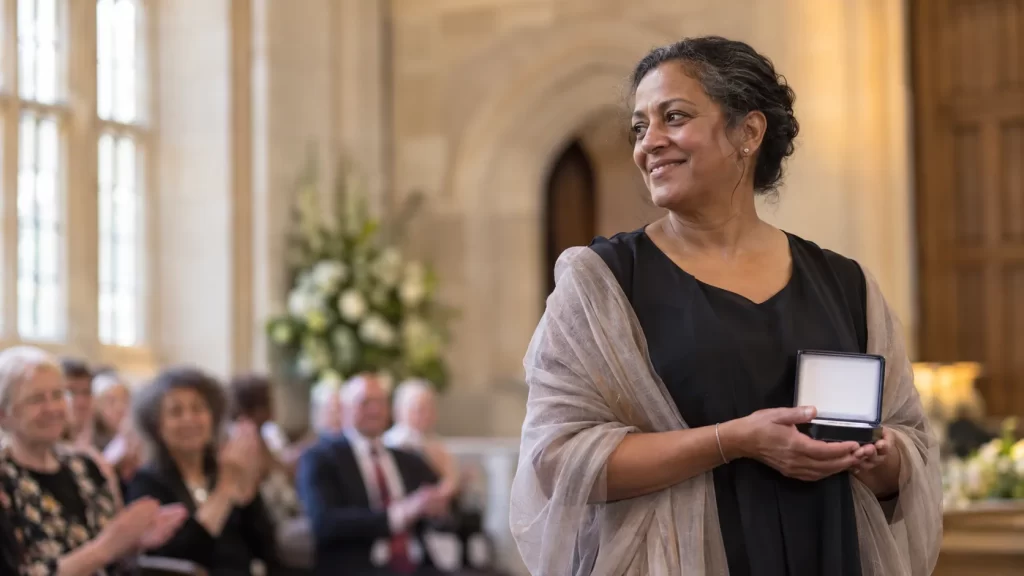
Once an individual accepts and the award has been announced, they may be invited to an investiture. The Cabinet Office receiving-an-honour guide describes this as a formal presentation of insignia by the King or a member of the Royal Family. The ceremony may happen after the announcement. It is therefore wrong to say that a recipient must wait for the ceremony before the letters MBE can appear after their name; the official guide says post-nominals can be used immediately after announcement.
The same guidance explains that a warrant of appointment confirms an appointment within an order. It may arrive before or after an investiture. Neither the ceremony date nor a photograph of a medal should be used as the sole test of whether someone holds an honour. The public announcement and official record are better starting points. People may also choose how prominently to display an honour in ordinary life; it is a recognition, not a compulsory new identity.
What an MBE does not confer
An MBE does not give a legal right to a salary, grant, government office or automatic promotion. It does not make a charity or business endorsed by the government. It does not confer the style “Sir†or “Dame,†and it is not academic certification. A recipient may find that recognition draws attention to their cause, but that is a possible social effect, not a guaranteed benefit built into the award. Ask what the person was honoured for rather than assuming the letters prove expertise in every subject.
If you see “honorary MBE,†do not silently treat it as identical to a substantive UK appointment. Honorary awards can recognise foreign nationals for contributions connected to the UK. The Royal Family’s account of honorary MBEs for BLACKPINK illustrates that distinct category. Check the wording of the official announcement before describing a particular person’s status or use of post-nominals; different nationality and award circumstances can matter.
Is an MBE a medal, a title, or a name suffix?
In everyday speech, people may refer to an “MBE medal,†because an insignia is presented. Formally, MBE identifies membership at a level within an order. The letters are post-nominals, not a title placed before a first name. This distinction matters in a school essay, a newsroom caption or a profile: write the person’s usual name followed by MBE after official announcement, and describe the award accurately in a sentence if readers may not know the abbreviation.
There can also be confusion with the unrelated abbreviation “MBE†in other contexts. In a business procurement document it might mean “minority business enterpriseâ€; in education it might mean a different subject-specific term. This particular article is about the UK honour. Context decides the meaning. The legacy /finance/ path of this page does not change what the existing article and its readers are about, and it is not a reason to conflate the honour with a commercial certification.
Can an MBE be refused or removed?
A proposed recipient may choose not to accept an honour. There are personal, political and ethical reasons someone might make that choice, including discomfort with the order’s name. Those reasons should be described fairly rather than assuming ingratitude. The public record usually tells you who accepted an announced award; it cannot reveal every private consideration. An award also should not be treated as a permanent guarantee against future scrutiny.
The Cabinet Office explains that an honour may be removed through forfeiture when conduct damages the system’s reputation. A committee considers recommendations and removal requires the Sovereign’s approval. This is a formal process, not something a newspaper or social-media account can declare on its own. When discussing a specific person, distinguish an allegation, a review and an officially confirmed removal.
The possibility of forfeiture should not overshadow the ordinary reasons awards are made. It does, however, help explain why merit and probity checks exist at nomination stage. It also reminds readers that an honour is public recognition of particular service, not an all-purpose moral certificate. A careful profile can celebrate the documented contribution without making exaggerated claims about the recipient’s character or every organisation with which they are associated.
How to evaluate a claim about an MBE
Start with the exact name and the award level in an official list. If a social profile says someone is “MBE nominated,†remember that a nomination is confidential and not itself an honour. If a marketing page says “MBE-approved,†ask whether it means an individual founder is a recipient; the award does not certify a product. Distinguish MBE from BEM, OBE, CBE and a knighthood. Do not infer award level from a photograph of an investiture, because the ceremony presents several kinds of honour.
Read the service citation and, when needed, find independent reporting or primary records about the contribution. A citation may say “for services to education†without giving a complete evaluation of an educational programme. Conversely, a person’s impact may be substantial even when a brief citation cannot convey every detail. For research or an essay, cite the official list for the fact of the award, then cite separate evidence for claims about outcomes.
If the claim appears in a job application, institutional biography or charity appeal, checking the official record is a proportionate verification step. It is not appropriate to demand private nomination correspondence. The most useful question is not “How impressive are the letters?†but “What specific, verifiable service did the person provide, and what does the source actually establish?†That approach respects the award while keeping public claims accurate.
The order’s name and modern debate
The name “Order of the British Empire†can be painful or alienating to people whose families experienced colonial rule. Others emphasise the modern order’s role in recognising volunteers and public service. The issue is not resolved by saying that the name is merely historic, nor by dismissing recipients’ achievements. Both the language and the contemporary service deserve to be discussed honestly. The parliamentary review linked above records criticisms and the practical question of how a renamed or replacement order would be structured.
Readers exploring the wider history of empire can start with Sly Academy’s imperialism and decolonisation study material, which places colonial systems and their aftermath in world-historical context. That topic is separate from an individual’s nomination, but it helps explain why public responses to the award can differ. Avoid treating all recipients, critics or Commonwealth communities as though they share one view.
The Cabinet Office also publishes information about diversity in the honours system. Its data and outreach discussion show that representation is an ongoing question, not a settled claim that every community has equal access to recognition. The most practical response for a prospective nominator is to identify excellent service that may otherwise be overlooked and document it rigorously, rather than assuming a high-profile role is necessary.
A practical checklist for nominators and readers
If you are considering a nomination, first confirm that the person is an individual whose current service can be described with evidence. Write down the problem they addressed, the actions they personally led, the people who benefited, the duration and the long-term result. Ask independent supporters for specific, recent letters and keep the process confidential from the nominee. Use the official form and guidance, check the current requirements, and submit without paying a third party for supposed access.
Before writing a final draft, test each claim with the question “How do we know?†A number of people helped should have a clear period and source. A claim that a programme changed policy should identify the decision and the nominee’s contribution to it, not assume that sequence proves causation. If a supporter describes an individual success story, ask whether the person involved has agreed to its use and remove identifying detail that is unnecessary. This is a better way to protect credibility than filling a nomination with impressive-sounding but uncheckable adjectives.
It is also worth distinguishing paid work from service that exceeds routine expectations. Paid professionals can receive honours; the award is not restricted to volunteers. But holding a senior post is not itself the contribution. Explain the innovation, leadership, sustained extra effort or public benefit that made the work distinctive. A teacher, scientist or business founder might have created a method that others adopted, opened access to people previously excluded, or maintained a useful service through difficult conditions. The evidence should show what happened rather than imply that a job title proves merit.
For educators discussing honours with students, a productive exercise is to compare two short, fictional nominations for the same person. One can list personality traits and awards; the other can identify a problem, documented actions, beneficiaries, limitations and independently observed outcomes. Ask which account would help an assessor evaluate impact and why. Then examine an official honours citation and note what it tells you and what it does not. This exercise teaches evidence evaluation without asking students to disclose private details or speculate about a real nominee’s confidential assessment.
If a nomination is unsuccessful or there is no immediate update, avoid public speculation about hidden reasons. The process has limited awards, confidential checks and many possible outcomes. Continue supporting the underlying community work on its own merits. Recognition can amplify a cause, but a project should not depend on receiving letters after someone’s name. That perspective keeps the focus where the honours system says it belongs: the contribution itself and the people who benefited from it.
If you are simply trying to understand an announced MBE, verify the honour and citation through the current or archived official list. Check that the award level is MBE rather than a different order or medal. Remember that post-nominals follow the name after announcement, an investiture may come later, and “Sir†or “Dame†does not come from an MBE alone. Keep the contribution, the person, and the historical debate about the order’s name analytically distinct.
The central idea is straightforward: an MBE recognises outstanding service or achievement with lasting impact, but its value lies in the real work behind the letters. A useful explanation therefore moves beyond ceremony and prestige. It asks how the contribution changed lives, how that change is evidenced, and what the official record actually says. Those questions help a student, prospective nominator or curious reader approach the UK honours system with both respect and accuracy.