
Information checked: 22 October 2026. This adult-focused guide supports a conversation with a qualified healthcare professional.
Understanding arthritis in the fingers
Arthritis in the fingers can make a simple action, such as fastening a button or turning a key, unexpectedly difficult. The phrase describes a location, not a single diagnosis. Osteoarthritis, rheumatoid arthritis, psoriatic arthritis and other conditions can affect the hand, and their treatments are not interchangeable. The useful first question is therefore not which cream is strongest, but what is causing the pain, swelling or loss of movement. A healthcare professional can assess the pattern and help you choose appropriate treatment. This guide explains what to notice, when to seek help and how to discuss practical hand care. It is general information, not a diagnosis or a personal exercise or medication prescription. Your own examination, medical history and daily needs should guide decisions. [1]
What the finger joints do
Several small joints work together whenever you pinch, grip or release an object. Cartilage provides a smooth surface where bones meet, while the joint lining produces lubricating fluid. Tendons move the fingers and supporting tissues help keep movement controlled. Arthritis can interfere with this coordinated system, so a problem in one small area may affect the whole task. For example, a painful joint may make you change your grip even when the other fingers remain comfortable. It helps to point to the precise painful area rather than describing all discomfort as hand arthritis. Tell the clinician whether pain is at a fingertip joint, a middle joint, a knuckle near the palm or the thumb base. Also describe any movement you cannot perform and whether the difficulty is pain, stiffness or weakness. [2]
Patterns that help distinguish possible causes
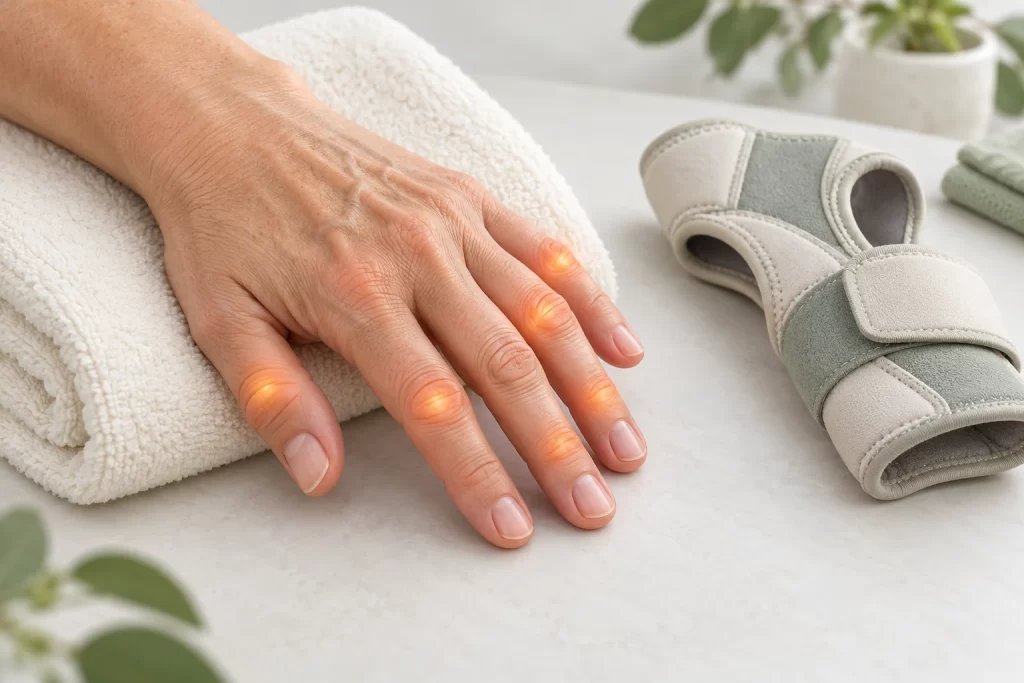
Hand osteoarthritis commonly affects the joints near the fingertips, the middle finger joints and the base of the thumb. Fingers may feel stiff, tender or swollen, and bony enlargements can change their appearance. These changes do not tell you exactly how much pain a person feels. Some people retain useful movement despite visible bumps, while others struggle with tasks even when changes look modest. Symptoms can fluctuate rather than follow a steady decline. A joint may be uncomfortable during one period and settle later, although its shape remains altered. Record which activities are difficult, such as writing or opening a container, instead of judging the condition only from a photograph. Persistent symptoms deserve assessment. A new lump or change in shape should not automatically be labelled osteoarthritis without considering other explanations. [3]
Why “wear and tear” is an incomplete explanation
Osteoarthritis involves changes in several joint tissues, not simply the fingers being worn out by normal use. Cartilage, bone, the lining and supporting tissues may all be involved. Age, family history and previous injury can contribute to risk, but getting older does not make every painful finger an inevitable arthritis problem. Younger adults can also develop osteoarthritis, particularly after damage to a joint. The practical implication is that you should not assume movement is harmful or stop using your hands altogether. At the same time, repeated activities that reliably aggravate symptoms may need adjustment. A clinician or therapist can help distinguish sensible modification from unnecessary avoidance. The aim is to maintain useful function with a plan suited to the affected joints, rather than blame yourself for ordinary daily activities or expect a single cause to explain everything. [4]
When inflammatory arthritis is possible
Rheumatoid arthritis often begins in small joints of the hands or feet. Swelling, warmth, pain after rest and morning stiffness lasting longer than expected can be important clues. Both hands may be involved, but symmetry is not a requirement, especially early on. Fatigue or other general symptoms may accompany joint problems. None of these observations proves rheumatoid arthritis, and their absence does not settle the diagnosis either. Write down how long morning stiffness actually lasts and whether swollen joints remain swollen between painful episodes. Explain if making a fist has become difficult or if several joints have changed together. The broader context is discussed in our guide to rheumatoid arthritis, but an examination is needed to interpret your own symptoms. Do not wait for a dramatic deformity before seeking advice about persistent swelling. [5]
Psoriasis, nails and whole-finger swelling
Psoriatic arthritis can cause pain, stiffness and swelling in one or more joints. A whole finger may swell, and nail changes such as small pits or altered colour may provide useful context. Recurrent symptoms should be assessed even when you have never been diagnosed with psoriasis. A clinician may ask about skin patches, nails and symptoms elsewhere rather than focus only on the most painful knuckle. Mention these details without assuming that every nail change is linked to arthritis. For related background, see our overview of psoriatic arthritis symptoms. Its role is additional reading, not a substitute for professional assessment. If you already have psoriasis, reporting new joint problems promptly is more useful than waiting to see whether a skin treatment also resolves the hand symptoms. [6]
Look beyond the painful finger
Psoriatic arthritis can also affect the places where tendons or ligaments attach to bone, and some people have heel pain, back symptoms or substantial fatigue. Joint symptoms occasionally appear before a recognisable skin rash. This is one reason a complete history matters: the finger may be the symptom that brought you to an appointment, but not the only relevant finding. New eye pain, redness or blurred vision also needs prompt medical attention because inflammatory eye disease can occur with this condition. Tell the clinician about these changes rather than treating each problem as unrelated. Early treatment is associated with better outcomes, but the appropriate treatment depends on the individual pattern. A family history or a single swollen finger is a clue to discuss, not a diagnosis you can confirm by comparing pictures online. [7]
Can gout affect a finger?
Yes. Although many people associate gout with the big toe, it can affect joints in the hands and wrists. An attack may cause sudden, intense pain with a hot, swollen joint. This presentation overlaps with infection, so a first attack or an unusual episode should not be managed on the assumption that it is definitely gout. If swelling and pain are worsening, especially with fever, shivering or feeling unwell, obtain urgent medical help. For someone with established gout, use the flare plan provided by the treating clinician and contact the team if the usual treatment is not working. Treatment to relieve an attack and treatment to reduce future attacks serve different purposes. Improvement in pain is not a reason to independently stop a prescribed long-term urate-lowering medicine. [8]
What a hard lump does and does not mean
Longstanding gout can produce collections of urate crystals called tophi, which may form hard lumps around joints or under the skin. Osteoarthritis can also produce bony enlargements, and other hand conditions cause lumps. Appearance alone cannot reliably separate these possibilities. In gout, urate accumulation reflects how much the body produces and removes over time; a high blood level does not mean everyone will develop gout. This makes a single food or a single blood result an inadequate explanation for a swollen finger. Bring a history of previous attacks, kidney problems and current medicines to the appointment. Do not squeeze, puncture or attempt to drain a lump yourself. If it changes rapidly, becomes painful or breaks the skin, ask for medical assessment rather than assuming it is the same process as an old stable bump. [9]
A hot, acutely swollen joint needs urgent attention
Septic arthritis is an infection inside a joint and requires urgent medical assessment. Warning features include sudden severe pain, swelling, warmth or a colour change and difficulty moving the joint. Fever may occur, but not everyone has a fever. Therefore, a normal temperature is not a safe reason to dismiss a new, intensely painful swollen finger. Tell the clinician about recent wounds, procedures or infections and any medicine that suppresses the immune system. Do not try to exercise through this presentation or wait several days to see whether an arthritis remedy works. Use an urgent care service appropriate to your location; in the UK, an urgent GP appointment or NHS 111 can direct care. Treatment may involve hospital antibiotics and drainage, so early assessment matters more than choosing a home pain-relief method. [10]
After an injury, consider more than arthritis
A finger that becomes painful and swollen after a fall, impact or twisting injury may be fractured, dislocated or badly sprained. These can be difficult to distinguish without examination and sometimes an X-ray. Seek prompt assessment for a painful, bruised finger that is hard to move. Following an injury, an abnormal angle, blue colour, numbness or an open wound with visible bone needs emergency assessment. Remove rings early if swelling is developing and they come off easily; do not let attempts to remove a trapped ring delay urgent help. Do not force a crooked finger straight. A previous arthritis diagnosis does not make a new injury harmless. Explain the exact event, when it happened and which movements were lost, because injury care and a chronic arthritis exercise programme are different pathways. [11]
Other conditions that can mimic finger arthritis
Trigger finger is a tendon problem that can make a finger catch, click or remain bent when you try to straighten it. Pain may be felt in the finger or palm, and symptoms may interfere with gripping or food preparation. This can occur alongside arthritis, but it is not the same thing as damage to the joint surface. Tell the clinician whether the finger catches during movement, whether it releases suddenly and where the tenderness is located. Avoid repeatedly forcing it to demonstrate the problem. If symptoms persist or limit normal activities, an assessment can clarify whether reducing aggravating tasks, a suitable splint, an injection or another treatment is appropriate. A treatment recommended for a neighbour’s swollen knuckle may not address a tendon that is catching, even if both problems affect the same finger. [12]
Tingling and numbness require a different question
Carpal tunnel syndrome involves pressure on a nerve at the wrist and can cause pain, tingling, numbness and difficulty gripping. Symptoms may be worse at night. These sensations are not explained simply by the word arthritis, although the two conditions can coexist. Record which fingers are affected, whether you wake with symptoms and whether you are dropping objects. Persistent or worsening symptoms deserve assessment rather than indefinite use of painkillers alone. A wrist splint may be part of treatment for carpal tunnel syndrome, but that does not make it the correct support for every painful finger joint. The location and purpose of a support matter. Sudden loss of sensation or a colour change, particularly after injury, should be assessed urgently rather than attributed to a longstanding nerve or joint condition. [13]
A finger that gradually bends toward the palm
Dupuytren’s contracture is another reason a finger may not straighten fully. It often begins with lumps, dimples or cords in the palm and can gradually draw one or more fingers inward. It is not usually painful, and the ring and little fingers are commonly involved. This differs from an acutely swollen joint or a finger that catches during a movement, although a person may have more than one hand condition. Seek assessment if you cannot lay the hand flat or everyday activities are becoming difficult. A clinician can explain whether observation or specialist treatment is appropriate. Do not assume that stronger stretching will reverse the change. Describing when the restriction began and whether it is fixed or intermittent helps the examination more than trying to name the condition yourself. [14]
What happens at the first assessment
A clinician will usually ask about symptoms and examine the hand before deciding which tests are useful. Bring a clear account of onset, affected joints, swelling, morning stiffness and changes in function. Mention symptoms you think may be unrelated, along with your medical history and medicines. In suspected rheumatoid arthritis, blood tests such as inflammatory markers, rheumatoid factor and anti-CCP may contribute information, but no single blood test definitively proves or rules out the diagnosis. Imaging may also help assess inflammation or damage. Ask what question a test is intended to answer and what happens if the result is normal. A useful appointment ends with a working explanation, a plan for any uncertainty and instructions about when to seek reassessment, not merely a list of results without context. [15]
Do not let normal blood tests delay referral
NICE recommends specialist assessment for adults with suspected persistent synovitis, meaning ongoing inflammation of the joint lining, when the cause is uncertain. Referral should be urgent when small hand or foot joints are affected, more than one joint is involved or presentation has been delayed for at least three months. Normal inflammatory markers or negative rheumatoid factor or anti-CCP tests do not remove that need, and investigations should not delay referral. This is guidance for clinicians, not a self-diagnosis checklist. For a patient, the practical message is to return if swelling persists despite reassuring initial tests and ask whether inflammatory arthritis remains a possibility. Explain the duration accurately. Do not interpret “blood tests normal” as a permanent answer if the physical symptoms continue or change. [16]
Why an X-ray is only part of the picture
An X-ray can show features such as narrowing of a joint space, bone changes or spurs, but early joint damage may not be visible. Other imaging may be selected when a particular soft-tissue or diagnostic question needs answering. Blood tests and, in selected circumstances, a sample of joint fluid can help investigate alternative causes such as gout or infection. The choice depends on the clinical problem rather than a standard scan package for everyone with finger pain. Ask the clinician to relate any finding to the painful movement and the examination. A report is more useful when you understand what it explains and what remains uncertain. Keep copies of relevant results for future appointments, especially if different teams are involved, but do not let an imaging label replace discussion of your actual hand function. [17]
When a clinical diagnosis may be enough
For a typical osteoarthritis presentation, a clinician may be able to make the diagnosis from the history and examination without routine X-rays or blood tests. The NHS describes a common pattern in adults aged forty-five or older: activity-related pain and no morning stiffness, or stiffness lasting less than thirty minutes. This does not mean that younger people cannot have osteoarthritis or that a longer stiff spell automatically establishes rheumatoid arthritis. Atypical symptoms may prompt investigation for another or additional condition. The important distinction is between avoiding unnecessary tests and overlooking unexplained symptoms. Ask why a test is or is not needed in your case. If the agreed diagnosis does not fit later changes, such as new persistent swelling or a sudden marked loss of movement, arrange reassessment rather than continuing the same plan indefinitely. [18]
Bring these details to your appointment
| What to record | Useful detail |
|---|---|
| Timing | When it started; sudden, gradual or recurring. |
| Location | Point to each affected joint; note one or both hands. |
| Stiffness | How long it lasts after waking or resting. |
| Function | One task you can no longer do comfortably. |
| Context | Injury, skin or nail changes, other symptoms and medicines. |
| Plan | Ask what to do next and when to seek earlier review. |
Make hand function the centre of the plan
Occupational therapy focuses on the everyday activities that a health problem makes difficult. For finger symptoms, useful goals might be dressing independently, preparing a meal, completing schoolwork or handling tools safely. Bring two or three specific examples instead of saying only that your hands are bad. Describe the object, the movement, how long the task takes and what you currently do to compensate. This helps the therapist consider a different technique, equipment or a change to the environment. The aim is not to buy every available aid or abandon all demanding activities. It is to make important tasks more manageable in your own setting. Access routes differ between health systems, so ask your clinician how to obtain an appropriate hand or occupational therapy assessment where you live. [19]
Pacing is a skill, not a demand to stop living
A rheumatology occupational therapist can assess the hand, advise on joint protection and help plan activities around pain and fatigue. A practical starting point is to separate a demanding task into smaller stages rather than complete it all during one long gripping session. Alternate activities when possible and plan where help or equipment would genuinely reduce strain. For example, preparing ingredients and cooking do not always have to happen in one uninterrupted block. The right arrangement depends on your responsibilities, symptoms and home or workplace. Discuss supports and exercises as part of the same plan rather than treating them as competing options. An assessment can also identify whether a splint is intended for rest or for a particular activity. Ask for clear instructions and a review point so that the plan can change with your needs. [20]
Reduce unnecessary pinch and gripping force
Joint protection means changing how a task is performed so that it places less strain on the hands. Use a comfortable larger grip where possible rather than sustained fingertip pinching. A wide pen grip, a stable phone stand or voice input may reduce time spent gripping tightly. Non-slip material or a suitable opener can make a resistant lid easier to manage. Avoid forcing a task that produces escalating pain; consider another method or ask for help. Equipment should make the task safer as well as easier. Try one change at a time so you can tell whether it helps. There is no requirement to replace everything in your home. Choose the activity that matters most and work from the actual difficulty, such as a slippery surface, small handle or heavy load. [21]
Spread demanding tasks across the day
Hand osteoarthritis advice from NHS hand therapy services emphasises pacing, sharing a load between hands and avoiding prolonged gripping or awkward positions. Apply this to a real routine: if chopping, wringing and carrying all aggravate the same joints, avoid stacking them together without a break. Use an appropriate aid for the movement that causes trouble rather than simply gripping harder. A change is worthwhile when it lets you complete the task with less discomfort and better control. If severe pain develops, stop and reconsider the activity instead of treating it as necessary training. This does not mean every uncomfortable movement causes damage. It means that your daily workload and your planned exercises should be coordinated. A therapist can help you decide what to modify while preserving the activities that give you independence or enjoyment. [22]
Exercise should be tailored to the hand
A hand exercise programme may work on movement, flexibility and strength, but the selection should match the diagnosis and the condition of the joints and tendons. NHS rheumatoid arthritis hand-exercise guidance specifically places these exercises within the care of a hand therapy team. Ask the therapist to demonstrate the movements and watch you practise them. Clarify which joints should move, what range is appropriate and how to adjust on a difficult day. A generic online routine cannot account for a recent injury, active inflammation, instability or surgery. Do not assume that squeezing a firm ball repeatedly is the best starting point for every sore hand. The useful measure is whether the agreed programme supports function over time, not how hard you can push through a single session or how closely your hand resembles an illustration. [23]
Avoid forcing a painful range
For flexibility work, move slowly and within a range that is comfortable for you. Northern Care Alliance hand-therapy guidance advises reducing the movement range if an exercise causes pain. This is particularly relevant when a stiff finger cannot reach the position shown in a demonstration. Do not use your other hand to force it further unless a therapist has specifically taught that technique for your condition. Ask how much activity to do and what symptom response should prompt a reduction or review. A programme may need adjustment as swelling, pain or function changes. New marked swelling, loss of movement or a suspected injury should be assessed before you intensify exercise. Keeping a brief note of how the hand feels during and after the prescribed routine can make a follow-up appointment more useful than simply reporting that exercise did or did not work. [24]
Use warmth or cold cautiously
Warmth may make a stiff hand feel more comfortable, while a cool pack may help some painful, swollen joints. Neither treatment identifies the cause or replaces assessment of an acutely hot swollen joint. Protect the skin and avoid extreme temperatures or direct ice contact. NHS Dorset advises caution when sensation or circulation is impaired, checking the skin and stopping if excessive pain, tingling or numbness develops. Seek individual advice before using these methods if you cannot reliably feel temperature changes. A comfortable sensation is the goal, not enduring a treatment because it feels intense. Heat is not appropriate for every swollen joint, and recent injuries need their own advice. If you use a pack, remain awake and attentive to the skin rather than leaving it in place while sleeping. [25]
Topical and oral anti-inflammatory medicines are different decisions
For osteoarthritis affecting joints other than the knee, NICE says a topical non-steroidal anti-inflammatory drug may be considered. If topical treatment is unsuitable or ineffective, an oral NSAID may be considered after assessing risks. Relevant factors include stomach and intestinal problems, kidney, liver and cardiovascular toxicity, pregnancy, other medicines and existing illnesses. Use should be at the lowest effective dose for the shortest appropriate time, alongside non-drug measures rather than instead of them. A clinician may also prescribe stomach protection with an oral NSAID. This is not an instruction for everyone with finger pain to take an anti-inflammatory. Ask a pharmacist or prescriber which formulation is suitable and what benefit to expect. If repeated use is needed to get through ordinary tasks, review the diagnosis and wider management rather than simply increasing the amount. [26]
Check interactions and warning symptoms
NSAIDs can interact with other NSAIDs, blood thinners, steroids, some antidepressants and medicines used for blood pressure. They can also cause stomach ulcers or bleeding and kidney problems. Tell the pharmacist about prescribed medicines, shop-bought products and supplements before adding a new pain remedy. Different brand names do not guarantee different ingredients, so check the active substance rather than relying on packaging. Seek urgent medical advice for concerning symptoms such as vomiting blood or black, tar-like stools, and emergency help for breathing difficulty or signs of a severe allergic reaction. Do not assume an over-the-counter medicine is automatically safe for long-term use. Keep the patient leaflet and ask what to do if a dose is missed, side effects occur or the medicine does not help enough. [27]
A gel still needs a safety check
Diclofenac is available in topical and other forms, but it is not suitable for everyone. Before starting it, tell a pharmacist or clinician about previous reactions to aspirin or other NSAIDs, asthma, ulcers or digestive bleeding, high blood pressure, heart failure and kidney or liver disease. Pregnancy plans and breastfeeding are relevant too. The exact product and your health history determine the advice, so a general recommendation for a gel is not a guarantee of safety. Do not use someone else’s prescription or transfer instructions between products of different strengths. A short conversation can also establish whether the pain needs assessment before treatment. If the product causes a new rash or other troublesome symptom, stop and seek advice rather than cover the reaction with another cream and continue. [28]
Pregnancy changes the medication discussion
The FDA warns that NSAID use around twenty weeks of pregnancy or later can cause kidney problems in the unborn baby and reduce amniotic fluid. Do not start an NSAID for hand pain during pregnancy without advice from the clinician responsible for your care. Tell them the exact medicine, formulation and any doses already taken, rather than assuming a product bought without a prescription is exempt from the warning. This is a reason to seek tailored advice, not to panic about an exposure or independently stop every prescribed medicine. The FDA communication makes an exception for low-dose aspirin prescribed for certain pregnancy-related conditions; that medicine should be managed by the prescribing clinician. Ask for a pain-management option suited to your pregnancy and diagnosis, including practical measures that reduce the need for medication. [29]
Follow the instructions for the exact product
Diclofenac products differ in strength and directions, so follow the package instructions and the advice of your pharmacist or doctor. More frequent application is not a reliable way to obtain better relief. For a medicine used on the hands, clarify practical questions such as when to wash your hands, how to avoid contact with eyes and whether any covering or other skin product is allowed. Do not improvise a dose by comparing the amount with a different gel you used previously. Keep a simple record of what you are using if several products have been suggested. This makes it easier to identify duplication and judge benefit. If the medicine is not helping, ask about the next step instead of indefinitely repeating a treatment that has not improved the task or symptom that matters to you. [30]
Disease control is different from short-term pain relief
Rheumatoid arthritis treatment aims to reduce inflammation and prevent or slow joint damage as well as relieve symptoms. Disease-modifying antirheumatic drugs, often called DMARDs, and biological treatments are options within specialist care. They are not general painkillers for every type of finger arthritis. Some treatments take time to work and require monitoring, so ask what improvement to expect, which tests are needed and whom to contact about side effects. Do not stop a prescribed disease-modifying medicine simply because the fingers feel better or because an over-the-counter remedy reduces pain. Conversely, continued swelling deserves discussion even if pain is tolerable. The specialist may adjust treatment according to disease activity and safety. Hand therapy and adaptations can support function, but they do not replace appropriate control of an inflammatory disease. [31]
Treatment must fit the whole disease pattern
In psoriatic arthritis, the clinician considers joint symptoms alongside skin disease and other affected areas when choosing treatment. Medicines that modify immune activity may be needed, and the best choice can change if symptoms or risks change. Ask whether the current plan is addressing active inflammation, persistent damage or both, because these can call for different approaches. Discuss pregnancy plans, infections and other health conditions with the treating team. An injection into a particular joint or a course of another medicine is an individual decision, not a universal next step for every swollen finger. Before agreeing to a procedure, ask about the expected benefit, how long it may last, relevant risks and what aftercare involves. No treatment should be selected solely because a photograph or a friend’s symptoms look similar to yours. [32]
When is hand surgery considered?
Surgery may be discussed when symptoms and loss of function remain substantial despite appropriate non-operative care. The choice depends on the specific joint, the type of arthritis and what you need the hand to do. For terminal finger-joint arthritis, fusion can relieve pain by preventing movement at that joint, so the trade-off needs careful discussion. Other procedures may be appropriate for other joints or problems. Ask the surgeon to explain the expected position, remaining movement, recovery demands and limitations rather than focusing only on the name of the operation. Consider how you would manage dressing, cooking, work and transport during recovery. Surgery is not an automatic consequence of a bony bump, and it cannot be promised to restore every hand to its previous condition. A shared decision should connect the proposed procedure to your own priorities. [33]
Review progress using symptoms and meaningful tasks
For inflammatory arthritis, regular review helps the team assess whether disease activity is controlled and treatment remains appropriate. Report persistent swelling, changing function and medicine concerns rather than waiting until every symptom becomes severe. Choose a few meaningful tasks to discuss, such as fastening clothing, holding cutlery or completing a working day, and explain what has improved or deteriorated. Keep taking prescribed medicines as directed and check before adding supplements or non-prescription remedies because interactions are possible. If a plan is difficult to follow, say why: awkward packaging, side effects, uncertainty or cost may need a practical solution. A clear follow-up arrangement should include when you will be reviewed and how to get earlier advice if the hand changes. Feeling better is encouraging, but treatment changes should still be agreed with the responsible clinician. [34]
A realistic long-term approach
Living well with hand osteoarthritis usually involves ongoing adjustment rather than finding one permanent fix. A balanced diet, regular appropriate activity and support for daily tasks can contribute to general health, but a food plan should not be presented as a way to rebuild finger joints or replace disease-specific treatment. Discuss supplements before using them, especially alongside medicines. Persistent pain can also affect sleep, work and confidence; these concerns are valid reasons to ask for support, not evidence that you have failed at self-care. Review what is helping and what is unnecessarily difficult. The best next step may be a clearer diagnosis, a different task technique, an equipment trial or a treatment review. Aim for safer, more comfortable use of the hands and a plan you understand, rather than an unrealistic promise that all symptoms will disappear. [35]
Sources
- NHS: Arthritis
- AAOS OrthoInfo: Arthritis of the Hand
- NHS: Osteoarthritis symptoms
- NIAMS: Osteoarthritis
- NHS: Rheumatoid arthritis symptoms
- NHS: Psoriatic arthritis
- NIAMS: Psoriatic arthritis
- NHS: Gout
- NIAMS: Gout
- NHS: Septic arthritis
- NHS: Broken finger or thumb
- NHS: Trigger finger
- NHS: Carpal tunnel syndrome
- NHS: Dupuytren’s contracture
- NHS: Rheumatoid arthritis diagnosis
- NICE NG100: Rheumatoid arthritis recommendations
- NIAMS: Osteoarthritis diagnosis and treatment
- NHS: Osteoarthritis overview
- NHS: Occupational therapy
- Bristol NHS: Rheumatology occupational therapy
- Northern Care Alliance NHS: Joint protection advice
- Torbay and South Devon NHS: Osteoarthritis of the hands
- St George’s NHS: Hand exercises for rheumatoid arthritis
- Northern Care Alliance NHS: Hand exercise flexibility
- NHS Dorset: Osteoarthritis of the thumb
- NICE NG226: Osteoarthritis recommendations
- NHS: NSAIDs
- NHS: Who can use diclofenac
- FDA: NSAIDs and pregnancy safety communication
- NHS: How to use diclofenac
- NHS: Rheumatoid arthritis treatment
- NIAMS: Psoriatic arthritis diagnosis and treatment
- British Society for Surgery of the Hand: Terminal finger joint arthritis
- NHS: Living with rheumatoid arthritis
- NHS: Living with osteoarthritis





