
Germanium (Ge)
- Classification: Metalloid, group 14, period 4
- Atomic number: 32
- Relative atomic mass: 72.630
- Melting point: 938.25 °C
- Boiling point: approximately 2833 °C
- Identified: 1886 by Clemens Winkler
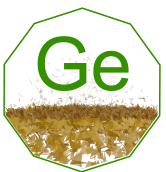
Germanium is the chemical element Ge, atomic number 32. It sits in group 14 beneath silicon and is usually classified as a metalloid: it looks metallic but is brittle and has semiconductor behavior rather than the ordinary conductivity of a metal. Its unusual combination of electrical and optical properties explains why it matters in fiber-optic glass, infrared lenses and selected electronic devices. If you are studying the periodic table, germanium is also a memorable example of how a predicted gap led to a real discovery.
This guide separates reliable elemental facts from claims that depend on a particular compound, manufacturing process or market year. It explains what the numbers in a Germanium element box mean, how its electrons influence bonding, why doping changes conductivity and how industry obtains a relatively scarce byproduct. It also corrects a common mistake: naturally occurring germanium has five isotopes, but one is very long-lived radioactive, so it is misleading to call all five absolutely stable. For the wider context, open Sly Academy’s interactive periodic table as you read.
Germanium at a glance
The Royal Society of Chemistry element record lists atomic number 32, relative atomic mass 72.630, group 14, period 4 and p block. At about 20 C it is a solid, silvery-gray material with density about 5.323 g/cm3. Its melting point is 938.25 C and boiling point approximately 2833 C. These values describe the element under stated conditions; a germanium-containing compound can have very different properties.
Atomic number is the count of protons in every germanium nucleus. A neutral atom therefore has 32 electrons. Relative atomic mass is not the mass number of one chosen atom: it is an abundance-weighted average across naturally occurring isotopes. Density tells you how much mass occupies a unit volume at a stated temperature. A 1 cm3 piece of pure germanium at room temperature would have a mass near 5.32 g. In a practical sample, impurities, porosity and temperature can alter a measured value.
The element’s symbol Ge is case-sensitive. GE is not the standard chemical symbol, and GeO2 is a compound, germanium dioxide, not elemental germanium. These distinctions matter when reading a mineral label or device specification. ‘Germanium’ in an industrial report may refer to the mass of contained Ge even when the traded product is an oxide or another chemical form. Always check the basis of a reported quantity before comparing sources.
Where germanium fits in the periodic table
Germanium lies between silicon above and tin below in group 14. The outer electron configuration is 4s2 4p2, with a filled 3d subshell included in the full shorthand configuration [Ar] 3d10 4s2 4p2. Four valence electrons make four covalent bonds common, especially in a tetrahedral network. In a crystalline sample, each Ge atom is bonded to neighbors in a diamond-cubic arrangement. The same broad structural motif occurs in silicon and diamond, but bonding strengths and electronic properties differ.
The term metalloid is useful because germanium does not fit a simple classroom metal/nonmetal split. Its surface has a metallic luster; a crystal is hard and brittle rather than readily hammered into sheets. Its electrical conductivity is between that of a good conductor and a strong insulator and is strongly affected by impurities and temperature. Classification boundaries for metalloids are conventional, not a separate fundamental law, so the most informative description names the actual properties.
Compare germanium with silicon in the same group. Both have four valence electrons and form covalent network solids, yet silicon is far more abundant and dominates mainstream integrated circuits. Germanium’s narrower band gap and high carrier mobility can be attractive in specialized devices. Compare it also with tin farther down group 14, which is typically discussed as a metal. Moving down a group reveals trends, but no single trend explains every application or chemical behavior.
Physical properties and what they imply
Pure germanium is solid at room temperature and appears grayish white with a bright metallic sheen on a fresh surface. It is brittle: a crystal may fracture rather than bend. That matters during crystal growth, slicing and polishing for optical or semiconductor parts. Germanium’s density is much greater than silicon’s, so equal-sized samples do not feel equally heavy. Its melting point is lower than silicon’s, yet still high enough that industrial processing requires controlled high-temperature equipment.
The diamond-cubic lattice helps explain both brittleness and semiconductor behavior. Bonds are directional. A metal usually has mobile conduction electrons even at low temperature; a semiconductor has a gap between occupied and available electronic states. Thermal energy, light or deliberately added dopant atoms can increase charge carriers. That is why simply calling germanium a ‘metal that conducts poorly’ misses the mechanism that makes it useful.
For infrared optics, the relevant question is not whether a material looks transparent to human eyes. Germanium appears opaque in visible light but can transmit portions of the infrared spectrum useful for thermal imaging. Optical performance depends on wavelength, temperature, surface coatings, lens design and material purity. A statement that ‘germanium is transparent to infrared’ is a useful shorthand, not a promise that every thickness transmits every infrared wavelength equally.
Germanium compounds behave differently. Germanium dioxide is a white solid used in selected glass and chemical processes; germanium tetrachloride is a reactive liquid used as a precursor. The appearance and handling of the element cannot be copied onto every compound. When a source reports refractive index, solubility or safety information, ask whether it refers to crystalline Ge, GeO2, GeCl4 or another specific substance.
Electrons, bonding and common oxidation states
Germanium commonly shows oxidation states +4 and +2 in compounds. In GeO2, each oxygen is ordinarily assigned -2, so charge balance gives Ge an oxidation state of +4. In GeCl2, assigning -1 to each chlorine gives Ge +2. Oxidation state is a bookkeeping model for electron allocation; it does not mean a Ge atom literally carries that full ionic charge inside every covalent compound. This distinction matters particularly for group 14 materials, where bonding is often substantially covalent.
Germanium forms tetrahedral covalent environments in many compounds. Its chemistry is related to, but not identical with, silicon chemistry. Some germanium halides react with moisture and require controlled conditions. Germanium dioxide can appear in different structures with different behavior. A beginner can learn the broad pattern from four valence electrons and group placement, then use a compound-specific reference for detailed reactions. Avoid memorizing a long list of isolated reaction equations without knowing which species and conditions are involved.
An ionization-energy value measures energy needed to remove an electron from a gaseous atom. The RSC lists first ionization energy near 762 kJ/mol and Pauling electronegativity about 2.01. These are useful comparison measures, but neither alone predicts semiconductor performance in a solid crystal. Band structure depends on how many atoms bond together in a lattice, not just the behavior of a free atom. For exam study, keep atomic trends, oxidation-state bookkeeping and solid-state electronics as related but distinct levels of explanation.
Isotopes: why the average mass is not a whole number
Atoms of the same element have the same 32 protons but can have different neutron numbers. Naturally occurring germanium includes mass numbers 70, 72, 73, 74 and 76. The NIST isotope table provides isotopic masses and approximate natural abundances; Ge-74 is the most abundant, with Ge-72 and Ge-70 also substantial. An isotope label such as Ge-74 gives protons plus neutrons, not the exact atomic mass in unified atomic mass units.
Introductory sources often describe all five natural isotopes as stable. That shorthand needs care. Ge-76 undergoes extremely slow double-beta decay; its half-life is so long that it behaves as stable for ordinary chemical purposes, but it is not strictly stable in nuclear physics. Ge-73 has been investigated for possible rare decay modes, so avoid making a stronger categorical claim than the evidence supports. For most chemistry calculations, the five natural abundances are what determine the standard relative atomic mass near 72.63.
To see why 72.63 is plausible, imagine only two fictional isotopes: one with mass 70 at 25% abundance and one with mass 74 at 75% abundance. Their weighted average would be 0.25 x 70 + 0.75 x 74 = 73. The real element has more isotopes and exact masses that are not integers. Multiplying each exact mass by its fractional abundance and adding gives a value around 72.63. You cannot read 72.63 as a particular atom having a fraction of a neutron; it summarizes a population.
Some radioactive isotopes are made artificially and used as tracers or calibration sources. A medical or industrial application involving a named isotope must be distinguished from everyday bulk germanium. The isotope determines nuclear behavior, while the element’s chemical identity still comes from 32 protons. When comparing isotope lists, check whether a source is listing naturally occurring isotopes, known radioactive isotopes, or only those used in a particular field.
How germanium was predicted and discovered
In the nineteenth century, Dmitri Mendeleev arranged known elements in a periodic pattern and left gaps where the pattern suggested missing elements. He called one predicted element ‘eka-silicon’ because it belonged below silicon. His predictions included approximate atomic mass, density and chemical behavior. In 1886, Clemens Winkler identified germanium in the silver-bearing mineral argyrodite. Its measured properties closely matched the expected gap, giving the periodic table an influential early validation.
That story is stronger than a simple ‘scientist guessed an element’ anecdote. Mendeleev used recurring relationships among already known elements to make a testable forecast. Winkler then analyzed an unfamiliar mineral and found that its unexplained component behaved like a new element. The match was meaningful because multiple properties lined up. The RSC history of germanium describes the prediction, the 1885 mineral discovery and Winkler’s 1886 identification. The name ultimately reflects Germany, not the similarly spelled flowering plant geranium.
A useful history-of-science question is what would have happened if one property had disagreed. A good model is judged by several independent observations, not by one number chosen after the event. Mendeleev’s table did not explain atomic structure, which was understood later, but it organized chemistry well enough to make productive predictions. Modern electron structure explains many of the regularities that his empirical arrangement revealed.
Where germanium comes from
Germanium is not usually mined from an enormous deposit of pure germanium metal. It occurs dispersed in certain zinc ores and other mineral systems and can be recovered as a byproduct while processing those materials. The U.S. Geological Survey overview identifies zinc ore processing as a principal route and describes the element as hard, brittle and semiconductor-like. RSC also notes recovery from zinc-smelter residues and selected coal-derived byproducts.
Byproduct production creates an important supply-chain effect. The amount of germanium recovered depends not only on demand for Ge but also on mining and processing of the host material, whether a refinery has suitable recovery equipment and whether recovery is economical. A deposit can contain germanium without being a practical source. Conversely, residues that once seemed waste can become valuable feedstock if technology and prices change. Do not confuse crustal occurrence with the quantity available to buy in refined form.
A simplified process begins with a germanium-bearing feedstock, separation into a germanium-rich intermediate, chemical refining and purification to the grade required for the intended use. Optical parts, fiber precursors and semiconductor crystals do not all demand the same final form or purity. Semiconductor-grade crystal production may involve zone refining or controlled single-crystal growth. The full industrial flowsheet varies with feedstock and producer, so a school-level overview should not present one universal sequence as if every plant used it.
The USGS 2026 mineral commodity summary is useful for current production, recycling and trade context. Its figures are tied to stated years and reporting methods; they should not be copied into a timeless element fact box. If you need a market statistic for an assignment, quote its year, unit and whether it describes metal, oxide or contained germanium. Supply conditions and restrictions can change faster than elemental properties.
Why germanium became a semiconductor material
Early solid-state diodes and transistors used germanium because a very pure crystal could be made to carry controlled electrical current. In a semiconductor, electrons and the ‘holes’ they leave behind act as mobile charge carriers. Doping introduces small, deliberate amounts of other elements to increase one carrier type. An n-type region has electrons as majority carriers; a p-type region has holes as majority carriers. Bringing these regions together makes a junction whose current depends on voltage and illumination conditions.
A diode is not simply a one-way mechanical valve. Its current-voltage relationship follows charge-carrier behavior at a junction and has leakage, voltage dependence and temperature sensitivity. A transistor uses one electrical signal to control another and can amplify or switch. Germanium’s role in early transistors was historically important, but silicon became dominant in mass-produced electronics because of abundance, manufacturing advantages and a useful native oxide for many device processes. ‘Silicon replaced germanium’ is a broad market story, not proof that germanium has no modern electronic role.
Specialized germanium-containing devices remain relevant, including selected high-speed semiconductor structures and multijunction solar-cell designs. The engineering choice depends on performance, cost, manufacturing compatibility and operating environment. A classroom comparison should avoid claiming that one material is universally ‘better.’ Semiconductor properties are a system of tradeoffs. That is why a material can lose one mainstream market and still remain valuable in several specialized ones.
Fiber optics and infrared optics
Telecommunications fiber guides light through glass rather than sending electric current along the glass. Germanium-containing compounds can be used to alter the refractive index of part of the fiber, helping confine light within a core. In that application, the germanium is generally part of specially formulated glass, not a solid metal wire carrying the message. The USGS identifies fiber-optic systems as a major use, but an exact share of consumption must be tied to a particular market and year.
In thermal imaging, polished crystalline germanium can serve as a lens or window because it transmits useful infrared bands. The detector behind the lens converts incoming radiation to an image; the lens is not itself necessarily the sensor. Coatings and optical design matter. A consumer visible-light camera lens and a thermal camera lens solve different wavelength problems, so it is misleading to say that germanium ‘replaces ordinary glass’ in every camera. Its cost and mass are among the practical tradeoffs.
Germanium dioxide can also be involved in specialized optical glasses and catalysis. The chemistry of an oxide precursor differs from that of a finished germanium crystal lens. When writing about uses, identify the material form and function: a glass dopant changes refractive index, a polished crystal transmits infrared radiation, and a semiconductor junction controls charge flow. Those three uses share the element but rely on different mechanisms.
Other applications and material tradeoffs
Germanium compounds can be used as catalysts in some polymer manufacturing, including certain processes that produce polyethylene terephthalate, or PET. A catalyst helps a reaction proceed but is not the plastic’s main building block. Whether a manufacturer uses a germanium catalyst depends on product requirements, cost and local practice. Germanium-containing materials also appear in selected solar cells and electronic components. These are examples of uses, not a guarantee that every bottle, phone or solar panel contains germanium.
A key tradeoff is that germanium is usually obtained as a byproduct and can be expensive to refine to high purity. If a cheaper material supplies adequate performance, manufacturers may select it. If a particular infrared band or semiconductor structure benefits strongly from germanium, the extra cost may be justified. Material selection therefore starts with a required property and operating condition, not with a claim that one element is inherently superior.
Recycling can reduce dependence on newly recovered material. Manufacturing scrap, off-specification components and end-of-life devices may contain recoverable germanium, but collection and separation are challenging when the element is dispersed in tiny amounts or combined with other materials. A claim that a product is ‘recyclable’ says little without a real collection and processing route. The USGS commodity reports distinguish primary production from recycling and can help an advanced student discuss this issue with dated evidence.
Safety: element, compounds and supplements are different questions
Germanium has no established essential biological role in humans. A polished bulk specimen in an educational display is not the same exposure as inhaled dust, a reactive laboratory compound or a swallowed supplement. Safety guidance must be substance-specific and exposure-specific. Follow laboratory instructions for any chemical; do not infer that a compound is safe because the pure element is sometimes described as having relatively low toxicity.
There is no sound reason to present germanium as a dietary necessity. The NIH PubChem record compiles reports of kidney, liver and nerve injury associated with some germanium exposures and high-dose supplements. That evidence is a warning against broad health claims, not a diagnosis for any reader. This article is about chemistry and materials science, not treatment; someone considering or using a supplement should discuss it with a qualified clinician rather than relying on an element page.
For classroom handling, teachers should use the safety data sheet for the actual material and keep powders, salts and volatile precursors under appropriate controls. A vendor label that says ‘germanium’ may hide a compound with different hazards. Never taste chemicals or improvise a heating experiment. This cautious approach is more accurate than a simplistic statement that all germanium materials are either harmless or poisonous.
Three worked examples
Example 1: interpret an atom’s composition
A neutral Ge-74 atom has atomic number 32 and mass number 74. It therefore has 32 protons, 32 electrons and 74 – 32 = 42 neutrons. A Ge-72 atom also has 32 protons and, if neutral, 32 electrons, but it has 40 neutrons. Their chemical similarity comes mainly from the same electron count; their nuclear masses and some nuclear properties differ. Do not subtract the standard average atomic mass 72.63 from 32 to calculate a neutron count. Choose a specified isotope first.
Example 2: calculate a sample’s approximate mass
Suppose a rectangular piece of pure germanium measures 2.0 cm by 1.5 cm by 0.50 cm at room temperature. Its geometric volume is 2.0 x 1.5 x 0.50 = 1.5 cm3. Using density 5.323 g/cm3, mass is about 1.5 x 5.323 = 7.9845 g, or 8.0 g to two significant figures. This assumes a solid, nonporous sample and appropriate temperature. If the object is a compound, an alloy or a hollow display piece, the pure-element density is not the right input.
Example 3: assign an oxidation state
Germanium dioxide has formula GeO2. Assign oxygen its usual oxidation state -2; two oxygen atoms contribute -4 in total. Because the compound is neutral, germanium must be +4 by oxidation-state bookkeeping. Germanium dichloride, GeCl2, similarly gives Ge +2 if chlorine is -1. These calculations help classify compounds, but they do not establish every bond as 100% ionic or predict how the compound behaves in water. Use compound-specific data for reactions.
Common misconceptions, corrected
- Germanium is the same as geranium. Germanium is an element; geranium is a plant. Similar spelling does not imply related chemistry.
- Every natural isotope is absolutely stable. Five isotopes occur naturally, but Ge-76 has an extremely long radioactive half-life. Its decay is irrelevant to ordinary handling yet important in precise nuclear language.
- A germanium optic works like a normal clear window. It is opaque in the visible range but useful for selected infrared wavelengths; exact performance depends on design and material.
- Germanium fiber optics are metal wires. In many fiber applications a germanium compound modifies optical glass; light, not electric current through a metal strand, carries the signal.
- Silicon made germanium obsolete. Silicon dominates mainstream integrated circuits, while germanium retains important specialized optical and electronic uses.
- Natural occurrence equals easy supply. Recovery is tied to host ores, refining capacity, economics and recycling. Geological presence alone does not ensure a usable supply.
- A chemical element page can endorse supplements. It cannot. Germanium is not an established essential nutrient, and reported supplement-related harms demand caution.
How to study germanium effectively
Start with five anchors: Ge, atomic number 32, group 14, four valence electrons and metalloid behavior. From those anchors, explain the diamond-cubic network and why the material can be a semiconductor. Then connect one property to one use: tunable charge carriers to a junction device, altered glass refractive index to optical fiber, and infrared transmission to thermal-imaging optics. This causal chain is more durable than memorizing a disconnected list of applications.
Next practice calculations: find neutrons for Ge-70 and Ge-74; estimate mass from density and volume; assign the oxidation state in GeO2. In each case, state assumptions and units. For a research assignment, compare an undated RSC element fact with a dated USGS market figure and explain why only the latter can quickly become stale. Finally, use the surviving interactive 3D model on this page as a visualization aid, not as proof of bond lengths, charge distribution or optical properties unless the model provides those measurements.
Germanium rewards this layered approach. Periodic position helps predict bonding; measured properties explain what a material can do; processing and economics explain whether a product actually uses it. To place it among neighboring elements, revisit the periodic table overview and compare verified data for silicon and tin. Keep the distinction between element, isotope, compound and manufactured device clear, and the subject becomes much easier to reason about.
Questions to ask when a source makes a germanium claim
Ask first whether the source means elemental Ge, a named compound such as GeO2, a germanium-bearing ore, or the contained germanium mass in an industrial product. The same word can appear in very different contexts. A chemistry data table may report the melting point of the pure element, while a manufacturer may discuss a glass with only a small amount of a germanium compound. Transferring a property from one to the other can lead to a confident but false explanation.
Ask next when and where a market figure was measured. A dated estimate of production or end-use share is evidence for that period, not an eternal property of the element. New refining capacity, demand for optical components and trade changes can shift the numbers. State the year whenever you use a supply statistic. If two trustworthy sources disagree, check whether one counts metal, oxide, contained Ge or recycled material, and whether they cover the same region.
Finally, ask which physical principle connects the claimed property to the use. A phrase such as ‘used in technology’ teaches little. A better explanation says that a semiconductor junction can control charge flow, that a glass composition can tune refractive index, or that an infrared-transmitting crystal can form a lens for a detector. Those explanations are testable and transferable to other materials. The point of studying an element is not just to collect facts but to connect atomic structure, measured behavior and real-world design.