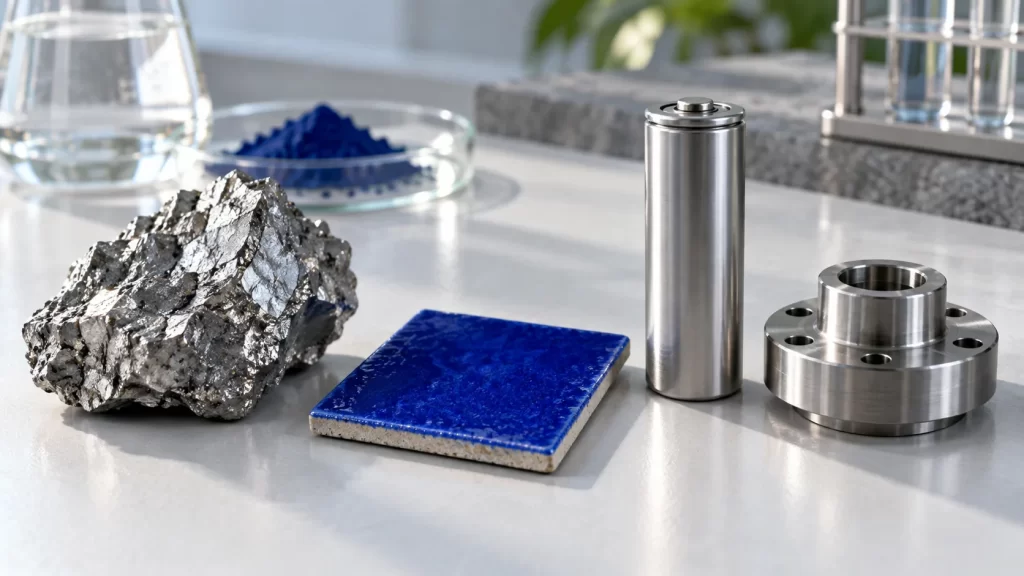
Cobalt (Co) is element 27: a silvery magnetic transition metal whose compounds can appear vividly blue and whose chemistry helps make certain batteries, heat-resistant alloys, magnets, pigments, and medical radiation sources possible. It is also the metal at the center of vitamin B12. Those connections are easy to recite but easy to misunderstand. A rechargeable battery does not necessarily contain cobalt; a blue object is not necessarily made from cobalt; and the cobalt in a vitamin molecule is not an invitation to take cobalt salts. This guide separates the element from its compounds and applications so that the periodic-table facts become useful explanations rather than isolated trivia.
The reference values in this article come from the Royal Society of Chemistry’s cobalt element page, the IUPAC Commission on Isotopic Abundances and Atomic Weights, and the U.S. Geological Survey’s cobalt data. Conditions, chemical form, and source year matter: a metal’s melting point is not the melting point of every compound it forms, and a mine-production estimate is not a permanent property of the element. Where a number is rounded for study, it is identified as such.
Cobalt at a glance
Cobalt’s symbol is Co, with an uppercase C and lowercase o. Its atomic number is 27, so a neutral cobalt atom has 27 protons and 27 electrons. It sits in period 4, group 9, and the d block of the interactive periodic table. Its standard atomic weight is 58.933194(3), usually rounded to 58.93 in introductory calculations. The parentheses convey uncertainty in the final digit; they do not mean that each atom weighs exactly that many grams. One mole of naturally occurring cobalt atoms has a mass close to 58.93 grams.
At about 20 °C, cobalt is a solid, lustrous metal. The Royal Society of Chemistry lists a melting point of 1495 °C, a boiling point of 2927 °C, and a density of about 8.86 grams per cubic centimeter. These values are for elemental cobalt under stated or conventional conditions, not a cobalt oxide, battery cathode, or commercial alloy. Cobalt is ferromagnetic, as are neighboring iron and nickel, but magnetic behavior depends on temperature and material composition. A cobalt-containing compound should never be assumed to act like a piece of cobalt metal.
The name has a history older than its scientific identification. European miners used a word related to kobold, or goblin, for troublesome ores that failed to yield the expected metal and could release hazardous arsenic-bearing fumes during processing. Swedish chemist Georg Brandt identified cobalt as a distinct metal in the eighteenth century; the RSC describes his work beginning around 1730 and publication in 1739, while the CIAAW notes discovery in 1735. Those dates describe stages of investigation, not two separate discoveries. The memorable name does not tell us which modern cobalt materials are safe to use.
Where cobalt sits on the periodic table
The position between iron and nickel’s element overview is a useful starting point, but neighbors are not interchangeable. All three are period-four transition metals that form alloys and exhibit magnetic behavior in their metallic forms. Cobalt’s group-9 placement and electron arrangement help explain why it can form compounds in several oxidation states and act as a component in catalysts. The periodic table suggests patterns; experiments and the specific compound determine actual color, reactivity, solubility, and hazard.
A neutral cobalt atom has the ground-state electron configuration [Ar] 3d⁷ 4s². The shorthand [Ar] represents the 18 electrons of the argon core; seven 3d and two 4s electrons account for the remaining nine. Students sometimes write only “nine outer electrons” and then treat all nine as equally easy to remove. That shortcut is misleading. In common cobalt ions, the 4s electrons are removed before 3d electrons: Co²⁺ is commonly represented as [Ar] 3d⁷, and Co³⁺ as [Ar] 3d⁶. Oxidation state is formal electron accounting, not a photograph of an isolated ion in every material.
Cobalt commonly appears in the +2 and +3 oxidation states. Co²⁺ and Co³⁺ can coordinate to surrounding molecules or ions, creating many compounds whose structures and colors differ. A material with cobalt in a battery cathode is not simply a pile of Co²⁺ ions; its behavior comes from a solid crystal framework and the movement of lithium ions and electrons during charging. Likewise, cobalt in vitamin B12 is held in a complex molecular environment. To understand a claim about “cobalt,” first ask whether it refers to atoms in a metal, a dissolved ion, an oxide, an alloy, or an organometallic complex.
Why cobalt looks blue in some materials but not in others
The metal itself is silvery, sometimes described as silvery-blue. The famous intense blue belongs to particular cobalt-containing pigments and glasses, not to every cobalt sample. Cobalt salts have colored glass, ceramics, pottery, and enamels for centuries. In a pigment, cobalt’s ions interact with oxygen or other surrounding atoms in a defined crystal structure. Light absorption in that environment leaves the reflected or transmitted color we see. Change the chemical surroundings and the observed color can change too.
A classic classroom example is cobalt chloride, whose hydrated and anhydrous forms can look different because water changes the ions’ coordination environment. This illustrates a broad lesson about transition-metal chemistry: color is evidence of a specific material and its surroundings, not a permanent label attached to one atomic number. The demonstration is not a home experiment; cobalt compounds can present exposure hazards. For study, compare diagrams or supervised demonstrations, record the formula and water content, and resist the statement “cobalt is blue” without specifying what substance is blue.
The old article mixed the metal’s physical properties with compound properties and gave two different boiling-point figures. The RSC fact box lists 2927 °C for elemental cobalt, so that is the value used here. A manufacturer may report a different thermal value for a cobalt alloy because alloy constituents and measurement methods differ. If a worksheet, database, and article disagree, check whether they describe the same substance, temperature scale, and source edition before treating the discrepancy as a scientific contradiction.
From ore to usable cobalt
Cobalt is not ordinarily found as abundant pure metal in nature. It occurs with other elements in minerals and ores, often alongside copper and nickel. The USGS cobalt overview explains why mining and refining routes are strongly connected to those other metals. A company extracting copper or nickel may recover cobalt as a valuable byproduct. That relationship means the cobalt supply cannot always respond to cobalt demand as directly as the supply of a metal mined mainly for itself.
An ore is a rock or mineral mixture from which a valuable material can be extracted economically; it is not automatically a pure cobalt compound. Cobaltite and other named minerals contain cobalt together with sulfur, arsenic, or additional elements. Processing starts with identifying and concentrating the relevant material, then separating cobalt from associated metals and impurities through a sequence suited to the ore. There is no single universal “flotation then smelting” recipe. Sulfide ores, laterite ores, and recycled battery materials require different processing decisions, and environmental controls are part of any responsible operation.
The supply picture is time-sensitive. In its 2026 cobalt Mineral Commodity Summary, USGS estimates that the Democratic Republic of the Congo supplied about 73% of mined cobalt in 2025 and Indonesia about 14%. These are estimates for a named year, not timeless percentages or a prediction of where a phone’s cobalt came from. USGS also distinguishes mined material from refined cobalt; China is prominent in refining and consumption. A battery supply chain can therefore cross several countries between ore and finished product.
Concentrated production can create exposure to political, logistics, labor, and environmental risks. It does not prove that every cobalt-containing item was produced under the same conditions. Procurement questions should ask for traceability, auditing methods, material specifications, and recycling practices rather than assuming a single answer from a country statistic. Readers comparing cobalt with other strategic metals can use the zirconium guide as a contrast: that element’s prominent nuclear and ceramic applications create a very different supply-and-use story.
Cobalt in rechargeable batteries
The leading global use of cobalt, according to USGS, is in rechargeable battery electrodes. In many lithium-ion cells, cobalt is part of the cathode material, commonly a metal oxide that can reversibly host lithium ions. During charge and discharge, lithium ions move between electrodes while electrons travel through the external circuit. Cobalt’s role is tied to the cathode’s structure and electrochemical performance; cobalt metal is not simply dropped into a battery as a standalone energy source. Battery design also requires an anode, electrolyte, separator, current collectors, and safety controls.
Several familiar cathode families illustrate why “a lithium-ion battery contains cobalt” is too broad. Lithium cobalt oxide uses cobalt; nickel-manganese-cobalt materials use it together with other transition metals; nickel-cobalt-aluminum formulations include it as well. Lithium iron phosphate, usually shortened to LFP, is a commercially important lithium-ion chemistry that does not require cobalt in its cathode formula. Actual devices can use different chemistries under the same broad lithium-ion label, so identify the cell chemistry before making a cobalt-content claim.
The U.S. Department of Energy’s discussion of low-cobalt batteries explains the engineering tradeoff. Lowering cobalt content can reduce reliance on a concentrated supply chain, but a replacement cathode must still meet targets for voltage, usable energy, durability, safety, and manufacturability. A cobalt-free research result is not automatically a drop-in substitute for every application. The appropriate chemistry depends on the product’s performance requirements and the whole cell design, not a single ingredient’s reputation.
Battery recycling offers another supply route. It cannot recover material that has not yet reached end of life, and collection, sorting, and processing all have costs, but it can return valuable metals to use. When a source says “cobalt demand will rise” or “cobalt will disappear,” check its publication date, assumptions about electric-vehicle adoption, cathode mix, and recycling recovery. The purpose of a durable element guide is to explain what cobalt does and how to examine such forecasts, not to turn a changing market estimate into a permanent chemical fact.
Heat-resistant alloys, magnets, tools, and coatings
An alloy is a material containing two or more elements, at least one of them a metal. Cobalt can help an alloy retain strength and resist wear or corrosion in demanding conditions. Gas turbines are a prominent example: components exposed to high temperatures need an engineered combination of mechanical strength, oxidation resistance, and service life. The RSC and USGS both identify superalloys as an important cobalt application. The whole alloy composition and manufacturing process, not cobalt alone, determine whether a component is suitable for an aircraft or power-generation turbine.
Cobalt also appears in wear-resistant alloys and hard materials used in cutting or drilling. In cemented carbides, a cobalt-containing binder can hold hard particles together. This is helpful for machining but creates an occupational exposure question when tools are ground or processed and dust becomes airborne. A finished solid component and respirable dust are different exposure situations. The NIOSH Pocket Guide entry on cobalt dust and fume describes respiratory and skin effects and lists workplace exposure limits. Workers and employers should use the applicable safety data, engineering controls, and professional industrial-hygiene guidance.
Ferromagnetic cobalt contributes to several permanent-magnet systems, including alnico and samarium-cobalt magnets. The point is not that cobalt is the strongest magnet in every configuration; magnetic performance reflects composition, crystal structure, operating temperature, and design. Some applications value stable performance at elevated temperature more than a headline room-temperature strength. For a student, the useful distinction is between an element’s magnetic behavior and the engineered properties of a finished magnet. Copper wires near a magnet do not become cobalt; different materials play different roles in an electrical machine.
Electroplating and some coatings use cobalt-containing materials to alter hardness, appearance, or corrosion behavior at a surface. A coating’s thickness and chemistry matter because the bulk object can be made of another material. Cobalt catalysts and compounds also have specialized roles in chemical processes and pigments. Listing every possible use can obscure the core idea: cobalt is valuable where particular electronic, thermal, magnetic, or coordination properties improve the performance of a more complex system.
Cobalt-59, cobalt-60, and radiation
Naturally occurring cobalt is essentially cobalt-59, the one stable isotope. An isotope has the same 27 protons as every cobalt atom but a different number of neutrons. Cobalt-59 has 32 neutrons because 59 minus 27 equals 32. The standard atomic weight of cobalt is close to 59 because naturally occurring cobalt is monoisotopic; the exact value is below 59 because nuclear masses are not simply whole numbers. The CIAAW cobalt page gives the current standard weight and isotope relationship.
Cobalt-60 is different: it is radioactive and emits gamma radiation as it decays, with a half-life of about 5.27 years. It can be produced from cobalt-59 in a reactor. Carefully controlled radiation sources have been used in cancer treatment, industrial inspection, and sterilization. These are regulated applications requiring shielding, calibration, trained operators, and disposal plans. The existence of a medical use does not make an unshielded source safe, and the existence of a radioactive isotope does not make an ordinary cobalt-blue ceramic radioactive.
Half-life is sometimes misunderstood as the time until all radioactivity disappears. If a pure sample starts with 100 arbitrary units of cobalt-60 activity, about 50 remain after one half-life and about 25 after two, assuming no new cobalt-60 is added. Activity declines exponentially; it does not hit zero at the first half-life. This arithmetic is useful for interpreting radiation-safety discussions, but it is not a substitute for actual dosimetry or source-management procedures.
Why cobalt matters in biology without being a DIY supplement
Cobalt is an essential part of the structure of vitamin B12, or cobalamin. In humans, B12 supports processes including red-blood-cell formation and nervous-system function. The important nutritional requirement is for adequate vitamin B12, not for arbitrary intake of elemental cobalt or soluble cobalt salts. A trace metal bound inside a vitamin molecule behaves differently from an industrial cobalt compound. Food, fortified foods, and clinically indicated B12 supplements are not interchangeable with cobalt salts marketed as a shortcut to energy.
That distinction helps prevent two opposite errors. “Cobalt is essential” does not imply that more cobalt is better; “cobalt dust can harm workers” does not imply that every cobalt-containing molecule is harmful at every exposure. Health effects depend on chemical form, route, amount, and duration. The RSC identifies cobalt’s biological role in B12, while NIOSH addresses occupational inhalation hazards. If a person has symptoms that might relate to B12 deficiency or occupational exposure, diagnosis belongs with qualified clinicians rather than an element page or a self-experiment.
Safety: match the precaution to the material
For a classroom, a labeled solid periodic-table sample behind a display and a loose cobalt-containing powder are not the same scenario. Dust, fume, and soluble compounds can create inhalation, ingestion, or skin-contact risks; even bulk metal can require precautions during cutting or grinding. The NIOSH cobalt entry lists cough, breathing difficulty, wheezing, dermatitis, and other possible effects from occupational exposure. A reader should not infer from this that casual proximity to every manufactured object containing cobalt produces the same risk. Exposure pathways must be identified.
Follow the specific safety data sheet, institutional rules, and local regulations for the material actually handled. Do not heat, grind, ingest, or dissolve cobalt samples as a home activity. For professionals, exposure control typically begins with process design and ventilation rather than reliance on a mask chosen without assessment. Cobalt-60 adds radiation controls beyond ordinary chemical handling. This article explains categories of risk; it does not supply a laboratory protocol, medical treatment plan, or legal compliance checklist.
Environmental questions also depend on context. Mining and refining can disturb land, consume energy and water, and produce waste; batteries can create collection and processing challenges at end of life. Conversely, some cobalt-containing technologies contribute to equipment durability or energy storage. A serious comparison looks at the entire life cycle and the alternative material’s impacts rather than declaring an element categorically “green” or “dirty.” USGS commodity data help quantify supply; local environmental reports and independent audits are needed to assess a particular operation.
Worked examples for chemistry students
Suppose a worksheet asks for protons, electrons, and neutrons in a neutral cobalt-59 atom. Atomic number 27 gives 27 protons. Neutrality gives 27 electrons. The mass number 59 counts protons plus neutrons, so 59 − 27 = 32 neutrons. If the worksheet instead asks about Co²⁺ made from cobalt-59, the nucleus is unchanged: 27 protons and 32 neutrons. The +2 charge means two fewer electrons than protons, so the ion has 25 electrons. Changing an ion’s charge does not change it into a different element.
For electron configuration, start with the neutral atom’s [Ar] 3d⁷ 4s². Remove the two 4s electrons to write the simple ionic configuration of Co²⁺ as [Ar] 3d⁷. Remove one additional 3d electron to represent Co³⁺ as [Ar] 3d⁶. In a coordination compound, the surrounding ligands further influence energy levels and magnetic properties, so this bookkeeping is the beginning of an explanation, not its end. This is why memorizing a color for “Co²⁺” without naming its chemical environment can lead to wrong predictions.
For molar-mass arithmetic, one mole of cobalt atoms is approximately 58.93 grams. A 5.893-gram sample of pure elemental cobalt therefore contains about 0.1000 mole of cobalt atoms: divide sample mass by molar mass. Multiplying 0.1000 mole by Avogadro’s constant gives roughly 6.02 × 10²² atoms. That calculation assumes pure cobalt, not 5.893 grams of an ore or compound. If the material is CoO, include oxygen in the formula mass and then use the formula’s one-to-one cobalt-to-formula-unit ratio.
For an oxidation-state exercise, oxygen is usually assigned −2 in a simple oxide. In CoO, one oxygen contributes −2 and the neutral formula therefore requires cobalt to be +2. In Co₂O₃, three oxygens contribute −6 in total; the two cobalt atoms must sum to +6, so each is formally +3. These assignments help name cobalt(II) oxide and cobalt(III) oxide. They do not state that a black oxide sample has the same properties as shiny metal or that every real-world cathode can be described with one fixed cobalt charge through an entire battery cycle.
For source evaluation, imagine two study pages disagree: one says cobalt boils at roughly 2869 °C, another at 2927 °C. First identify whether each value is for pure metal, an alloy, or a compound. Next check a recognized reference such as the RSC and record its stated 2927 °C, rather than averaging incompatible numbers. Finally note that measurement uncertainty and reference conventions may produce small differences even among reliable sources. This method—substance, conditions, authority, date—is more transferable than memorizing an unexplained number.
How to read cobalt claims in a technology article
A report may say that a battery contains “ten percent cobalt,” but the denominator is essential. Ten percent of a cathode powder, ten percent of the entire cell, and ten percent of an electric vehicle’s battery pack are different quantities. A cathode can be only one component of a cell, while the pack includes casing, electronics, cooling, and structural material. Before comparing two percentages, identify the material boundary, measurement method, and chemistry. A lower cobalt percentage in a specific cathode does not by itself tell you the total cobalt per vehicle if battery size or the number of cells changes.
Similarly, “cobalt production” can refer to material mined, recovered as a byproduct, refined into a saleable chemical, or recycled from used products. USGS mineral-commodity tables often separate those stages and clearly state whether numbers are estimates. The production country of an ore is not necessarily the country that refined it or manufactured the finished battery. When interpreting the 2026 USGS summary, cite its 2025 estimate as a snapshot. Do not repeat the percentage without the year, and do not treat a listed reserve as all cobalt that can ever be discovered or economically extracted.
The word critical in a government mineral list refers to supply-chain and economic or security considerations, not to a unique kind of atom. A material can be chemically ordinary yet strategically important if demand is high and substitute supply is difficult. Conversely, cobalt’s strategic status does not mean that every application must keep using it. Engineers can reduce material intensity, redesign components, use alternative chemistries where suitable, and recover metals from scrap. Each option has a performance and environmental tradeoff that should be tested rather than assumed.
Material comparisons should also match the function. Replacing cobalt in one battery cathode might change charge rate, temperature behavior, energy density, or manufacturing process; replacing it in a high-temperature turbine alloy is an entirely different question. A headline about “cobalt-free batteries” says nothing about cobalt’s usefulness in pigments, catalysts, or magnets. For students and general readers, this is a chance to connect chemistry to systems thinking: the same element participates in multiple technologies for different reasons, so a single market headline cannot describe the whole element.
A practical study checklist
When reviewing cobalt for a chemistry exam, begin with four stable facts: symbol Co, atomic number 27, one naturally occurring stable isotope cobalt-59, and a standard atomic weight near 58.93. Then connect the neutral electron configuration to common +2 and +3 oxidation-state bookkeeping. Practice one formula, such as CoO, and one atom-count problem. These exercises test whether you can move between an atomic number, an isotope’s mass number, an ion’s charge, and a compound’s formula without confusing them.
Next, draw two columns titled “elemental metal” and “cobalt-containing material.” Put silvery appearance, ferromagnetism, and the metal’s melting point in the first; place cobalt-blue pigment, cathode oxide, B12, and cobalt-60 source in the second with a note about the exact chemical or nuclear form. Cobalt-60 is still an element isotope, but its radiation behavior belongs to its nucleus rather than the everyday chemistry of stable cobalt. The exercise reveals why a one-line list of “cobalt properties” can mix categories that should stay separate.
Finally, evaluate one real application with a three-question frame: Which cobalt-containing material is involved? What property is useful in that design? What limitation or alternative should be considered? For a battery, the answers might involve an oxide cathode, electrochemical performance, and the tradeoffs of low-cobalt or cobalt-free chemistries. For a turbine, they might involve an engineered alloy, high-temperature strength, and component-specific durability. Explaining the causal link is more valuable than repeating a catalog of uses.
Common misconceptions to correct
It is inaccurate to say that all lithium-ion batteries contain cobalt. Lithium-ion describes an ion-transfer family; cathodes differ. It is also inaccurate to say cobalt’s main use is simply “blue dye.” Pigments remain culturally important, but USGS identifies rechargeable battery electrodes as the leading global use. Both facts can be true when a material has diverse applications. When reading a product description, look for the actual compound or battery chemistry instead of inferring it from a broad marketing phrase.
Cobalt is not intrinsically radioactive. The stable isotope cobalt-59 dominates natural cobalt, while cobalt-60 is a produced radioactive isotope used under strict controls. Nor does the role of cobalt in B12 justify taking cobalt metal or salts. “Needed as part of a vitamin molecule” and “safe to consume as an isolated industrial compound” are different claims. These distinctions are particularly important because the same element name appears in nutrition, occupational-safety, and radiation contexts.
Finally, an element’s position in the periodic table is not a complete performance specification. Cobalt’s properties help explain why engineers select it for particular alloys, cathodes, and magnets, but the final material’s ingredients, processing, operating conditions, and alternatives decide its performance. Start with the atom, identify the material’s actual chemical form, then ask what problem that material solves. That three-step habit turns a fact sheet into a working understanding of cobalt.
Sources and further reading
- Royal Society of Chemistry: cobalt element data, uses, history, and biological role
- IUPAC CIAAW: cobalt standard atomic weight and isotopes
- U.S. Geological Survey: cobalt statistics and information
- USGS Mineral Commodity Summaries 2026: cobalt
- U.S. Department of Energy: reducing reliance on cobalt in lithium-ion batteries
- NIOSH Pocket Guide: cobalt metal dust and fume