
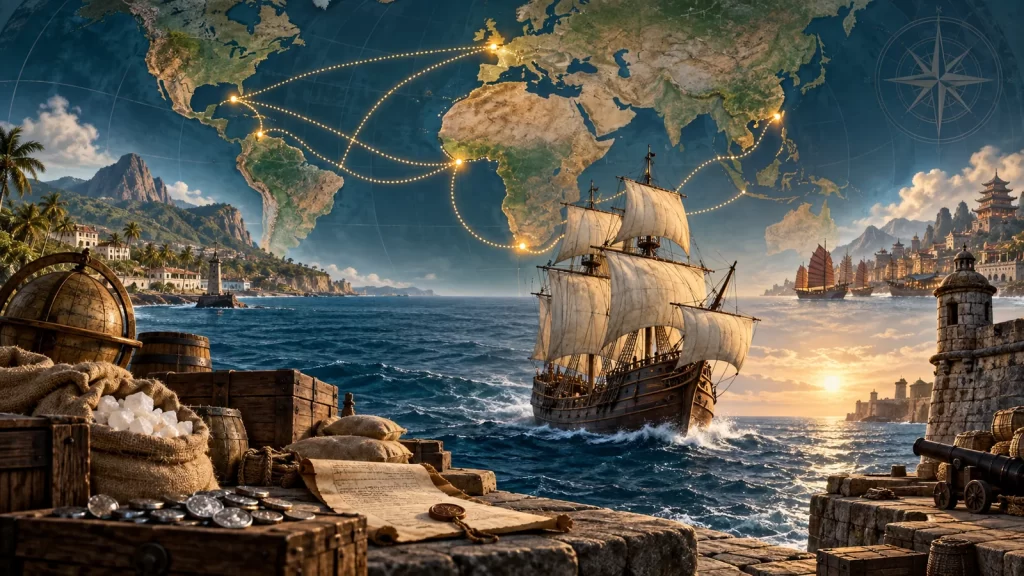
AP World History Unit 4.5 asks one central question: how did rulers use economic strategies to consolidate and maintain maritime empires from about 1450 to 1750? The short answer is that states combined mercantilism, monopoly trading companies, colonial extraction, and naval protection to turn overseas commerce into political power.
This guide follows the current College Board course framework. It focuses on the evidence you are most likely to need for multiple-choice, short-answer, document-based, and long-essay questions.
Topic 4.5 learning objective
You should be able to explain how rulers employed economic strategies to consolidate and maintain power between 1450 and 1750. This topic comes after how maritime empires were established. Topic 4.5 shifts the focus from exploration and conquest to the systems that kept those empires operating.
The core idea: commerce became a tool of state power
Maritime empires were expensive. Rulers needed ships, soldiers, forts, administrators, and dependable supply lines across great distances. They therefore designed economic policies that directed trade toward the state, protected favored merchants, and extracted wealth from colonies.
These policies did more than produce revenue. They helped monarchs compete with rival states, reward political allies, maintain navies, and extend authority into the Atlantic, Indian, and Pacific Ocean worlds.
Mercantilism and colonial trade
Mercantilism was the belief that a state could strengthen itself by controlling trade and accumulating wealth, especially precious metals. European governments tried to export more, import less, and reserve colonial markets for merchants from the home country.
In practice, mercantilist systems often included:
- exclusive trading rights for favored merchants or companies;
- tariffs and navigation laws that restricted foreign competition;
- colonies organized to supply commodities such as sugar, tobacco, silver, and dyestuffs;
- protected markets where colonists bought manufactured goods from the imperial power; and
- naval forces and fortified ports that defended commercial routes.
The purpose was not free trade. It was to make trade serve the strategic goals of the state. This is why economic disputes frequently became diplomatic crises or wars.
Joint-stock companies extended imperial power
A joint-stock company raised money from multiple investors, spreading the risk of long-distance trade. Governments granted some companies charters that included monopoly privileges and, in certain places, authority to build forts, negotiate treaties, maintain armed forces, or administer territory.
The Dutch East India Company, commonly called the VOC, is a key example. It linked private investment with Dutch state interests in the Indian Ocean. The English East India Company performed a similar role for England and later Britain. These companies were commercial organizations, but their chartered powers also made them instruments of empire.
AP exam connection: do not describe a joint-stock company as simply a modern corporation. Explain the historical relationship: merchants supplied capital, the charter supplied monopoly privileges, and the company helped the state compete for trade and territory.
Silver connected the major trading zones
American silver became one of the most important commodities in the early modern global economy. Spanish-controlled mines, especially at Potosí in the Andes and Zacatecas in Mexico, produced silver that moved across the Atlantic and Pacific.
The Manila galleon trade carried American silver to the Philippines, where it could be exchanged for Chinese and other Asian goods. Chinese tax policies and commercial demand made silver especially valuable. This flow illustrates how maritime empires connected production in the Americas, European imperial administration, and Asian markets.
Silver also produced consequences. It financed imperial activity and global exchange, while heavy inflows of bullion contributed to inflation in parts of Europe. Mining relied on coercive labor systems and imposed severe human and environmental costs.
Plantations, coerced labor, and imperial revenue
Plantation agriculture supplied European and global markets with high-value commodities. Sugar was particularly important in Brazil and the Caribbean. Plantation expansion increased demand for enslaved labor and intensified the transatlantic slave trade.
This system linked merchants, shipowners, colonial officials, plantation owners, and consumers. Profits and tax revenue strengthened imperial states, but the system rested on violence, forced migration, and racialized hierarchies. Connect this topic with the demographic and ecological effects covered in the Columbian Exchange.
Competition created rivalries and conflict
Trade monopolies could not eliminate competition. Instead, they often intensified it. European and regional powers fought over ports, sea lanes, commercial privileges, and access to commodities.
Useful examples include:
- Dutch-Portuguese competition for control of Indian Ocean trade;
- Anglo-Dutch Wars connected to shipping and commercial rivalry;
- Muslim-European rivalry in the Indian Ocean, an illustrative example named in the College Board framework; and
- Morocco’s conflict with the Songhai Empire, which involved control of trans-Saharan trade and strategic resources.
The larger pattern is clear: economic policy, military power, and imperial competition reinforced one another.
Evidence bank for AP World History 4.5
| Evidence | How it maintained power | Useful connection |
|---|---|---|
| Mercantilism | Directed colonial trade and revenue toward the imperial state | State building and economic control |
| VOC and English East India Company | Mobilized private capital under state-granted monopoly charters | Commercial and political power working together |
| Potosí and Zacatecas silver | Financed empire and linked American production to Asian demand | Global economic integration |
| Plantation complex | Generated export commodities and tax revenue | Coerced labor and social hierarchy |
| Fortified ports and navies | Protected routes, warehouses, and strategic chokepoints | Military-commercial competition |
How to use this topic in an SAQ, DBQ, or LEQ
Make a specific claim
A strong claim names both a strategy and its political effect. For example: European rulers maintained maritime empires by granting monopoly charters to joint-stock companies, which financed long-distance trade while extending state influence into strategic ports.
Explain the evidence
Do not stop after naming the VOC, mercantilism, or Potosí. Add a sentence explaining how the example supports your argument. The relationship between evidence and claim is what earns analysis credit.
Add complexity through comparison
You might compare chartered-company rule with direct royal administration, or explain that European states expanded their influence without completely replacing long-established Asian merchants and regional trade networks.
Common mistakes to avoid
- Treating all empires as identical: administrative systems and degrees of direct control differed.
- Separating economics from politics: Topic 4.5 is specifically about economic strategies used to maintain state power.
- Ignoring coerced labor: plantation wealth cannot be explained accurately without slavery and other compulsory labor systems.
- Using “triangular trade” as the whole story: Atlantic exchange involved many overlapping routes, and maritime commerce also connected the Indian and Pacific Oceans.
- Listing facts without causation: always state how a policy, institution, or commodity strengthened or challenged imperial power.
Quick review
Maritime rulers maintained their empires by regulating colonial commerce, chartering monopoly companies, extracting plantation and mining wealth, and using naval force to protect trade. These strategies expanded state capacity but also intensified forced labor, inequality, and conflict. If you can connect mercantilism, joint-stock companies, silver, and imperial rivalry in a causal argument, you understand the heart of Topic 4.5.
Continue with challenges to state power, or step back to the Unit 4 overview to connect this lesson with exploration, exchange, resistance, and continuity.
Official source
The learning objective, required content, and exam weighting in this guide are grounded in the College Board’s AP World History: Modern course page and current Course and Exam Description.