
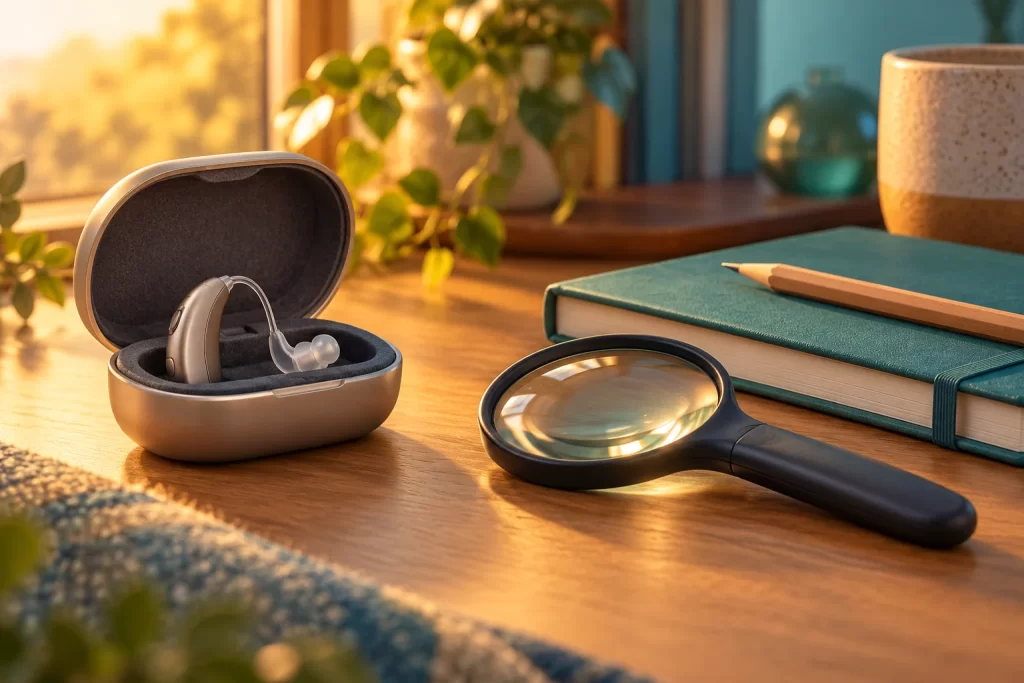
Hearing, vision, communication, and care
Usher syndrome affects hearing and vision and, for some people, balance. Its effects vary widely, so a diagnosis does not provide a fixed timetable for future hearing or sight. This guide explains the main types, clinical and genetic assessment, inheritance, and the practical support that can improve access to communication, learning, work, and everyday life. [1]
Educational information; sources checked 6 October 2026. This guide does not provide a personal diagnosis or treatment plan.
What is Usher syndrome?
Usher syndrome is a group of inherited conditions affecting hearing and vision, with balance differences in some people. The hearing loss is usually sensorineural, meaning it involves the inner ear’s sound-sensing system. The vision changes are caused by retinitis pigmentosa, often shortened to RP, which affects the retina at the back of the eye. These features can emerge at different times. A person may first be identified as deaf or hard of hearing and only later receive a diagnosis that connects the hearing and retinal findings. [1]
Deafblindness describes combined hearing and vision loss; it does not necessarily mean having no hearing and no sight. People use different identity terms, including DeafBlind, deafblind, deaf, hard of hearing, blind, or a person with Usher syndrome. Some identify strongly with Deaf or DeafBlind communities, while others prefer different language. Follow the person’s preference. Neither a diagnostic label nor the amount of hearing or vision someone has tells you what language they use, what they understand, or how they want to participate in decisions. [47]
A useful care discussion begins with specific activities. Can someone follow a conversation in a busy room, find a seat in dim lighting, read a classroom display, or identify an approaching bus? These are different questions, and one successful task does not answer the others. Writing down the situations that work well and those that create barriers gives the care team practical goals. It also helps family members avoid assumptions based on a single encounter or on how another person with the same diagnosis lives.
Why hearing, vision, and balance can be linked
Genes are stretches of DNA that provide instructions used by cells. Several genes associated with Usher syndrome help sensory cells develop, function, or maintain their structure. For example, MYO7A provides instructions for myosin VIIA, a protein involved in moving materials within cells and supporting specialized structures. It has roles in the inner ear and retina. Different disease-causing variants in this gene can have different effects, illustrating why a gene name alone is not a complete explanation of an individual’s clinical findings. [6]
USH2A provides instructions for usherin, a protein with roles in the inner ear and retina. Some variants in USH2A are associated with Usher syndrome, while others are associated with retinal disease without the characteristic hearing loss. This distinction matters when interpreting a report found online or comparing results with another family. The clinician needs the exact variants, how they were classified, and the person’s hearing and eye findings. Sharing a gene name does not automatically mean sharing the same condition or future course. [7]
CLRN1 provides instructions for clarin 1, which is involved in sensory cell function and is associated with many cases of type 3 Usher syndrome. Researchers continue to investigate how these proteins work together and why particular variants affect sensory systems differently. The term genetic therefore identifies an underlying biological explanation, not a single uniform experience. A laboratory finding may clarify the cause without predicting which daily activity will become difficult first or which communication support a person will prefer. [8]
For general biology background, Sly Academy’s nucleic acids study guide explains how DNA carries genetic information. Use the biology flashcards to revisit related biology concepts.
Usher syndrome types 1, 2, and 3
Type 1 usually includes severe to profound hearing loss from birth, vestibular dysfunction affecting balance, and retinal degeneration that becomes apparent during childhood. Children may reach some motor milestones later because of the balance component. These descriptions guide assessment but are not deadlines or requirements that every person must meet in exactly the same way. Molecular testing can clarify the diagnosis, and early access to language is essential. Signed language may be a primary language or used alongside other communication approaches, according to the child’s needs and family choices. [3]
Type 2 usually includes hearing loss present from birth, often more marked for higher frequencies, together with RP that is recognized later than in typical type 1. Hearing levels and retinal changes vary. Although balance is often described as relatively preserved, vestibular function can be variable; new imbalance should still be assessed. Established type 2 genes include USH2A, ADGRV1, and WHRN. A type label can help organize information, but follow-up should be based on actual hearing, retinal, and balance findings rather than a simplified description in a chart. [4]
Type 3 is especially variable. Hearing may be typical at birth and then decline, while the onset and progression of retinal changes also differ between individuals. Balance difficulties occur in some people. Research describing type 3 emphasizes this diversity rather than a single reliable age sequence. People in the same family may not have identical experiences. Someone whose findings overlap categories may need an individualized explanation from an inherited retinal disease or genetics service instead of repeated attempts to fit every symptom into one textbook pattern. [5]
| Type | Hearing pattern | Retinal and balance features |
|---|---|---|
| Type 1 | Usually severe to profound loss from birth | RP often apparent in childhood; vestibular dysfunction is characteristic. [3] |
| Type 2 | Usually present from birth; higher frequencies often more affected | RP generally recognized later; vestibular function varies. [4] |
| Type 3 | Often develops and progresses after birth | Retinal onset and progression vary; some people have balance difficulties. [5] |
On a small screen, scroll the table horizontally. Individual findings may overlap these broad categories.
Understanding hearing and balance changes
A newborn hearing screen is an early check, not a complete diagnosis of the cause of hearing loss. Follow-up testing is needed when screening suggests a concern. Hearing can also change after the newborn period, so a previous screening result does not settle later questions about listening or communication. Families who notice reduced responses to sound, changes in communication, or other hearing concerns should raise them with the child’s clinical team. The goal is timely assessment and support, without waiting for every part of a possible syndrome to become obvious. [10]
Balance depends on information from the inner ear, eyes, muscles, and joints working together. A vestibular difference may make movement or orientation harder, particularly when visual information is also limited. Assessment can help distinguish a longstanding balance pattern from a new problem. Depending on the findings, a team may include an ear specialist, audiologist, physical therapist, or vestibular rehabilitation professional. The useful questions concern the person’s actual difficulties, such as uneven surfaces, head movement, or unfamiliar environments, and what strategies could make those activities more manageable. [9]
For appointments, describe hearing and balance separately. A note such as “conversation is harder when several people speak” is more informative than “hearing is worse.” Similarly, describe whether imbalance occurs in darkness, with movement, or unexpectedly while standing still. Record when a change started and whether it affects one side or both. These observations do not identify the cause on their own, but they help clinicians decide what to examine. Bring relevant device details and previous test reports when available, so changes can be compared in context.
How retinitis pigmentosa affects vision
The retina contains light-sensing cells called rods and cones. Rods support vision in dim light, while cones support detailed and color vision. RP involves progressive damage to these cells. Early difficulties often include seeing at night or adjusting to dim surroundings, followed by changes in peripheral vision. Someone may therefore read a small item held directly in front of them yet miss a nearby obstacle. The pattern and speed of change differ, and a general description of RP cannot give an individual a timetable for future sight. [11]
Vision has several dimensions, including sharpness, field of view, contrast, and the ability to manage changing light. Low vision can interfere with daily activities even when ordinary glasses cannot fully correct the problem. Recognizing the particular difficulty helps identify useful adaptations. A person who needs clearer print may benefit from a different solution than someone who needs help locating information across a page. An eye chart result is useful clinical information, but daily function also needs to be discussed in the environments where the person actually studies, works, and travels. [12]
Sudden visual symptoms need a separate response. New flashes of light, many new floaters, or a shadow or curtain across vision can indicate a retinal emergency and require immediate eye care or emergency assessment. Do not assume that an abrupt change is simply the expected course of Usher syndrome. When seeking help, explain the change from the person’s usual vision and when it began. A known inherited eye condition should provide background for urgent assessment, not a reason to postpone it until the next planned review. [13]
How clinicians investigate a possible diagnosis
Assessment brings hearing, eye, and sometimes balance findings together. A clinician may ask about development, night vision, family history, and previous hearing tests, then arrange the appropriate specialist examinations. Usher syndrome is not established by one symptom such as difficulty seeing in darkness. Nor does every combination of hearing and vision difficulties have the same cause. A coordinated assessment is important because hearing and retinal changes may be recognized by different services at different times. Genetic testing can add evidence to this clinical picture. [2]
An eye examination may include tests of visual acuity and peripheral vision, as well as a dilated examination that lets the clinician inspect the retina. Different tests answer different questions; reading letters clearly does not by itself show that the peripheral field is unaffected. Dilation can temporarily blur vision and increase light sensitivity, so transport and communication arrangements deserve attention. Ask the clinic what will happen during the visit and how instructions will be provided when the lights are dimmed or the person’s eyes are occupied by testing. [14]
Electroretinography, or ERG, measures the retina’s electrical response to light and can help identify retinal dysfunction. It is different from taking a photograph of the eye. The test contributes information about retinal function, but its findings must be interpreted alongside the examination and other evidence. Before testing, the team can explain positioning, light exposure, and how the person can signal a question or ask for a pause. Agreeing on an accessible communication method in advance helps avoid instructions being missed during a procedure. [15]
What genetic testing can and cannot tell you
Genetic tests differ in scope. A panel examines a selected group of genes, while exome or genome approaches look more broadly. The clinical question, earlier results, and available laboratory methods influence which test is appropriate. Broader testing is not automatically the clearest answer for every person; it can also identify findings whose meaning is uncertain. Ask what the proposed test covers, which kinds of changes it may miss, and whether it is intended to confirm a suspected diagnosis or investigate several possible explanations. [16]
Results need interpretation. A pathogenic or likely pathogenic finding can be useful evidence when it fits the condition and inheritance pattern. A variant of uncertain significance, often called a VUS, means that available evidence is insufficient to determine its role. It should not be presented as a confirmed explanation simply because it appears on a report. A negative result may leave a suspected genetic condition unresolved. The meaning depends on the clinical findings, the genes and variant types examined, and what is currently known. [17]
Testing may clarify a diagnosis without reliably forecasting symptom severity or the pace of change. Results can also affect relatives and bring emotional, social, or financial concerns. Before testing, a genetics professional can help explain these limitations and discuss what information the person wants. Afterward, retain an accessible copy of the actual report, not only a remembered gene name. If the result is uncertain or incomplete, ask whether future reinterpretation might be useful and how the service handles updates as scientific knowledge changes. [18]
Informed consent requires a clear explanation of the test, its purpose, possible findings, and potential consequences. The person should have a genuine opportunity to ask questions and decide. Communication accommodations are part of that process; a signature alone does not show that information was accessible. Discuss who will receive the report, how the sample and data may be used, and which choices can be made about additional findings or research. For children, age-appropriate involvement should accompany the consent arrangements required in the local healthcare system. [19]
Inheritance and family planning
Usher syndrome generally follows an autosomal recessive inheritance pattern. A person typically has disease-causing variants in both copies of the relevant gene, often one inherited from each parent. A carrier has one such variant and usually does not have the recessive condition. This helps explain why a child can receive a diagnosis even when neither parent has hearing or vision changes and there is no recognized family history. Inheritance is a biological process; it is not evidence that a parent caused the condition through an ordinary action during pregnancy. [20]
The familiar 25% figure applies to a specific situation: both biological parents are carriers of disease-causing variants in the same recessive gene, with a variant combination that can cause the condition. For each pregnancy, the chances are 25% for a child with the condition, 50% for a carrier child, and 25% for a child who inherits neither familial variant. These total 100%. The arithmetic is one-half multiplied by one-half for inheriting both variants. Each pregnancy is a new event; earlier outcomes do not change the next pregnancy’s probability. [21]
That example is not a risk estimate for every person with Usher syndrome. The relevant gene, each partner’s findings, and the limitations of carrier testing matter. A genetics consultation can help relatives understand whether testing would answer a useful question and can support people considering pregnancy. Bring available laboratory reports and explain what decision the information is meant to support. Counseling should make room for uncertainty and personal values, without assuming that everyone wants testing, a particular reproductive option, or a prediction about a future child’s life. [23]
When familial variants are known, possible discussions may include partner testing, prenatal diagnostic testing, and testing embryos created through in vitro fertilization. The availability, accuracy, burdens, and implications of these options vary and need specialist explanation. People may also decide to conceive without testing or choose another family-building path. Tests can provide genetic information, but they do not describe a person’s whole future. Family planning is voluntary and personal, and information about disability should be respectful and balanced throughout the conversation. [22]
Hearing technology and communication support
Hearing aids make sound more accessible for some people with hearing loss. Fitting involves more than choosing a device: an audiologist assesses the hearing pattern, adjusts the aid, and checks how it helps in real situations. Background noise, distance, and device handling can affect the experience. Useful follow-up includes discussing comfort, maintenance, and communication goals. A device that works in a quiet testing room may still need adjustments or additional support for a classroom, meeting, or busy social setting. Individual benefit varies. [24]
Cochlear implants may be an option for some people whose hearing and clinical circumstances meet the relevant criteria. They work by stimulating the auditory nerve and do not restore typical hearing. Assessment considers potential benefit, surgery, ongoing programming, and rehabilitation. Decisions should reflect the person’s goals and preferences, with accessible information about practical demands and uncertainties. An implant is one possible component of communication access. A person may use signed language, spoken language, text, or combinations of approaches before and after implantation. [25]
Assistive listening systems can help address distance and background noise, while alerting devices can make important signals more noticeable. Options may include remote microphones, hearing loops, captioned communication, or tactile alerts, depending on the device and setting. For someone with both hearing and vision differences, an alert that relies only on flashing light may be insufficient. Trial the system in the situation where it is needed, check compatibility with existing equipment, and agree on a backup for a flat battery or a failed connection. [26]
Vision rehabilitation and practical independence
Vision rehabilitation can help people continue activities that matter to them. It may involve low-vision assessment, magnification, lighting, technology, daily living skills, or employment support. The starting point is a goal, such as reading a recipe, accessing study materials, or using a phone independently. Support can be useful while someone still has substantial vision; it need not wait for a particular label or degree of loss. Ask the eye care team about referral pathways, and explain hearing needs so that proposed tools and training remain accessible. [28]
Orientation and mobility training addresses travel and understanding the environment. A specialist can work with the person on route planning, navigating unfamiliar places, public transport, and appropriate travel aids. Combined hearing and vision loss requires attention to which cues are available and dependable. Training should be tailored to actual routes and priorities, not based only on a clinic result. Learning a skill in advance can create options, and choosing to use a cane, guide support, or another aid is compatible with having useful vision. [29]
Technology assessment can compare screen magnification, screen readers, braille displays, phone accessibility settings, and other tools. The most useful arrangement depends on the task and the person’s sensory access, existing skills, and preferences. Audio output alone may not be accessible to someone with hearing loss; enlarging everything may make navigation cumbersome for someone with a limited visual field. Training, practice, and compatible documents matter as much as the equipment. Review the setup when work demands, devices, or sensory needs change. [34]
Accessible communication and healthcare
Signed languages are complete languages with their own grammar. American Sign Language is one example; signed languages differ across countries and communities. Language choice should reflect access and identity rather than assumptions about what a person ought to use. Early, consistent access to language is particularly important for children. Learning signed language does not need to be framed as a failure of technology, and using hearing technology does not determine someone’s cultural identity. Families can seek qualified guidance about language development and accessible interaction. [27]
Communication methods can adapt as vision or circumstances change. Options may include adjusting the signing space, tactile signing, braille, text, or agreed touch-based information. Training should follow the person’s chosen language and preferences. Ask how they want to be approached, how to identify who is present, and how they prefer to receive environmental information. Never assume that touching someone or moving their hands is welcome. A brief agreement about communication at the start of an interaction can prevent avoidable confusion and preserve control. [30]
Healthcare access includes booking, arrival, examinations, consent, and follow-up. In the United States, effective-communication requirements under the Americans with Disabilities Act apply to covered services; other countries have their own rules. Appropriate supports can include qualified interpreters, tactile interpretation, captioning, or accessible written materials. The right method depends on the person and the complexity of the interaction. A family member’s presence does not automatically replace professional communication support. Ask the service to arrange suitable access before the appointment and to confirm how results will be delivered. [31]
Shared decision-making connects medical evidence with what matters to the person. A clinician can explain the options, expected benefits, harms, and uncertainties, while the person explains their priorities. Extra communication time may be needed, especially when several professionals are involved. Address the person directly and check understanding without treating disability as evidence of reduced decision-making ability. A supporter may help if invited, but the person’s own questions and choices remain central. An accessible explanation should be available for later review, not only during a rushed conversation. [32]
Learning, work, and everyday life
Children with hearing loss benefit from timely access to early intervention and communication support. A useful plan includes ongoing monitoring and changes as needs become clearer. For a child with combined sensory differences, teams should consider access to people, learning materials, and the physical environment together. Families need understandable explanations of the available approaches and a way to raise concerns between appointments. Support should build communication and participation rather than waiting for a complete genetic explanation or assuming that one device will resolve every learning barrier. [33]
At work, vocational rehabilitation can help explore skills, career goals, accommodations, and accessible technology. A person entering employment may need different support from someone adapting an established role. Discuss the actual tasks: joining meetings, reading documents, moving around a site, or using specialized software. The aim is a workable arrangement that supports the person’s contribution and choices. Training and adjustments can be reviewed as responsibilities change. Having Usher syndrome does not by itself determine a suitable occupation, level of ambition, or whether someone can work independently. [43]
Independent living training can address cooking, organization, labeling, household tasks, and accessible alerts. Practical changes work best when the person helps choose them. For example, a consistent location for frequently used items can make them easier to find, while an accessible labeling system can reduce reliance on someone else’s memory. Supporters should ask before rearranging a room or taking over a task. The goal is to make activities more manageable and give the person more choices, including the choice to ask for help when it is useful. [35]
Adjustment can involve uncertainty, frustration, grief, pride, community, or several feelings at once. There is no required emotional response to a diagnosis. Accessible counseling and peer connection may help when the person wants them. Mental health support should recognize both sensory access needs and ordinary life concerns, including relationships, work, and identity. A service experienced in DeafBlind communication may offer practical advantages. Support should make space for the person’s own account rather than assuming that distress is inevitable or that every difficulty comes from the condition. [36]
Eye care, follow-up, and changes that need attention
A cataract is clouding of the eye’s lens and can add to visual difficulties. Assessing it separately matters because lens changes and retinal degeneration are different problems. When surgery is considered, the eye team should explain what improvement might be possible given the underlying retinal condition and what risks or follow-up are involved. Treating a cataract does not treat the genetic cause of RP. The practical goal is an informed decision based on the examination, the person’s daily difficulties, and their priorities. [37]
Macular edema is swelling in the central part of the retina and can affect detailed vision. It has several causes, and an eye specialist uses the examination and appropriate imaging to determine what is happening. When it occurs alongside an inherited retinal condition, management depends on the specific findings. New central blur or distortion deserves discussion with the eye team rather than being automatically attributed to the usual course of RP. Ask what is being monitored and how to report a meaningful change between planned visits. [38]
A sudden change in hearing also needs prompt medical advice, even for someone who already has hearing loss. Causes differ, and some need timely treatment. Describe whether the change occurred abruptly or over several days, which ear is affected, and any accompanying symptoms. Use urgent local services when needed instead of waiting for a routine device appointment. Everyday follow-up and urgent assessment have different purposes: a scheduled review helps monitor ongoing needs, while a new rapid change requires a fresh clinical judgment. [44]
Current treatment and research: realistic expectations
There is no established cure for Usher syndrome. Supportive care can nevertheless make a meaningful difference to communication, access, and daily activities. [2] Existing retinal gene therapy should not be assumed to apply to every inherited eye condition: the FDA indication for Luxturna concerns confirmed disease-causing variants in both copies of RPE65. That is a specific indication, not a general treatment for Usher syndrome. [39] A specialist must match any proposed therapy to the actual diagnosis and eligibility criteria.
Research is exploring approaches aimed at particular genes or variants. The LUCE-1 study evaluates an investigational gene therapy approach for retinal disease associated with MYO7A-related Usher type 1B. Its early-phase design evaluates safety and other outcomes; it does not establish a cure or predict benefit for every participant. [41] Separately, ultevursen is an investigational antisense treatment designed to change RNA processing in people with certain variants affecting exon 13 of USH2A. A strategy designed for that subgroup cannot automatically be applied to everyone with an USH2A variant or another form of Usher syndrome. [45, 49]
A clinical trial is research with defined questions, eligibility rules, procedures, and possible risks. Potential benefit is uncertain, and participation may involve substantial time, travel, testing, and follow-up. Before joining, ask what the study is measuring, what alternatives exist, which costs are covered, and how communication will be accessible. Trial status changes, so the study team must confirm whether participation is possible. A person can value research while deciding that a particular study does not suit their circumstances or priorities. [40]
Older online advice about vitamins should not be treated as a current prescription. A 2025 American Academy of Ophthalmology report found no high-quality evidence supporting the effectiveness of dietary supplements for RP. A retina specialist can explain what that evidence means in the context of an individual diagnosis and other health needs. Do not start a supplement regimen on the assumption that a vitamin is harmless or that an older recommendation applies to every genetic form of retinal disease. [48]
Be cautious about commercial promises to restore hearing or vision. A testimonial, laboratory experiment, or entry in a trial registry does not show that a treatment is proven or approved. The FDA has warned about serious harms from unapproved regenerative medicine products, including vision loss and infections. Discuss an offer with an independent qualified clinician before committing money or undergoing a procedure. Research developments deserve careful attention, but practical support and ordinary clinical care should continue while evidence is being gathered. [42]
Frequently asked questions
Does everyone with Usher syndrome lose all vision?
No. The pattern and extent of retinal change vary, and some people with RP retain central vision throughout life. A general type description cannot predict an individual’s future sight. Assessment and support should follow the person’s actual visual function. [1]
Can Usher syndrome be diagnosed before vision changes are obvious?
Sometimes. Hearing findings, family information, specialist assessment, and genetic testing may identify the condition before a person notices retinal symptoms. Testing is voluntary and needs interpretation; it cannot reliably predict every aspect of future function. [3, 46]
What does an uncertain genetic test result mean?
A variant of uncertain significance has insufficient evidence to establish whether it contributes to disease. It is not a confirmed diagnosis by itself. A genetics professional can explain the result alongside the clinical findings and whether additional testing or later reinterpretation may help. [17]
Is the chance of having a child with Usher syndrome always 25%?
No. The 25% figure applies when both biological parents are carriers of disease-causing variants in the same recessive gene and that combination can cause the condition. Other situations need an individualized genetics assessment. Each pregnancy is a separate event. [21]
Can hearing aids or cochlear implants cure Usher syndrome?
No. These technologies can support access to sound for some people, but they do not cure the syndrome or treat retinal degeneration. Suitability and benefit vary, and communication planning may also include signed language, text, or tactile approaches. [25]
When should someone ask about vision rehabilitation?
When vision creates difficulties with activities they want or need to do. Rehabilitation can support reading, travel, technology use, work, and daily living. It can be useful while a person still has substantial vision, and should account for hearing and communication needs. [28]
Sources
Sources checked 6 October 2026. Research links describe investigational work and do not imply treatment approval or current availability. Service pathways and legal provisions depend on location.
- MedlinePlus Genetics: Usher syndrome
- NIDCD: Usher syndrome
- GeneReviews: Usher Syndrome Type I
- GeneReviews: Usher Syndrome Type II
- Primary research: Usher syndrome type III variability
- MedlinePlus Genetics: MYO7A gene
- MedlinePlus Genetics: USH2A gene
- MedlinePlus Genetics: CLRN1 gene
- NIDCD: Balance disorders
- NIDCD: Your baby’s hearing screening and next steps
- National Eye Institute: Retinitis pigmentosa
- National Eye Institute: Low vision
- National Eye Institute: Retinal detachment
- National Eye Institute: Get a dilated eye exam
- MedlinePlus: Electroretinography
- MedlinePlus Genetics: Types of genetic tests
- MedlinePlus Genetics: Understanding genetic test results
- MedlinePlus Genetics: Risks and limitations of genetic testing
- MedlinePlus Genetics: Informed consent
- MedlinePlus Genetics: Inheritance patterns
- MedlinePlus Genetics: Inheritance risk assessment
- MedlinePlus Genetics: Uses of genetic testing
- MedlinePlus Genetics: Reasons for genetic consultation
- NIDCD: Hearing aids
- NIDCD: Cochlear implants
- NIDCD: Assistive devices for hearing and communication
- NIDCD: American Sign Language
- National Eye Institute: Vision rehabilitation
- Helen Keller National Center: Orientation and mobility training
- Helen Keller National Center: Communications training
- US Department of Justice: Effective communication
- Agency for Healthcare Research and Quality: The SHARE Approach
- CDC: Hearing loss treatment and intervention services
- Helen Keller National Center: Adaptive technology training
- Helen Keller National Center: Independent living training
- Helen Keller National Center: Mental health services
- National Eye Institute: Cataracts
- National Eye Institute: Macular edema
- FDA: Luxturna indication
- NIH: Clinical research and trials, the basics
- UK Health Research Authority: LUCE-1 research summary
- FDA: Important information about regenerative medicine therapies
- Helen Keller National Center: Vocational training
- NHS: Hearing loss
- Sepul Bio: Ultevursen research program
- MedlinePlus Genetics: What is genetic testing?
- Helen Keller National Center: Training and DeafBlind terminology
- American Academy of Ophthalmology report: Dietary supplementation for retinitis pigmentosa
- Dulla and colleagues: Antisense oligonucleotide treatment for USH2A exon 13 variants