

Resonance and formal charge: the short answer
A Lewis diagram is a useful accounting model for valence electrons, but a single diagram is not always enough to represent a molecule or ion. Resonance describes a situation in which two or more valid Lewis diagrams keep the atoms in the same positions while placing some electrons and bonds differently. The actual species is one electronic structure, often called a resonance hybrid; it does not rapidly alternate between the drawings. Formal charge is a bookkeeping number assigned to each atom in a proposed Lewis diagram. It helps you compare diagrams, check an ion’s total charge, and explain why one electron arrangement is more plausible than another.
For AP Chemistry, the practical task is to count electrons, draw a complete Lewis diagram, identify equivalent alternatives when they exist, calculate charges accurately, and justify the model you choose. The College Board course description places resonance and formal charge in topic 2.6 and explicitly connects them to predictions of molecular structure and properties. This guide develops that sequence with worked nitrate, nitrite, carbonate, ozone, and other examples. It also shows where the Lewis model has limits, so you do not confuse a helpful diagram with a literal photograph of electrons.
If counting bonds and lone pairs is still unfamiliar, review the site’s Lewis-diagram prerequisite before the examples below. The complete AP Chemistry study guide places this topic in the broader nine-unit course. Those pages are useful next steps, not substitutes for checking each electron and charge in your own drawing.
What a Lewis structure can and cannot show
Lewis structures represent valence electrons as dots and shared electron pairs as lines. They make it easier to count an atom’s bonding and nonbonding electrons, apply the octet rule to common second-period atoms, and compare candidate connectivity. In a classroom question, a line between two atoms represents one shared pair; two parallel lines represent two shared pairs. A bracket and overall charge are normally added around a polyatomic ion. These conventions give everyone a common language for testing whether the diagram accounts for all available electrons.
The diagram is not a precise map of electron density in space. Electrons occupy orbitals, bonds have three-dimensional geometry, and some molecules cannot be captured well by one localized-bond sketch. That limitation matters most when several valid arrangements use the same atom skeleton and total electron count. Drawing only one such arrangement may misleadingly imply that one bond is permanently shorter or that a negative charge belongs exclusively to one atom. Resonance keeps the convenient Lewis language while warning us that the full structure distributes bonding and charge more broadly.
The order in which atoms are connected is called the skeleton or connectivity. Do not change it when drawing resonance contributors. Moving hydrogen to a different oxygen, moving an atom from one end of a chain to another, or changing the number of atoms produces a different chemical species or isomer, not another resonance form. You may move a lone pair into a bond or move a multiple bond to an adjacent position, provided every candidate has the same number of valence electrons and a valid accounting of charges. In simple AP Chemistry examples, the nuclei remain fixed while the electron-placement model changes.
An ion has one overall charge no matter how many resonance drawings you make. If the formula is nitrate, NO3−, every contributor must total −1. The locations of formal charges can differ, but their sum cannot. This is a powerful error check before you discuss which contributors are equivalent or important. The OpenStax Chemistry 2e treatment of formal charge and resonance provides a complementary college-level explanation of these conventions.
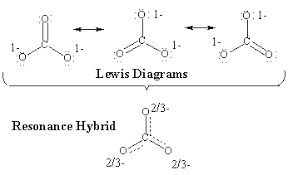
A repeatable workflow for drawing resonance contributors
Start by calculating the total valence-electron count. Add the group-number valence electrons for neutral atoms, add an electron for each negative unit of ionic charge, and subtract one for each positive unit. Write that total above your scratch work. If you later draw more or fewer electrons, something has gone wrong even if the picture looks familiar. For NO3−, nitrogen contributes five, three oxygens contribute eighteen, and the negative charge contributes one: 5 + 18 + 1 = 24 electrons.
Next, connect atoms in a reasonable skeleton. The least electronegative suitable atom is commonly central, while hydrogen is terminal. Use one line per initial bond, deducting two electrons for each line. Place remaining electrons as lone pairs on terminal atoms before assigning any to the center. Check octets where appropriate. If the center has too few electrons and a terminal atom has a lone pair, see whether converting that lone pair into a multiple bond produces a valid diagram without changing the overall count. Then calculate formal charge on every atom rather than relying on the appearance of the bonds.
Once one valid diagram exists, ask whether an equivalent electron placement can be made without moving atoms. In nitrate, the N=O double bond may be assigned to any of the three oxygen positions. Each resulting drawing has the same connectivity, 24 electrons, and overall −1 charge. Put the resonance arrow, ↔, between drawings. That arrow is not the forward-and-reverse reaction symbol; it says the separate Lewis drawings contribute to one description of the same species. Include brackets and the ionic charge around each contributor when drawing an ion for a graded response.
Finally, interpret rather than merely enumerate. If three equivalent contributors differ only by which oxygen carries the N=O line, it is misleading to call one oxygen permanently double-bonded. The full description has three equivalent N–O bonds. If two contributors are nonequivalent, the hybrid need not be a fifty-fifty average: a more favorable electron arrangement can contribute more. Formal charge, octets, and electronegativity help you make that judgment, while measured properties and more advanced electronic models can refine it further.
How to calculate formal charge without losing electrons
For an atom in one Lewis diagram, formal charge equals the valence electrons of its neutral free atom minus its nonbonding electrons minus half the bonding electrons assigned to it. Because each bond line is a pair of electrons, this becomes a fast classroom form: formal charge = valence electrons − lone-pair electrons − number of bond lines. Count a double bond as two lines and a triple bond as three. Count lone-pair electrons, not lone pairs: one lone pair contains two electrons. This distinction prevents a common factor-of-two error.
Consider an oxygen with two lone pairs and one double bond. Neutral oxygen has six valence electrons, the lone pairs contain four nonbonding electrons, and the double bond counts as two lines. Its formal charge is 6 − 4 − 2 = 0. An oxygen with three lone pairs and one single bond has 6 − 6 − 1 = −1. In a typical nitrate contributor, nitrogen has four bond lines and no lone pairs, so its formal charge is 5 − 0 − 4 = +1. The two singly bonded oxygens are each −1 and the doubly bonded oxygen is zero; +1 − 1 − 1 + 0 = −1 overall.
The phrase “equal sharing” in the formal-charge definition is hypothetical bookkeeping. Formal charge is not necessarily the actual partial electric charge measured on an atom in a polar bond. Oxygen and nitrogen do not truly divide bonding electrons into exact halves. The calculation deliberately does so to compare diagrams consistently. An oxidation number uses a different convention, assigning bonding electrons to the more electronegative atom, and therefore may give a different number. Keep these three concepts separate: overall ionic charge belongs to the species, formal charge belongs to an atom in a particular Lewis drawing, and partial charge reflects an unequal real electron distribution.
Always add all formal charges at the end. In a neutral molecule they must sum to zero; in a singly negative ion they must sum to −1; in a doubly negative ion they must sum to −2. If the sum disagrees with the formula, re-count lone pairs, multiple-bond lines, and the electron added or removed for the ion. Do not “repair” the total by changing the ion’s superscript after the fact. The total is a constraint established before any bonds are drawn.
Worked example: nitrate, NO3−
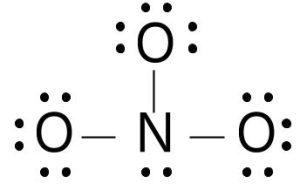
Nitrate is especially useful because it joins electron counting, octet reasoning, formal charge, and equivalent resonance contributors in one compact case. Start with 24 valence electrons. Put nitrogen at the center and attach three oxygens by single bonds. The bonds use six electrons, leaving eighteen. Giving all three terminal oxygens three lone pairs uses all eighteen, but nitrogen then sees only three bonding pairs—six electrons—rather than an octet. Convert one oxygen lone pair into an additional N–O bond. The total electron count stays 24; nitrogen now has four bond lines, or eight shared electrons around it.
The conversion changes formal charges but not the atom skeleton. Nitrogen is +1. The double-bonded oxygen has two lone pairs and formal charge zero. Each single-bonded oxygen has three lone pairs and formal charge −1. Sum the charges before proceeding: +1 + 0 − 1 − 1 = −1, as required. It would be incorrect to leave all three N–O bonds as single bonds while claiming that this is the usual complete octet diagram for nitrate. It would also be incorrect to add a second N=O double bond to nitrogen in this standard second-period model, because nitrogen would then exceed an octet.
Now rotate the placement of the double bond among the three oxygen positions while leaving the atoms fixed. You obtain three equivalent contributors. Each contributor is a representation, not a molecule that exists for a third of the time. The measured ion has equivalent N–O bonds, consistent with delocalized bonding. In the usual introductory bookkeeping language, four bond lines are distributed over three N–O connections, so the average bond order is 4/3. That ratio is a compact description for this symmetric case; it is not a universal formula to apply blindly to any resonance system or evidence that four individual electrons are literally travelling around three slots.
Notice the distinction between formal-charge placement and observed equivalence. Each drawing puts −1 on two particular oxygens and zero on the third. The hybrid does not permanently designate those two oxygens as different. You may sketch a resonance hybrid with dashed partial bonds and a distributed negative charge, but on an AP Chemistry response, clear complete contributors, correct brackets and total charges, and an explanation of equivalent bonds often communicate the idea more reliably than a vague cloud. The preserved diagram below can serve as a visual aid; use the accounting above to check any sketch you see.
Worked example: nitrite, NO2−
Nitrite has 5 + 2(6) + 1 = 18 valence electrons. Put nitrogen between two oxygens and begin with two N–O single bonds. Those bonds consume four electrons. If each oxygen receives three lone pairs, twelve more electrons are used, leaving two for a lone pair on nitrogen. Nitrogen then has a lone pair and two single bonds, only six electrons around it. One oxygen lone pair can become a second bond between that oxygen and nitrogen. The result gives nitrogen an octet and uses the original eighteen electrons.
In either complete contributor, nitrogen has one lone pair plus three bond lines: 5 − 2 − 3 = 0. The double-bonded oxygen is zero, and the single-bonded oxygen is −1. Add them: 0 + 0 − 1 = −1. Shift the double bond to the other oxygen, retaining the O–N–O connectivity with N at the center, and you have the second equivalent contributor. This does not mean the ion flips from one side to the other. The two N–O bonds are equivalent in the resonance hybrid.
An introductory average bond order of 3/2 follows because there are three bond lines across the two equivalent N–O connections. Compare that with nitrate’s 4/3: the arithmetic differs because the number of bonds and equivalent positions differs. Never memorize “all resonance bonds are 1.5.” Instead, first decide whether the contributors are equivalent and which particular set of bonds is being averaged. Where contributors are not equivalent, a simple arithmetic average can be misleading.
Worked example: carbonate, CO3^2−
Carbonate illustrates why you must account for both charge and the central atom’s octet. Its electron count is 4 from carbon, 18 from three oxygens, and 2 added for the 2− charge: 24 electrons. Draw carbon in the center with three single bonds to oxygens, then distribute lone pairs. Carbon has only six electrons in that first all-single-bond sketch. Form one C=O double bond by converting a lone pair on an oxygen. Carbon now has four bond lines and an octet.
The carbon formal charge is 4 − 0 − 4 = 0. The double-bonded oxygen is zero; each singly bonded oxygen is −1. Their sum is −2. As with nitrate, the double bond can be drawn at any of the three oxygen positions, giving three equivalent contributors and equivalent C–O bonds in the hybrid. The average bond-order shorthand is again 4/3 for those three connections, but do not conclude that carbonate and nitrate have identical charge distributions or central-atom chemistry. Carbonate’s central carbon is formal-charge zero in the standard contributor; nitrate’s central nitrogen is +1.
If an exercise asks which drawing is “correct,” a better answer is that each properly completed equivalent contributor is valid and the hybrid represents the ion. A drawing with a double bond on one oxygen is not more correct merely because it appears first on the page. If a drawing has the wrong total electron count, gives a second-period atom too many electrons, or sums to the wrong charge, it is not an additional resonance contributor. Validity comes before equivalence.
A neutral example: ozone, O3
Ozone has 18 valence electrons, three oxygen atoms times six. Put one oxygen in the middle and draw two O–O single bonds. After completing terminal octets and placing the remaining lone pair on the central oxygen, the central atom still needs an octet. Turn one terminal lone pair into a second O–O bond. In that contributor, the central oxygen has one lone pair and three bond lines: 6 − 2 − 3 = +1. The singly bonded terminal oxygen has three lone pairs and one bond line: 6 − 6 − 1 = −1. The double-bonded terminal oxygen is zero. The charges add to zero, matching neutral O3.
The second equivalent contributor has the O=O double bond on the other side. These drawings predict equivalent O–O connections in the hybrid, with an introductory bond-order shorthand of 1.5. They also remind us that a neutral molecule can have nonzero formal charges on individual atoms. Do not discard a valid ozone contributor just because it contains +1 and −1; with its electron count and octets, charge separation is part of the best ordinary Lewis account. Formal-charge minimization is a guideline, not a demand that every atom in every molecule receive zero.
Ozone is also a good place to distinguish a resonance arrow from an equilibrium arrow. The drawings are not two isolable compounds with a reaction rate between them. They are alternative symbolic representations of one molecular species. If your answer says “the double bond jumps back and forth,” replace it with “the two contributors represent delocalized bonding in the actual ozone molecule.” That wording is both more accurate and easier to connect to bond equivalence.
Choosing among nonequivalent Lewis diagrams
Equivalent contributors such as the three nitrate drawings contribute equally by symmetry. Other molecules have several diagrams that are formally possible but not equally useful. Start with constraints: correct total electrons and overall charge, reasonable connectivity, and octets for second-period atoms where applicable. Then prefer arrangements that reduce unnecessary formal-charge magnitude and avoid large charge separation. When charges remain, a negative formal charge is generally more plausible on a more electronegative atom than on a less electronegative one, all else equal. These rules guide a comparison, not a mechanical scoring formula that overrides evidence.
For carbon monoxide, CO, a common Lewis diagram has a triple bond and one lone pair on each atom. Carbon’s formal charge is 4 − 2 − 3 = −1; oxygen’s is 6 − 2 − 3 = +1. That may look surprising because oxygen is more electronegative, but both atoms have octets and the ten valence electrons are all used. Rejecting the structure solely because the negative formal charge is on carbon would miss the other constraints. This example shows why formal charge is a model-comparison tool, not a substitute for counting electrons or understanding chemistry.
For sulfur- or phosphorus-containing ions, classroom materials may display expanded-valence drawings as well as drawings that retain octets on the central atom. Different courses emphasize these alternatives differently. The AP Chemistry topic 2.6 objective focuses on using octets and formal charges as criteria for diagrams; it does not license an absolute rule that the drawing with the fewest printed charges is always the one physical “real structure.” State the assumptions in a problem and follow the course framework or supplied data. In phosphate or sulfate, particularly, do not casually redraw a double bond and announce that the new picture proves a fixed, shorter bond to one specific oxygen.
Resonance contributors can also be nonequivalent because they place a multiple bond or charge in environments with different stability. An important contributor may weigh more heavily than a less favorable one. This is why “the molecule is the exact average of every conceivable sketch” is too blunt. Include only valid contributors and explain which features are supported by octets, formal charges, and symmetry. At a more advanced level, molecular orbital theory and experimental bond measurements give a fuller description; the Lewis diagrams remain a practical first model.
Formal charge is not the same as oxidation state or partial charge
These terms appear near each other in chemistry courses, so a student can obtain the right numerical charge for the wrong reason. Formal charge splits each covalent bonding pair evenly between its two atoms, regardless of electronegativity. Oxidation state is an electron-accounting convention used especially for redox chemistry; it assigns bonding electrons to the more electronegative atom. A partial charge, often written δ+ or δ−, describes a real polarization of electron density and need not be an integer. Overall ionic charge is the net charge of the entire species.
Take a polar covalent bond in a neutral molecule. Both atoms could have formal charge zero in its Lewis diagram even though one end has a partial negative charge and the other a partial positive charge. Conversely, ozone’s usual contributor assigns formal +1 to its central oxygen and −1 to one terminal oxygen while the molecule as a whole remains neutral. Neither statement says that one oxygen nucleus has literally lost exactly one entire electron to another. The bookkeeping reveals how a proposed Lewis diagram allocates electrons, not a direct experimental measurement.
In a question, identify the requested quantity before calculating. If asked for formal charge, use neutral-atom valence electrons, lone-pair electrons, and bond lines. If asked for overall charge, add the atom formal charges or read the formula superscript. If asked for oxidation numbers, apply the separate redox rules. If asked for bond polarity or molecular dipole, consider electronegativity and geometry. This short pause prevents a large class of otherwise avoidable errors.
How resonance relates to bond length, strength, and shape
An equivalent set of resonance contributors can explain why bonds that appear different in one Lewis drawing are equivalent in measured structure. In nitrite, one drawing shows an N=O and an N–O, yet the two N–O bonds are equivalent. Resonance gives a qualitative reason: the bonding is delocalized across those positions. In a simple comparison, a bond with some multiple-bond character is often shorter and stronger than a pure single bond of the same atom pair, but the exact length or energy requires data. Do not infer a precise measurement from a fraction such as 1.5.
Molecular shape requires another step. The Lewis diagram supplies a count of bonding regions and lone pairs, while VSEPR helps predict how those regions arrange in three dimensions. Resonance does not move the atoms between separate shapes; it changes the electron-placement description while retaining the skeleton. To continue from a completed Lewis diagram toward geometry, the site’s VSEPR and bond-hybridization lesson is a useful next-stage guide. Keep the distinction clear: resonance is about multiple valid electron-placement drawings; geometry is about the spatial arrangement of nuclei and electron regions.
For nitrate and carbonate, the three terminal bonds are equivalent in the hybrid because the positions are symmetry-related in the usual model. That does not mean all bonds in every resonant ion must be equivalent. In bicarbonate, one oxygen bears hydrogen and the other two do not, so the atom environments are not all interchangeable. You may have resonance between the two non-protonated oxygen positions, but you cannot move the hydrogen itself and call the result a resonance contributor. Looking for symmetry is often more informative than mechanically counting drawings.
How to write a strong AP Chemistry explanation
An AP response usually rewards a scientific claim supported by a representation and the relevant evidence. Rather than writing only “because resonance,” name the fixed atom skeleton, show valid Lewis contributors, give the electron count, and identify what differs among them. For nitrate, a concise explanation could say: “There are 24 valence electrons. Three equivalent contributors differ only in which oxygen has the N=O double bond. Each has formal charges of +1 on N, −1 on two singly bonded O atoms, and zero on the doubly bonded O, summing to −1. The actual ion has three equivalent N–O bonds, not one permanent double bond.”
If the prompt asks you to choose between two nonequivalent diagrams, calculate the formal charges in both diagrams explicitly. A statement such as “A is better because it is more stable” is a conclusion without evidence. Say what charge magnitudes arise, whether octets hold for second-period atoms, and whether a negative charge is on a plausible atom. If one drawing violates the electron count, it is invalid rather than merely less important. If both are valid, explain why one is a stronger contributor rather than pretending the weaker drawing cannot be written.
When an exam prompt includes measured bond lengths, use them. A claim that two bonds are identical is stronger when the problem supplies equal lengths or equivalent chemical environments. Do not invent experimental values. The current College Board AP Chemistry course page links the course framework and clarifications; use that official document when checking what is required for the course. This guide intentionally does not label its own practice items as questions from a particular past AP exam without a verified released prompt.
Practice set with explanations
Try nitrite first without looking back at the worked solution. Count the electrons, draw the N–O–O skeleton with nitrogen central, and ask whether each atom has an appropriate octet. Write both valid contributors with brackets. Then calculate formal charge for nitrogen and each oxygen. You should obtain two equivalent contributors, each with one singly bonded oxygen at −1 and the other oxygen at zero; nitrogen is zero. If your sum is zero, check whether you forgot the extra electron supplied by the ion’s −1 charge.
For carbonate, calculate 24 valence electrons, place carbon centrally, and make one C=O double bond. Write the other two contributors by moving only the electron-pair placement, not an oxygen atom. Calculate charges: carbon zero, doubly bonded oxygen zero, two singly bonded oxygens −1 each. Explain why a drawing with a permanently unique double-bonded oxygen would be incomplete as a model. The key reason is equivalence across three valid arrangements, not an assertion that the oxygen atoms are “taking turns” in time.
For ozone, write two contributors that preserve the O–O–O skeleton. Each should have a central formal charge of +1, a singly bonded terminal oxygen at −1, and a double-bonded terminal oxygen at zero. The sum is zero. If you decide that all formal charges must vanish because ozone is neutral, compare the full electron count and octets again. A neutral total does not require every atom in each drawing to carry zero formal charge.
As a challenge, examine bicarbonate, HCO3−. Begin with 4 + 1 + 18 + 1 = 24 electrons. Place the hydrogen on one oxygen and leave it there. Complete the carbon-centered skeleton, then compare the two non-protonated oxygen positions for a possible C=O placement. Ask which bonds are symmetry-related and which is not. This problem is a useful defense against the habit of calling any redrawing a resonance form: the hydrogen-bearing oxygen has a different connection, and shifting H would change connectivity rather than only the electron placement.
Finally, make a deliberate error-check table on scrap paper for any unfamiliar ion: total electrons available; electrons drawn as bonds and lone pairs; each atom’s formal charge; sum of charges; second-period octets; number of equivalent contributors. The table takes only a minute and is especially valuable under exam pressure. If one line fails, repair the drawing before interpreting bond order or shape. If every line passes, your explanation can focus on what the model predicts and what it cannot show.
Common misconceptions to correct
“Resonance means a molecule switches between structures” is the most persistent error. The contributors are static drawings of one species; the real electron distribution is not a time-lapse animation between them. “All valid drawings contribute equally” is also too broad. Symmetry-related contributors are equivalent, but nonequivalent contributors may have different importance. “The best Lewis drawing has zero formal charge everywhere” fails for ions and for some neutral species such as ozone. Formal charge is a guide used alongside electron count, octets, and chemical context.
Another tempting shortcut is to move atoms while drawing resonance. Do not. If the hydrogen changes its attachment or the central atom changes, you are considering a different connectivity. A subtler mistake is treating a fractional bond order as a count of physically roaming electrons. The 4/3 shorthand for nitrate averages four bond lines across three equivalent N–O links in an introductory model; it does not mean four bonding electrons spread across three “spaces.” Bond order may be described more rigorously by other bonding models, and measured properties are not obtained by the fraction alone.
Watch the language of charges too. Three lone pairs means six nonbonding electrons, not three. A double bond is two bond lines, not one. An ion’s superscript is its whole-species charge, not the formal charge of every atom. A diagram with the right-looking bond pattern but the wrong total electrons is not valid. Checking those points is more reliable than memorizing pictures of nitrate or carbonate.
Final study checklist
Before moving on, you should be able to explain resonance in one sentence without saying that atoms or electrons “flip” between drawings. You should be able to count valence electrons for an ion, complete a Lewis diagram, calculate formal charges with either form of the equation, and confirm that their sum equals the formula charge. You should recognize when several equivalent diagrams differ only by electron placement and when a proposed change actually moves an atom. You should also be able to state one limitation of the Lewis model and connect equivalent resonance contributors to equivalent bonds without inventing exact bond lengths.
Use the official course framework for the assessment boundary and the linked OpenStax section for a second explanation. Then practice the drawings yourself, checking every dot and line. The goal is not to memorize a gallery of ions. It is to develop a method that works for an unfamiliar species and produces a defensible explanation of the model you drew.





