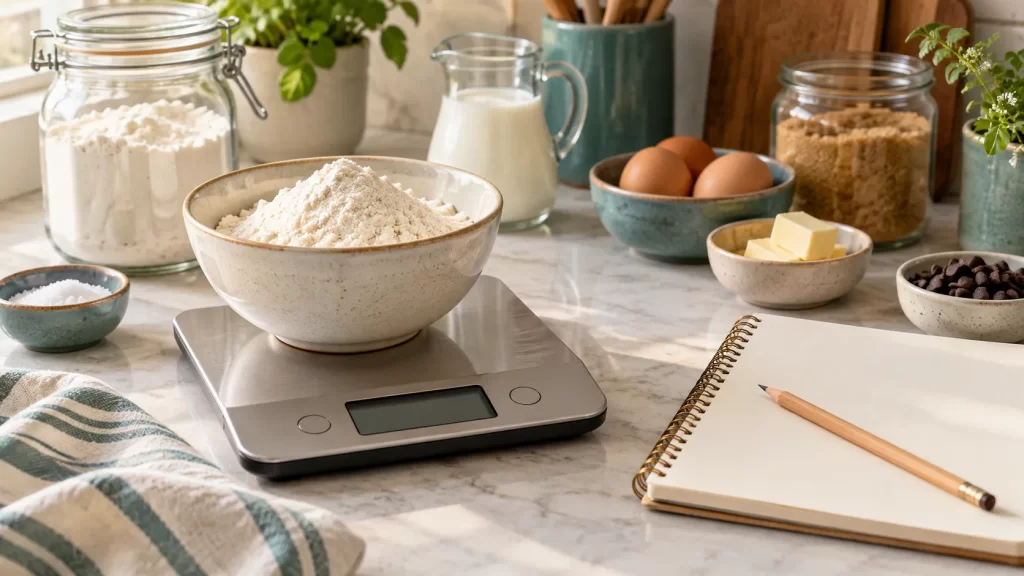
How to convert Grams to Ounces
Weight Converter
Conversion Details
Conversion Factors
- 1 kilogram = 1000 grams
- 1 pound = 453.59237 grams
- 1 pound = 16 ounces
- 1 ounce = 28.34952 grams
To convert grams to ordinary ounces of mass, divide the number of grams by 28.349523125. One gram is approximately 0.035274 ounce, and one avoirdupois ounce is exactly 28.349523125 grams. The calculator above can help with quick values, while this guide explains the arithmetic, precision and situations where the word “ounce” means something else. These distinctions matter more than memorising a long decimal: a kitchen recipe, a shipping label and a precious-metal quote may use different conventions.
This guide uses “ounce” to mean the common avoirdupois ounce unless it explicitly says “fluid ounce” or “troy ounce.” NIST’s U.S. customary-to-metric conversion table separates mass ounces from fluid ounces, and its 2026 Handbook 133 conversion appendix gives the detailed mass factor. A conversion calculator cannot infer which ounce you intend from a number alone. Confirm the unit on the source label before trusting a result.
The grams-to-ounces formula
The exact relationship for the ordinary mass unit is 1 ounce = 28.349523125 grams. Therefore ounces = grams ÷ 28.349523125. You can also multiply grams by approximately 0.03527396195, the reciprocal of the gram value per ounce. Both operations describe the same conversion; differences in displayed results come from rounding, not from two competing definitions. For most recipes and informal estimates, 28.35 grams per ounce is enough. For technical work, retain the exact factor during calculation and round only the final answer to an appropriate number of decimal places.
For a concrete example, 100 grams divided by 28.349523125 equals approximately 3.527396195 ounces. Rounded to two decimal places, that is 3.53 oz. For 5 grams, the result is about 0.17636981 oz, or 0.18 oz to two decimals. For 250 grams, the result is approximately 8.81849049 oz, commonly written 8.82 oz. The unit cancels cleanly in dimensional analysis: grams × (1 ounce / 28.349523125 grams) leaves ounces. Writing the units is a useful check against accidentally multiplying when you meant to divide.
A quick reasonableness check is that 28 or 29 grams is close to one ounce. If you convert 100 grams and obtain about 2,835 ounces, the decimal or operation is wrong. If the answer is about 3.5 ounces, it is plausible. For larger amounts, 454 grams is roughly one pound, or 16 ounces. These landmarks make it easier to detect a wrong calculator mode, a misplaced decimal or confusion between ounces and pounds without having to remember many digits.
How to use the calculator on this page
Enter the known mass in the grams field and read the value in ounces. If the interactive converter lets you choose a decimal precision, remember that this controls the displayed answer, not the accuracy of the original measurement. An ingredient weighed to the nearest whole gram does not suddenly become known to one ten-thousandth of an ounce because the display shows four decimals. Use Reset before starting an unrelated calculation, particularly if you have previously entered a value into ounces, pounds or kilograms.
The calculator is a convenience for arithmetic, not a substitute for checking units. Its ounces field refers to ordinary mass ounces; it is not a fluid-volume conversion. When converting a quantity for an important specification, calculate once manually with the stated factor or cross-check with a trusted tool. Verify that the input is in grams rather than kilograms: entering 0.5 as though it were 0.5 gram when the source meant 0.5 kilogram changes the result by a factor of 1,000. Similarly, a scale’s “oz” display should be checked for the mode actually selected.
If you are using the result to follow a recipe, first decide whether the recipe uses weight or volume. “Four ounces of flour” and “four fluid ounces of milk” do not describe the same kind of measurement. A mass-to-mass converter answers the first. For the second, you need a volume conversion and, if you ultimately want mass, information about the liquid’s density. The NIST Metric Kitchen equivalencies show the different unit families side by side and mark household equivalents as approximate.
Why the exact factor has so many digits
The avoirdupois pound is defined as exactly 0.45359237 kilogram, or 453.59237 grams. There are exactly 16 avoirdupois ounces in that pound. Dividing 453.59237 by 16 gives 28.349523125 grams per ounce. That is why the long decimal is not just a measurement somebody once took of a standard object; it follows from a defined relationship between units. NIST publishes the value in its conversion tables. The reciprocal, ounces per gram, is an infinite repeating decimal when written out, so a calculator must display a rounded version.
The apparent precision of the factor must not be confused with precision of an ingredient or product measurement. If a household scale reads 100 g in whole-gram increments, the reported value is not guaranteed to represent exactly 100.000000000 g. Using the exact conversion factor prevents avoidable arithmetic error, but it cannot recover detail the scale never measured. A useful rule is to retain the exact factor inside the computation and then display a result compatible with the quality of the input and the decision you are making.
This distinction also explains why common tables show 1 oz as 28 g, 28.35 g or 28.349523125 g. The first is a rough kitchen shorthand; the second supports most everyday conversions; the full figure states the defined relationship. All can be useful in the right context. Trouble begins when a rough factor is used for a precision-sensitive total or a long calculator output is treated as if it made the original measurement exact.
Worked examples for everyday amounts
Suppose a recipe asks for 75 g of butter, and your scale is set to ounces. Compute 75 ÷ 28.349523125 ≈ 2.64555 oz. A scale that shows hundredths may lead you to target about 2.65 oz. If it displays only tenths, 2.6 or 2.7 oz may be the nearest available reading depending on how it rounds. Before accepting the number, check whether the recipe can simply be followed in grams by changing the scale mode; avoiding a conversion can reduce error.
Suppose a packet lists 200 g of an ingredient and you want to know its approximate ounce mass. The calculation gives about 7.05479 oz, which is 7.05 oz to two decimals. For shopping or meal planning, saying “about seven ounces” may be clearer than quoting five decimals. But if you are comparing two packages close in size, use the label’s original gram quantities rather than comparing one rounded ounce figure with another. Unit conversion should aid comparison, not add artificial noise.
For a larger quantity, 1,000 g equals 1 kg. Dividing by 28.349523125 gives approximately 35.27396 oz. Since 16 ounces make a pound, this is about 2.20462 lb. You may see the same mass written as 2 lb plus roughly 3.274 oz. All three descriptions refer to the same mass, but they have different practical uses: grams for a laboratory or metric recipe, decimal ounces for a scale, and pounds-plus-ounces for a parcel or household context. Do not write 2.20462 as though it were “2 pounds and 20.462 ounces”; the fractional pound must be multiplied by 16 to obtain the remaining ounces.
For a tiny amount, 1 g equals about 0.03527 oz. A two-decimal display rounds that to 0.04 oz. For 2 g, it shows 0.07 oz. At this scale, rounding makes different gram values look surprisingly similar. If the amount matters at the single-gram level, keep the source value in grams or use a scale with suitable gram resolution. Do not use a coarse kitchen scale or this general conversion guide to determine a medication dose; follow the product’s instructions and a qualified professional’s guidance.
Reverse conversion: ounces back to grams
To reverse the calculation, multiply ordinary ounces by 28.349523125. For example, 6 oz × 28.349523125 g/oz = 170.09713875 g, or roughly 170 g. This is the inverse of grams ÷ 28.349523125. Using the same factor in both directions helps you catch a transcription error. If you convert 170.1 g to ounces and back, you should recover about 170.1 g apart from the rounding you introduced at intermediate steps.
Round-trip checks are useful but not infallible. If you round an original 170.097 g result to 170 g and then convert back, the difference is a predictable consequence of the rounding. If you accidentally use 31.1034768 g per ounce, you have switched to the troy ounce and the result will not match ordinary kitchen or shipping units. If you want a dedicated reverse-direction tool, Sly Academy’s ounces-to-grams conversion page provides the related calculation; confirm it is set to the same kind of ounce.
Ordinary ounces, fluid ounces and troy ounces
An avoirdupois ounce is a unit of mass. It is the everyday “oz” used for many foods, packages and body-weight-related contexts. A fluid ounce, abbreviated “fl oz,” is a unit of volume. U.S. fluid ounces and Imperial fluid ounces are themselves different volumes. Neither becomes a fixed number of grams without knowing what liquid or other substance fills that volume. A fluid ounce of water may weigh close to an ounce under some everyday approximations, but that coincidence is not a general conversion rule for oil, syrup or any other ingredient.
Volume-to-mass calculations require density. The logic is mass = volume × density, with consistent units. If a recipe measures milk in millilitres but the scale reads grams, the answer depends on the actual liquid and conditions; a one-size-fits-all “fluid ounces to grams” multiplier is unreliable. For many home recipes it is simplest to follow the units supplied by the recipe or use its stated ingredient-specific equivalent. NIST’s kitchen resources give approximate household guidance while keeping volume and mass in separate columns.
A troy ounce is another unit of mass, used prominently for precious metals. NIST’s precious-metals conversion information gives 31.1034768 g per troy ounce. That is heavier than the ordinary avoirdupois ounce of 28.349523125 g. If a jewellery quotation says “oz t” or “troy oz,” using the ordinary gram-to-ounce calculator would give a materially different number. Conversely, a recipe’s ounce is ordinarily not a troy ounce. Read the label, market convention and instrument mode before converting.
The simplest decision tree is this: if the source says g and the destination says oz on a food or parcel scale, ordinary mass ounces are likely intended; if it says fl oz, stop and identify the volume and substance; if it concerns bullion or explicitly says troy, use the troy factor. If the context is ambiguous, do not guess from the numerical value alone. A 30 g sample is approximately 1.058 ordinary oz but about 0.965 troy oz, so both outputs can appear plausible unless you identify the unit family first.
Grams, ounces and pounds in one calculation
Grams and kilograms are metric mass units: 1 kg = 1,000 g. Ordinary ounces and pounds are related by 16 oz = 1 lb. The internationally defined avoirdupois pound is exactly 453.59237 g. These relationships let you cross-check a result by two paths. To convert 500 g to ounces, divide by 28.349523125 and obtain about 17.637 oz. Alternatively, convert 500 g to pounds, roughly 1.10231 lb, and multiply by 16; the outcome is the same apart from rounding.
The distinction between decimal pounds and pounds-plus-ounces is easy to miss. A result of 1.5 lb is one pound and eight ounces, not one pound and five ounces. The “.5” represents half of a pound, and half of 16 ounces is eight. For 1.25 lb, the fractional quarter-pound is four ounces. A converter that displays pounds as a decimal is mathematically correct, but an address label or recipe may expect mixed units. Read the output format before copying it elsewhere.
When you regularly move among these units, consider using a table of stable relationships rather than successive rounded conversions. Go from grams directly to ounces with the exact divisor, or from grams directly to pounds with 453.59237. Each time you round an intermediate value you discard information, and that error can accumulate. For a reverse check, Sly Academy’s pounds-to-grams converter helps bring a decimal-pound result back into grams before comparison.
Rounding, significant figures and sensible display
Rounding answers to two decimals is often convenient but not universally appropriate. A kitchen quantity of 500 g converted to 17.64 oz is usually adequate. A one-gram quantity shown as 0.04 oz loses much of the information in the input. A parcel weighing several kilograms may need only a tenth of an ounce if the shipping service’s rule rounds to that increment. The right display depends on the measurement instrument and the task, not on a fixed SEO table or a desire for visually neat numbers.
When converting a measured number, do the arithmetic at full available precision and round once at the end. Suppose 28.35 g is converted using the rough rule 28 g = 1 oz; the result is 1.0125 oz, an avoidable error for a quantity near one ounce. Using the defined factor gives approximately 1.000017 oz. The input itself, if measured to 0.01 g, does not justify endless displayed digits, but the exact factor avoids adding its own avoidable error. This is the difference between calculation precision and measurement uncertainty.
For a quick mental estimate, 30 g is about one ounce. This overstates grams per ounce by roughly 5.8 percent, so it is suitable only for a rough answer. A better mental shortcut is 28.35 g per ounce. For 140 g, 28 g per ounce gives five ounces, while the more accurate result is about 4.94 ounces. Neither mental method should be used when a specification sets a precise threshold. Use the converter or direct division for final figures.
Make your answer communicate its uncertainty. If the source is “about 100 g,” write “about 3.5 oz,” not “3.527396195 oz.” If a regulated label states a specific quantity and rounding rule, follow that rule rather than this general-purpose guide. For education, the most important habit is to preserve units next to every number. “28.35” alone could be grams per ounce, ounces per kilogram, or a mistaken result; “28.35 g per oz” makes the operation inspectable.
Measurement practice: make the input reliable
A correct conversion cannot fix a poor measurement. Place a kitchen scale on a stable, level surface, set the desired unit, and tare the empty container if you want ingredient mass alone. Add the ingredient gradually, let the reading settle and record the value with the unit shown. If the scale automatically changes between grams and ounces, verify its mode each time. NIST’s metric recipe resources recommend kitchen scales for measuring ingredients and distinguish mass from volume.
For baking, using a mass measurement can reduce variation introduced by different ways of filling a cup. A cup of flour can contain different masses depending on packing and handling, so there is no universal cup-to-gram conversion without an ingredient-specific convention. If a recipe gives grams, following that mass directly is often the clearest route. If your scale only displays ounces, convert the mass quantity as described here. Avoid turning a gram value into cups through an arbitrary generic table and then back into ounces.
If an object’s mass exceeds the scale’s range, do not split it into portions unless that method suits the task and you can account for all portions. A parcel scale, kitchen scale and analytical balance are designed for different ranges and resolutions. A display that reads to one decimal place is not necessarily accurate to one decimal place throughout its range. For any decision with safety, contractual or regulatory consequences, use the measurement standard and equipment required by that context, then apply the correct unit conversion.
Recipes and ingredient substitution
Imagine a recipe calling for 225 g of flour and a scale set to ounces. The calculation 225 ÷ 28.349523125 gives about 7.9366 oz, so 7.94 oz is a practical target on a scale showing hundredths. This conversion does not change the ingredient. If you substitute almond flour or another product, the same mass is still 225 g, but the recipe’s texture and behaviour may differ for reasons unrelated to units. A conversion guide cannot promise that a substitution will perform the same way.
For butter, sugar and flour, distinguish a recipe’s mass amount from a package’s volume claim. “8 oz” on a packet usually denotes mass if no “fl” appears, but packaging conventions vary by product and jurisdiction. Verify the label. If your recipe gives 100 g and the product label gives ounces, convert once and compare. If a recipe gives tablespoons, do not put the number into a grams-to-ounces calculator; tablespoons are volume measures, and ingredient density plus the measuring method determine their mass.
For batch scaling, work in the original gram quantities before converting the final shopping or scale target. If a recipe uses 125 g of an ingredient and you triple it, 375 g converts to about 13.23 oz. Converting 125 g to a rounded 4.4 oz first and tripling produces 13.2 oz; the difference is small here but can grow with coarser rounding. Multiply the unrounded mass, then convert and round at the end. The same principle applies when halving a recipe.
Packaging, postage and commerce
A product may list net contents in grams and an ounce equivalent. These are two expressions of a mass, but label requirements and permissible rounding depend on the jurisdiction and product type. Do not replace a legally required declaration with a figure generated from this page without checking the applicable rule. For ordinary comparison, work from the original declared amount: 250 g is about 8.82 oz, and 500 g is about 17.64 oz. A double-size package should have roughly double the mass even if each printed equivalent is rounded separately.
Shipping can add another complication: the mass used for postage may include packaging, and a carrier may round a measured value up to a billing increment. A 450 g item is about 15.87 oz before its box, padding and label are added. It is not safe to assume that the quoted parcel mass is less than one pound merely because the item alone is. Weigh the complete parcel and follow the carrier’s current rule. The conversion formula gives a physical-unit relationship; it does not decide a carrier’s price band.
When comparing quoted prices per gram and per ounce, convert the unit in the denominator carefully. If a food costs a certain price per 100 g, the price per ordinary ounce is that price multiplied by 28.349523125/100. Do not multiply by 100/28.349523125, which converts the quantity in the opposite direction. For precious metals, identify troy ounces first. A price per troy ounce cannot be compared directly with a price per ordinary ounce without changing the unit basis.
Science and classroom problem solving
In a classroom calculation, dimensional analysis gives a more dependable path than memorising a numerical trick. Start with the known mass, multiply by a fraction whose denominator is the old unit and numerator is the desired unit, and cancel units before computing. For 85 g, write 85 g × (1 oz / 28.349523125 g) ≈ 3.00 oz. The grams cancel. If you mistakenly write 85 g × (28.349523125 g / 1 oz), the units become g²/oz, showing that the operation is unsuitable even before the numerical answer looks absurd.
Science reports often use grams or kilograms because those units fit the SI system. If an imported data set uses ounces, document whether they are ordinary or troy ounces and state the factor used. Keep raw observations in their original units in the source record, then add a converted column. This preserves auditability if the assumption is later corrected. A result such as 3.00 oz from 85 g should not be treated as more precise than the original 85 g measurement permits.
For teaching, ask students to predict whether the ounce number is larger or smaller than the gram number. Since one ounce contains more than one gram, a given mass expressed in ounces has a smaller numerical value than when expressed in grams. That comparison catches many inverted factors. It also prepares students to distinguish a unit relationship from an empirical statement: “one ounce equals 28.349523125 grams” is defined for ordinary mass ounces, whereas “one cup of flour weighs a certain number of grams” depends on the material and measurement method.
Common conversion mistakes
The most frequent mistake is to multiply grams by 28.349523125 when the goal is ounces. Multiplication by that factor converts ounces into grams; division converts grams into ounces. A second error is to treat an ounce as 28.35 grams in one step and then round aggressively before scaling a recipe. Keep the exact factor through intermediate calculations. A third error is to confuse “oz” and “fl oz” on product packaging, converting a volume as if it were mass.
Another mistake is to ignore scale tare. If a bowl weighs 150 g and the filled bowl reads 350 g, the ingredient is 200 g, about 7.05 oz, not 350 g or 12.35 oz. A similar issue arises when a parcel’s listed mass includes packaging but the object specification does not. State clearly what has been weighed. The arithmetic can be flawless while the answer is still wrong for the question because the measured object was different.
Watch for mixed-unit notation. “1 lb 4 oz” means 16 + 4 = 20 oz, which is about 566.99 g. It is not 1.4 lb, which would be 22.4 oz. If you need to convert mixed units, first express everything in one unit, then convert. Likewise, 1,000 g is 1 kg; entering “1” into a grams field when you mean a kilogram understates the mass by a thousandfold. Unit labels on inputs are as important as the calculator itself.
Finally, beware of copying an answer with more digits than the situation supports. A bag described as “approximately 2 kg” is not suddenly known to a thousandth of an ounce after conversion. Use the numerical precision the purpose requires. For everyday planning, about 70.5 oz may be enough for a 2 kg quantity. If a technical specification requires a tolerance, report the measured value and uncertainty according to its own procedure rather than substituting a long decimal from a general converter.
A compact conversion reference
Useful benchmarks are: 1 g ≈ 0.03527 oz; 10 g ≈ 0.35274 oz; 28.349523125 g = 1 oz; 100 g ≈ 3.5274 oz; 500 g ≈ 17.637 oz; and 1,000 g ≈ 35.274 oz. These are ordinary mass ounces. The table already on this page gives more common values, but it should be read as a rounded reference, not a separate definition. For other quantities, direct division by 28.349523125 is usually quicker and less error-prone than interpolating between table rows.
Use an inverse check when a result matters: multiply the displayed ounces by 28.349523125 and compare with the starting grams. A small discrepancy may come from rounding. A large discrepancy signals a wrong unit, a mistyped figure or a calculator mode problem. For example, 3.53 oz multiplied by the factor is about 100.07 g, close to the starting 100 g because 3.53 oz was rounded to two decimals. This simple check is especially helpful when transferring numbers between a recipe, online converter and physical scale.
Choosing the appropriate unit in the first place
If a recipe, product specification or data source already uses grams and your instrument can read grams, leaving the quantity in grams is often best. Conversion is useful when another person or system genuinely needs ounces. Every additional unit switch creates an opportunity to transpose digits or confuse volume with mass. In international work, retaining the original amount alongside the converted value makes the result easy to verify: “250 g (about 8.82 oz)” is clearer than replacing the original with the approximate equivalent alone.
Conversely, if a buyer, scale or form accepts only ounces, use the ordinary ounce formula after establishing that mass is intended. Record the factor, round only at the final step and make the level of precision appropriate to the source measurement. If the word “ounce” appears in a precious-metal, fluid-volume or specialised context, pause and identify its definition first. The best converter is the one that makes its assumptions visible. This page’s standard grams-to-ounces guidance is for the everyday avoirdupois mass ounce.
Grams-to-ounces reference table
| Grams (g) | Ounces (oz) |
|---|---|
| 0 g | 0 oz |
| 1 g | 0.0353 oz |
| 2 g | 0.0706 oz |
| 3 g | 0.1058 oz |
| 4 g | 0.1411 oz |
| 5 g | 0.1764 oz |
| 6 g | 0.2116 oz |
| 7 g | 0.2469 oz |
| 8 g | 0.2822 oz |
| 9 g | 0.3175 oz |
| 10 g | 0.3527 oz |
| 20 g | 0.7055 oz |
| 30 g | 1.0582 oz |
| 40 g | 1.4110 oz |
| 50 g | 1.7637 oz |
| 60 g | 2.1164 oz |
| 70 g | 2.4692 oz |
| 80 g | 2.8219 oz |
| 90 g | 3.1747 oz |
| 100 g | 3.5274 oz |
| 1000 g | 35.2740 oz |