
The short answer: choose the workout you can do well and repeat
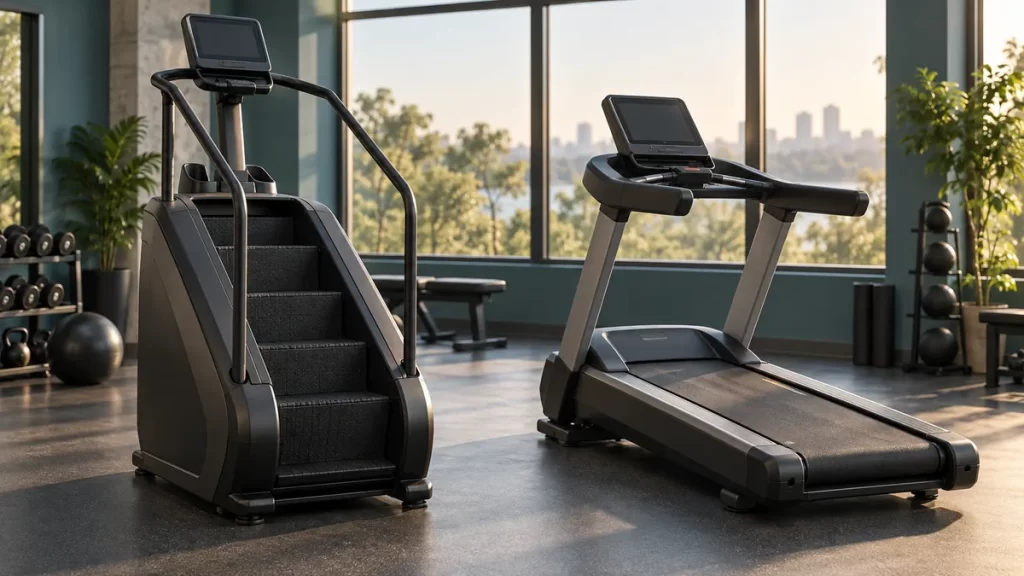
A stair-climbing machine and an incline treadmill can both make walking-style exercise more demanding, but they do it in different ways. A rotating stair machine asks you to lift your body onto a succession of steps. A treadmill keeps you walking on a continuous belt while its deck rises. Neither wins every comparison. A stair machine may suit someone who likes compact, harder stepping intervals; a treadmill may suit someone who wants longer, more adjustable walking sessions. Your current fitness, balance, joint tolerance, equipment access, and enjoyment matter more than a dramatic calorie number on a console.
The most useful question is not “Which machine burns more?” but “At a sustainable effort, which lets me accumulate useful activity without provoking symptoms or compromising technique?” The CDC’s adult activity guidance recommends at least 150 minutes of moderate aerobic activity, or 75 minutes of vigorous activity, each week, plus two days of muscle-strengthening work. Both machines can contribute aerobic minutes. Neither automatically replaces strength training, and either can be too easy or too hard depending on settings and how you use it.
For a fair trial, try each machine on separate days after a similar warm-up. Choose an effort at which you could speak in short sentences, note the duration you can maintain with comfortable form, and note how you feel later and the next day. That small experiment tells you more about fit than comparing a stranger’s calorie estimate online. If you are new to exercise, recovering from injury, pregnant, or managing a heart, lung, balance, or joint condition, use a qualified clinician’s or exercise professional’s advice to tailor the starting point.
What the two machines actually do
“StairMaster” is often used casually for any stair-climbing machine, although it is also a brand name. A rotating stairmill resembles a small escalator: steps descend as you climb. A pedal-style stepper has a different movement and may feel different underfoot. The distinction matters because advice about a moving staircase does not automatically apply to every device sold as a stair climber. Check the exact machine, its emergency stop, step height, handrails, and how to start and stop before increasing speed.
On a treadmill, incline usually means the belt is tilted upward by a percentage grade. A ten-percent grade is ten units of vertical rise for every hundred units of horizontal travel; it is not ten degrees. You can change belt speed and grade independently, so a gentle walk at a low grade and a brisk walk at a steep grade are very different workouts. On some treadmills the displayed grade is calibrated imperfectly, and the feel of the belt varies between models. The setting is a starting description, not an exact measure of effort for every person.
The stairmill makes each step a relatively distinct lift. The treadmill gives you more continuous gait cycles. That difference changes step timing, balance demands, muscle emphasis, and how you use the handrails. A biomechanics study comparing stairmill and stair ascent found that a stairmill is not an exact stand-in for climbing a real staircase. Similarly, research on incline treadmill walking usually studies particular grades, speeds, and participants; it does not establish a universal winner against every stair machine. Use the evidence to understand mechanisms, not to promise one machine will sculpt a body part or cure a condition.
Which muscles work, and what does that mean?
Both exercises rely on your legs and hips. Your quadriceps help straighten the knee, your gluteal muscles help extend the hip, and your calves contribute around the ankle. Hamstrings and trunk muscles support movement and control, although their contribution changes with posture, pace, step height, grade, and technique. The stairmill generally requires repeated step-ups; the treadmill requires repeated walking strides against a slope. These are tendencies, not exclusive muscle lists: both patterns recruit many of the same regions.
You may feel the stair machine strongly in the glutes and thighs because you repeatedly raise your center of mass. A steeper treadmill grade can also increase the demand on hip and calf muscles, especially if you continue walking at a meaningful pace. A small controlled study of high-incline walking shows that equipment design and chosen conditions affect heart rate, perceived effort, and recorded muscle activity. It does not prove that every person obtains superior long-term strength or fat-loss results at a particular incline. Sensation of “burn” is not a reliable measurement of muscle growth.
If stronger legs are your goal, treat either machine as an aerobic and muscular-endurance tool. Progressively loaded squats, step-ups, hinges, calf raises, or other appropriate strength exercises are usually a clearer way to train strength. The CDC’s separate muscle-strengthening recommendation is there for a reason. Combine machine work with two weekly strength sessions that train the whole body, not just the muscles that happen to feel tired after cardio. For a practical comparison of walking and more structured sessions, see Sly Academy’s walking-versus-workout discussion; use its ideas as context, not as a substitute for individualized guidance.
Cardiorespiratory fitness: intensity is the lever
Your heart and lungs respond to the demand you place on them over time. Either machine can produce a light, moderate, or vigorous session. An experienced stairmill user moving slowly may work at a different intensity from a beginner at the same displayed rate. A steep treadmill grade can be very demanding at a walking speed, while a flat treadmill can be an easy recovery option. It is therefore misleading to say “StairMaster is always high intensity” or “treadmill walking is always easy.”
The CDC’s intensity guidance describes a useful talk test: at moderate intensity you can talk but not sing, while at vigorous intensity conversation becomes difficult. Perceived effort can be more practical than chasing a generic heart-rate zone, especially when medication, heat, anxiety, or fitness level changes your heart rate. If you use a wearable, look for trends over several sessions rather than treating one reading as exact. Stop and seek appropriate medical attention for chest pain, faintness, severe breathlessness, or unusual symptoms.
For a beginner, the treadmill often offers smaller adjustment steps: slow the belt, lower the grade, or return to level walking without changing machines. A stairmill can also be adjusted, but its minimum stepping rate and the need to mount moving steps may be a larger initial challenge. Conversely, a confident user may prefer the stairmill because shorter blocks feel engaging. The better aerobic tool is the one on which you can repeat a planned intensity, recover, and gradually increase total work over weeks.
Calorie expenditure and weight management
Energy expenditure rises when you do more work, but there is no honest universal calorie-burn verdict between these machines. Body size, speed, grade or step rate, workout duration, handrail support, fitness, and movement economy all influence the result. A ten-minute hard stair session may burn less total energy than a forty-minute moderate treadmill walk simply because it is shorter. Compare like with like: similar duration and perceived effort, or similar heart-rate range if that measure is appropriate for you.
Console calorie estimates are especially weak grounds for deciding. Machines often rely on generic equations, and the estimate can change if you enter a different body mass. Leaning heavily on the handrails reduces the work your legs and cardiovascular system do relative to the displayed settings. Avoid treating an on-screen number as permission to eat a specific amount or as a score to beat. A useful log records minutes completed, perceived effort, settings, and recovery rather than only estimated calories.
For weight management, regular movement is one part of a broader picture that includes eating patterns, sleep, health conditions, medications, and sustainable habits. The CDC’s physical-activity and healthy-weight guidance explains that activity helps support health and weight management, while individual needs vary. If walking is the movement you can sustain most weeks, it may be more valuable than a theoretically “optimal” stair routine you avoid. Sly Academy’s walking habit ideas can help you think about consistency, but do not interpret any tip as a guaranteed change in body weight.
Impact and joint comfort are not the same thing
Walking on an inclined treadmill usually avoids the repeated airborne landing of running, but “low impact” does not mean “low load” or “safe for every joint.” Raising the grade increases demand on muscles and joints, and a steep slope may irritate a sensitive calf, Achilles tendon, hip, or knee. A stairmill is also typically not a running-type impact activity, yet each step requires appreciable knee and hip motion and a controlled shift of body weight. If your symptoms worsen during or after a session, the machine’s marketing label is irrelevant.
No generic rule says that the stair machine is better or worse for every knee. Step height, range of motion, speed, footwear, use of handrails, and a person’s diagnosis change the picture. Someone with knee pain on stairs may find repeated stairmill steps uncomfortable; another person may tolerate a slow stairmill but not a steep treadmill. The same caution applies to back pain, balance problems, and ankle or Achilles symptoms. Begin with a setting you can control, and ask a qualified professional about an individualized progression when you have persistent pain or a recent injury.
Use pain and recovery as information rather than as a challenge. A little exercise effort or normal muscle fatigue is not the same as sharp pain, joint swelling, limping, or symptoms that intensify into the next day. Reduce the setting or stop if your movement becomes guarded. Try a shorter duration, lower grade, slower step rate, or a different activity and note the response. Do not rely on “push through” advice from an article to manage a potentially significant health issue.
Balance, handrails, and safe setup
The stairmill asks you to step onto moving stairs and maintain your position as they descend. Before your first full session, locate the stop control and practice starting at the slowest comfortable setting. Look ahead instead of at your feet after you have established your footing, avoid skipping steps, and keep your whole foot on each step when the machine allows. Use the handrails for balance when needed; safety is more important than maximizing a calorie estimate. Do not lean your full body weight on them merely to make an excessive setting manageable.
On a treadmill, attach the safety clip if supplied, stand on the side rails while starting an unfamiliar machine, and enter at a slow belt speed. Increase grade gradually. Excessively steep walking can encourage holding the front console, shortening your stride awkwardly, or hinging forward from the waist. If you must cling to the rail to stay on the belt, lower the speed or incline. Supportive footwear and a clear area around the machine matter for both options. Do not step off a moving belt or moving staircase.
Handrails change the work done, which complicates comparisons. One person using the rail lightly for balance and another loading it heavily may have very different workloads at identical machine settings. A fair self-comparison can keep your own rail use roughly consistent, without sacrificing stability. If you cannot safely exercise without support, use the support; then judge the workout by tolerable time, breathing, and recovery rather than by a machine estimate that assumes unsupported movement.
How to compare the machines for your specific goal
For a longer steady-state session, an incline treadmill often has a practical advantage: you can fine-tune speed and grade independently and drop the grade when fatigue rises. The uninterrupted walking rhythm may make it easier to build from ten minutes toward twenty or thirty. This does not mean a stairmill cannot build endurance; it means the treadmill may offer a gentler entry point and more ways to adjust one variable at a time. If the treadmill at a low grade feels monotonous, music, a view, or a planned change in grade may help you continue without jumping to an unsafe intensity.
For short, challenging intervals, either machine can work. On the stairmill, a faster step rate or a brief block at a comfortable higher rate can raise effort quickly. On the treadmill, you can increase speed, grade, or both, although changing both at once makes the cause of fatigue harder to interpret. Intervals are not magic; their value depends on total work, recovery, and your ability to repeat them. A new exerciser does not need maximal sprints or breathless climbs to improve fitness. Moderate sessions are meaningful and often easier to sustain.
For hiking preparation, incline walking can resemble a portion of uphill hiking, especially when you practice longer continuous climbs. Outdoor hiking also involves uneven ground, descents, weather, and carrying equipment, none of which an ordinary treadmill fully reproduces. The stairmill may help with repeated ascents, but it does not train downhill control by itself. For real-world readiness, combine the machine you prefer with gradually longer outdoor walks and appropriate strength and balance work. Do not assume a console’s “floors climbed” equals the demands of a particular trail.
For climbing actual stairs, the stairmill offers a closer-looking motion than level walking, but it still differs from a fixed staircase. The moving steps can alter timing and mechanics, and a real stairwell has landings, descents, and perhaps different step dimensions. If you need to climb stairs confidently in daily life, practice on safe real steps where feasible, with an appropriate rail and supervision if balance is a concern. Machine training can be one part of preparation, not a guarantee of transfer.
For a home setup, do not decide solely from a claim that one device is “smaller.” Footprints, ceiling clearance, weight, noise, maintenance, electrical requirements, and cost vary by model. A stairmill may require substantial vertical clearance; a folding treadmill may occupy less floor space when stored, yet be awkward to move. Measure the actual room and check the manufacturer’s specifications before buying. If neither fits or the cost is unreasonable, outdoor walking, a safe staircase, or another accessible cardio option can still meet your goals.
A beginner’s first two weeks on an incline treadmill
Start with a five-minute level warm-up at a pace that feels easy. Then add a small incline, such as a low single-digit percentage grade, while keeping a walking speed at which you can maintain an upright posture and speak comfortably. Try five to ten minutes at that setting, lower the grade, and finish with a few easy minutes. The exact speed and grade are not universal prescriptions. A useful first session ends with the feeling that you could have done a little more, not with the need to hold the console or recover for days.
Repeat two or three nonconsecutive sessions, adjusting only one variable if you tolerated the previous one. You might add a few minutes before adding grade, or add a modest grade while holding duration steady. If your calves or Achilles tendons are unusually sore, reduce the incline and allow recovery; very steep settings are not necessary for benefit. A comfortable level walk is a successful session. You can also break activity into shorter bouts across the week, consistent with the CDC’s guidance that activity need not be completed all at once.
In the second week, consider a simple pattern: warm up, alternate several minutes at a comfortable incline with several minutes at a lower incline, and cool down. If you want a harder day, raise effort only enough that conversation becomes shorter, then return to a comfortable setting. The goal is controlled exposure and repeatability. Record how long you worked, your talk-test impression, and how your legs feel the next morning. These observations give you a basis for progression without pretending a specific grade is equivalent for everyone.
A beginner’s first two weeks on a stairmill
Learn the controls before stepping onto the moving stairs. Start at the lowest rate you can follow safely and use the rails lightly for orientation. A brief warm-up on level ground or another familiar machine can help you settle into the session. Then try a short block of a few minutes at a conversational effort, stop carefully, and assess your breathing and coordination. Some people need only a very short first attempt because the stepping pattern is unfamiliar; that is a sensible calibration, not a failure.
If the first sessions feel controlled, accumulate time with short repeats separated by easy recovery off the machine or on another device. For example, two or three brief blocks can be more manageable than one continuous climb. Add total minutes before chasing a faster step rate. If you repeatedly have to pull on the rails, miss steps, or hunch over, the setting is too demanding for a useful technique-focused session. The point of the early weeks is to learn steady stepping, not to match someone else’s workout video.
Once you can maintain comfortable form for a longer block, experiment with a modest change in step rate for one short interval, followed by easy steps. Check your response later that day and the next morning. The stairmill can feel harder quickly, so maintain an easier alternative in your routine; you do not have to climb every session. If the machine’s minimum pace still feels unsafe, choose another activity and revisit it later with supervision. There is no special health benefit that requires this exact device.
How to progress after the introductory phase
A sensible progression changes workload in small, observable steps. One week, add a few minutes to one session; another week, add a small grade or a short interval. Increasing time, speed, incline, and frequency all at once hides which change caused excessive fatigue or pain. It also makes your program harder to repeat. Rest or easy days are part of adaptation, especially when you add unfamiliar stair stepping or steep uphill walking. Build toward the weekly activity target over time rather than treating it as a first-week deadline.
Use an effort scale if you like numbers: imagine zero as rest and ten as the hardest sustainable effort you can picture. Many routine sessions can feel moderate, perhaps around the middle of that subjective scale, while a short interval can feel harder. The scale is personal, not a medical test. You should still be able to move with control, and the session should fit the rest of your week. If you are consistently exhausted or have persistent pain, reduce the load and seek individualized advice when needed.
Variety can make training more durable. A week might include two comfortable treadmill walks, one short stairmill session, two strength sessions, and ordinary walking outside. Another person may prefer only treadmill work and outdoor walks. The CDC’s guidance describes totals and general categories, not a mandate to own equipment. If you want to add running later, Sly Academy’s beginner running guide covers the next step; running changes impact and should be introduced gradually rather than treated as an automatic progression from steep walking.
Common mistakes that make comparisons misleading
One common mistake is matching machine levels instead of matching effort. “Level five” on a stairmill and “five percent” on a treadmill are not the same workload; they are settings on different systems. A second mistake is holding duration constant but ignoring the fact that one session was much harder. A third is leaning on the handrails on one machine and not the other. For a useful comparison, choose the same approximate session length, similar perceived effort, similar recovery conditions, and honest notes on how much support you used.
Another mistake is treating soreness as proof of a better workout. A novel movement often causes soreness because tissues are unaccustomed to it, not because it produced more cardiovascular benefit or permanent muscle change. It is also possible to finish a productive moderate session without dramatic sweat or aching legs. Sweat is influenced by temperature, clothing, hydration, and individual variation. Your ability to perform the next planned session, your progress over weeks, and how activity fits your life are more informative than a single uncomfortable afternoon.
Do not infer that incline walking targets fat on the legs or that stair stepping “isolates” the glutes. Muscles perform movement, but where the body loses fat is not selected by the machine. Nor does a harder session erase the need to manage overall activity and nutrition habits. Be skeptical of fixed promises such as “thirty minutes burns exactly X calories,” “the stairmill is safe for all bad knees,” or “a steep incline replaces leg day.” Those statements ignore differences among people and protocols.
When a different activity may be better
If both machines aggravate symptoms, exercise is not reduced to a choice between them. Level-ground walking, cycling, swimming, seated equipment, or tailored rehabilitation may offer a more tolerable route to activity. A person who cannot safely mount a moving stairmill may still be able to build aerobic capacity on a treadmill with rails, or vice versa. Your goal is movement that supports function and health, not loyalty to a machine. Instructors and clinicians can help adapt a plan when a disability or medical condition changes what is safe.
Accessibility includes more than physical ability. Gym hours, crowded equipment, costs, transportation, and confidence can determine what you actually do. A theoretically efficient stair workout has little value if you cannot access the machine or dislike it so much that you skip sessions. Walking near home may be the most dependable choice. If your fitness aim is consistency, design around real constraints first, then optimize pace or incline later. That is an evidence-compatible way to make exercise sustainable.
A practical decision guide
Choose the incline treadmill first if you want precise adjustments to pace and slope, a familiar walking motion, or the option to return immediately to level walking. It can be especially convenient for longer steady sessions and gradual introductions to uphill effort. Choose the stairmill first if you enjoy repeated stepping, can mount and use it safely, and prefer compact climbing blocks. In either case, set the workload by your breathing and technique rather than by social-media comparisons. You can alternate the machines if both are comfortable and available.
After two to four weeks, ask four questions. Did you complete the sessions you planned? Could you control posture and steps without excessive rail dependence? Did your joints and muscles recover for the next session? Do you enjoy the routine enough to continue? A machine that scores well on those questions is probably the better choice for you right now. You can change your answer as fitness, goals, and circumstances change. If you are preparing for a specific event, make the choice more specific to its demands.
The bottom line is simple but not simplistic: both devices can support aerobic fitness, and neither has a guaranteed advantage for fat loss, leg strength, or joint health across all users. Use the treadmill’s adjustability or the stairmill’s step-up challenge as tools, not promises. Start at a controllable effort, accumulate time, include strength work, and progress based on your own response. When symptoms, medical conditions, or uncertainty make that difficult, seek individual assessment instead of following a generic machine ranking.